Let’s stay tuned!

On the Timeless Bond Between Humans and Horses

On the Timeless Bond Between Humans and Horses — through the Lens of Art History

By Anna Archinger
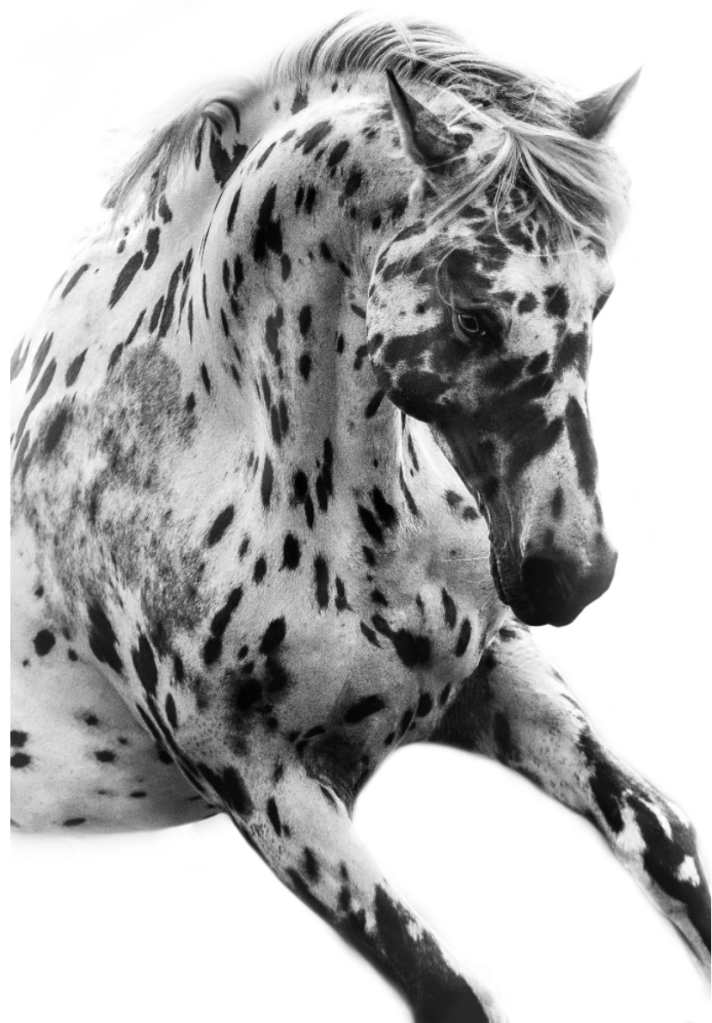
Anna Archinger, Knabstrupper, inkjet print on photographic paper, 2022. Image © Courtesy of the artist.

Horses (1933) by Pablo Neruda

From the window I saw the horses.

I was in Berlin, in winter. The light

had no light, the sky had no heaven.

I looked. I looked and was reborn,

for there, unknowing, was the fountain,

the dance of gold, heaven

and the fire that lives in beauty.

I have forgotten that dark Berlin winter.

I will not forget the light of the horses.

As an equine photographer, my artistic fascination with horses is boundless and continually expanding. Like many artists, I am captivated by their majestic power and elegance, key features that contribute to, as Neruda so eloquently put it, ‘the light of the horses.’  Artists and writers’ fascination with horses motivates me to look more into my own bond with horses and reflect on the reasons why they are so inspiring, making one experience an almost unearthly joy and, strangely, a sense of purpose.

Both Western art history and literature are fountains of inspiration, proof of the artists’ timeless fascination with these creatures whose presence has contributed to the quality of their lives by enhancing commerce and goods exchange, transporting traders from village to village (hundreds of years before e-commerce), or helping their human partners on the frontline. In war scenarios, to rely on a horse meant literally that – to trust the horse with your life. No other animal would be capable of such a deep connection and devotion, but building rapport with them is an art form that – equestrians or not – we all can learn and would gain from reflecting on this gracious, almost mythical bond. I first acknowledged this by studying not only through my photographic lens but also the “academic art of riding” itself, which has proven to be a never-ending source of inspiration for me.

Left: Peter Paul Rubens’s 1603 copy of Leonardo da Vinci’s lost fresco The Battle of Anghiari. Image © Alamy. Right: Sandro BotticelliPallas, and the Centaur, tempera on canvas, 207 x 148 cm, c. 1482. Image Source: Wikipedia

When riding became an art form

The art of riding is a complex process that involves communication and creative negotiation. Its history, as trainer researchers like Bent Branderup have extensively documented, helps us gain insight into how the horse as a means of combat transitioned throughout centuries until what can be called today as “leisure riding.”

Academic horsemanship dates back to the Renaissance when horses were important military vehicles – a tradition that’s been inherited from ancient times. In times of war, horses had, for centuries, two very precise purposes: -1- to protect the prince on the battleground; -2- to help fearless warriors win the battle. The goal was, to quote other professionals, very practical: “As long as the princes themselves fought in the front ranks on horseback on the battlefield, … it was simply a matter of survival, so the weapons exercises were given higher priority than the dressage.”

As princes and key members of European monarchies slowly withdrew from close combat, the demand for war horses decreased, and riding became a practice based on the concept of art for art’s sake. Cavalry schools began to recruit passionate people instead of professional soldiers. With this, the old riding techniques that involved a lot of training to handle weapons on horseback were also given up, and riding started experiencing its highest perfection.

The art of riding flourished for the first time in Naples around 1530, when Frederico Grisone founded the first riding academy in 1532. During the Renaissance, riding academies became so popular that horses captured the interest of artists such as Leonardo da Vinci, Michelangelo, and Raphael—all of whom left us some fascinating horse representations. Sandro Botticelli’s Pallas and the Centaur, a mythological painting tempera that fits in the Early Renaissance Genre, depicts two life-seize figures from classical mythology and probably, like most of his allegorical masterpieces, forms an allegory whose iconography still remains an enigma. The two figures dominate the bare landscape displayed in a vertical composition, focusing one’s gaze on the relationship between the two subjects. Though the composition does not unfold horizontally, its narrative force lies in the symbolism of the figures, which enhances the reading of the piece.

The centaur, a hybrid half-men half-horse creature from the Greco-Roman mythologies, was viewed as a lusty being, a wild and untamed beast, even a barbaric creature who commits violent acts to indulge their lust. Boticelli’s artwork represents the centaur being brought under control after having trespassed on forbidden territory. The tamer, an armed woman depicted as a confident guard, grabs the trespasser by the hair, determining him to take a submission posture. The female figure has been identified by art historians both as the goddess Pallas Athena and the Amazon Camilla, the chaste heroine of Virgil’s Aeneid — the Greek and Roman goddesses of wisdom and strategic warfare.

Some art historians have interestingly expanded the interpretations of this artwork to the point of explaining the political influence of the Medici family in the epoch – with Pallas as the embodiment of the Medici virtues and vision for peace (the rings emblem and the olive branches). Others have claimed that the female guardian encodes the state of alertness that Lorenzo de Medici maintained in Florence against the chaotic and cunning adversaries represented in this artwork by the Centaurs. What is without doubt hard to dispute is the moral content of the painting, in which virtue is depicted as victorious over sensuality and fierce behavior.

Connecting with a 500+ Kg horse requires their consent, and that’s captivating

I’ve been personally invested in horses as an equine photographer and a horse trainee, so I prefer to say that I connect with horses instead of taming them. Adult horses can weigh 500 kg (+/-). If you learn to connect with them, you can reach the point where you truly feel their power and that they generously share control over their own strength, making you feel almost like a centaur. To put it short, the bond can be empowering and, at the same time, humbling.

It became increasingly accepted that you can establish a predictable dialogue and body coordination with a horse by showing them that you are safe and know what you are doing. That means working with horses is based on learning to control your energy and compensate for the horses’ vibe. Riding, or horse training in general, is a sport that requires excellent control over your own body and coordination. But it is also a lot of intention. A high-energy horse requires a calm presence to calm them down. A low-energy horse, you can bring up by adding energy into the communication. Sometimes, just thinking of a correction will convince the horse to behave as expected. It’s like unconsciously giving them a signal with your body language, but there is definitely also a mental connection, especially with the more sensitive horses. Simply put, the relationship between a rider and their horse is based on respect and trust. Yet, there is no such thing as full control of horses. If they would change their mind, they could simply run us over. It is more about “consent,”  about building trust and learning to negotiate with them respectfully, which I find fascinating!

The Horse in Motion: Between objective and pictorial lenses

My photographic practice draws inspiration from Western art and how artists have expanded their understanding of horses’ value to our existence. During the Renaissance, painters mostly created anatomical studies of horses in various scenarios, especially military scenery. However, the invention of photography revolutionized knowledge in terms of its mechanical reproduction and distribution.
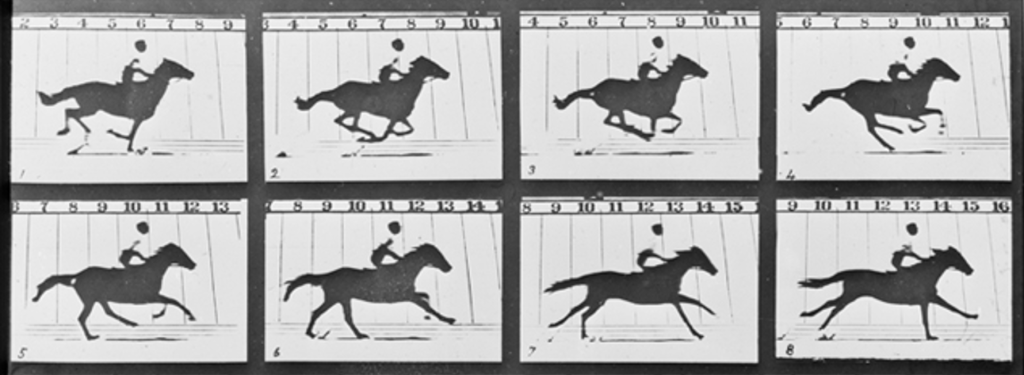
Eadweard Muybridge, Horse in Motion, cca. 1878. Image Source: Kingston Museum and Heritage Service.

Eadweard Muybridge’s first scientific study to use photography in the late 19th century perfectly shows that. Muybridge elaborated on a camera-shooting system that allowed him to capture the movement sequence, contributing to the understanding of “animal locomotion” and enriching visual effects with a perfect succession of images. His horse-riding studies became icons of the first visual research, demonstrating that a succession of images can represent movement. 

Muybridge pioneered motion pictures and is considered today the forefather of cinema due to his objective visual analysis of movement. His photographic inquiry of movement brings me back to my own artistic research and language. My equine photography is grounded on a strong bond with horses. My study of the “academic art of riding” informs my ‘portraiture’ of these monumental presences. Whenever I am commissioned for a horse shooting, I focus on its unique character and try to bring it out without pressing the animal to behave. Rather, I’m giving the horses space to express themselves; I observe their movements and capture their particularities, which often surprises many horse owners with accurate representations of their beloved friends. When you hear ”That’s exactly how my horse looks at me!” or people’s excitement when they recognize the particularities of their horses, I feel like an accomplished witness of a strong bond, and my photographs are ‘visual proofs’ of this special human-horse connection.

My artistic language is informed by studying the “academic art of riding”, as learning to control one’s energy and gaining a fundamental understanding of equine biomechanics is a prerequisite to a harmonious riding experience. This precious dynamic and a horse’s authentic character are aspects I’m trying to capture. However, I am meeting any horse without expectations from them. Even if I have certain visual compositions I might want to try beforehand, any of my sessions are horse-friendly as I adapt to the horse’s attitude. In a way, my artistic approach to horses is based on an objective reflection on a horse’s character and mood.

Unlike Muybridge’s objective lens, it’s important for me to play with different photographic techniques. For instance, long-exposure photography allows me to follow the horse’s motion, filling the frame with pictorial traces whose effects make the images almost look like drawings. My series Spirit in the Darkperfectly encapsulates this idea. The series consists of nine photographs depicting horses moving on a black background. The long-exposure technique gives the series a painterly aesthetic, almost Surreal, recalling Pictorialism, the first aesthetic movement in the history of photography to reclaim photography as an art form and not a mere device to represent reality. Dating from the same period as Eadweard Muybridge’s visual research. Pictorialism was an international style among photographers who explored the artistic potential of the new technology, often looking to iconic paintings for stylistic models. 

Given that I live at an equine education center, and I practice “academic at of riding” myself, my photographic language also builds on both objective and subjective approaches to photography, like Muybridge and the Pictorialists. Far from having reached a strict visual language, I’m boldly experimenting with techniques, composition formats, and chromatics, seeking to emphasize the beauty of horses in fresh ways.
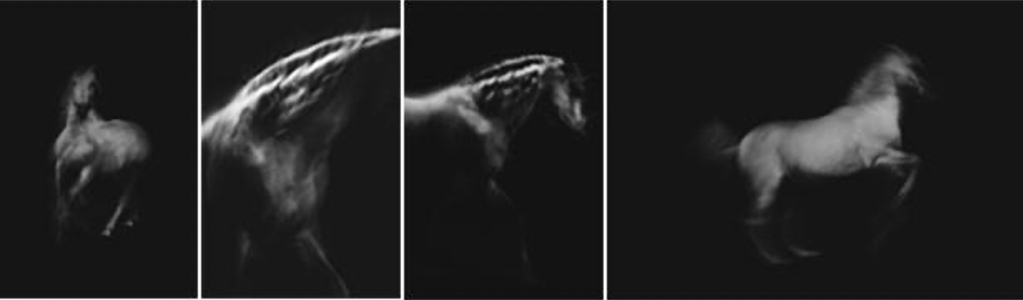
Anna Archinger, Spirit in the Dark, photographic series, 1-4/9, 2023. Image © Courtesy of the artist.

Though equine representations in Western art history seem to be dominated by anatomical studies or glorifying and tragic postures in the military genre, horses have also been carrying humans in less dangerous scenarios, nurturing self-reflection on one’s inner power and true nature—freedom. Never in history was leisure riding so celebrated until today, enriching our timeless bond with horses more than ever. Because a horse is like a mirror. If the rider is insecure and hectic, so will the horse; if the rider is calm and relaxed, the horse will behave like them. This responsiveness inspires riders to seek harmony in the relationship and understand they must be present and aware of their own energy.

Like any mirror, another element whose symbolism has been fascinatingly reflected in art across centuries, the human-horse friendships expand a sense of immaterial space. This bond is timeless that, like any mirroring effect, it can be best reflected and celebrated in the present moment, in the here and now. A horse offers a mutual exchange to those who show them respect and confidence. It’s a symbolic exchange that can accompany the rider’s move through life and its unpredicted storms in one of the best companies. Actually, it would be accurate to say that horses are capable of more than symbolic exchange because their power and distinct characters help us forget ‘dark winters’ and replace uncomfortable emotions with their well-composed attitude and ‘light’ that shines from within. 

After one experiences the depths of the timeless bond with horses, it’s almost impossible to forget it. It’s a relationship you just want to nurture and sustain because it enhances the quality of your life. It is for this reason that I enjoy my commitment to equine photography and explore my fascination with horses through my lens — and I can only experience joy in sharing this passion with others.

Left: Anna Archinger, Connection, inkjet print on photographic paper, 30 x 45 inches, 2023. Image © Courtesy of the artist. Right: Anna Archinger, Framed Bambi, inkjet print on photographic paper, 30 x 45 inches, 2023. Image © Courtesy of the artist.

Anna Archinger (b. 1994, Neuburg an der Donau) is a self-taught German artist based in Dronningmølle, Denmark. Her art practice focuses on horse photography as her fascination with horses goes beyond a mere passion. She lives at the farm Enggaarden, an education center specialized in teaching the “Academic Art of Riding,” where her connection to horses recalls seminal artists’ fascination with horse study. Within the last three years, Anna has been elaborating a stunning body of equine artwork, some of which was distinguished with the Honorable Mention in the Professional category by International Photo Awards USA (2023) and was shortlisted in a private competition run by the Motif Collective Photography Gallery, (2023). Anna’s work is also scheduled to be presented to the public throughout 2024 in venues such as The Glasgow Gallery of Photography (Glasgow, United Kingdom), the Black and White Photography Festival (Athens), and the Chateau Gallery (Louisville). More about her work: http://www.archinger.dk/

Publishing in Art Style Magazine is free of charge for anyone. There are no article processing charges or other publication fees. Art Style Magazine is independent and supports the Open Access Movement. The editors of Art Style Magazine cannot be held responsible for errors or any consequences arising from the use of information contained in essays and articles published on the Art Style Magazine’s website and editions. Authors agree to the terms and conditions and assure that their submissions are free of third parties’ rights. The views and opinions expressed in the essays and articles are those of the author and do not reflect the views of Art Style Magazine. The authors of Art Style Magazine’s essays and articles are responsible for its content. The Art Style Magazine‘s website provides links to third-party websites. However, the magazine is not responsible for the contents of those linked sites, nor for any link contained in the linked site content of external Internet sites (see Terms & Conditions).

BLUE CITY, a solo exhibition by Katarina Andjelkovic

Singidunum Gallery of The Association of the Artists of Applied Arts and Designers of Serbia, in Belgrade, is pleased to present: BLUE CITY, a solo exhibition by Katarina Andjelkovic.

Katarina Andjelkovic – BLUE CITY

21-29 June 2024

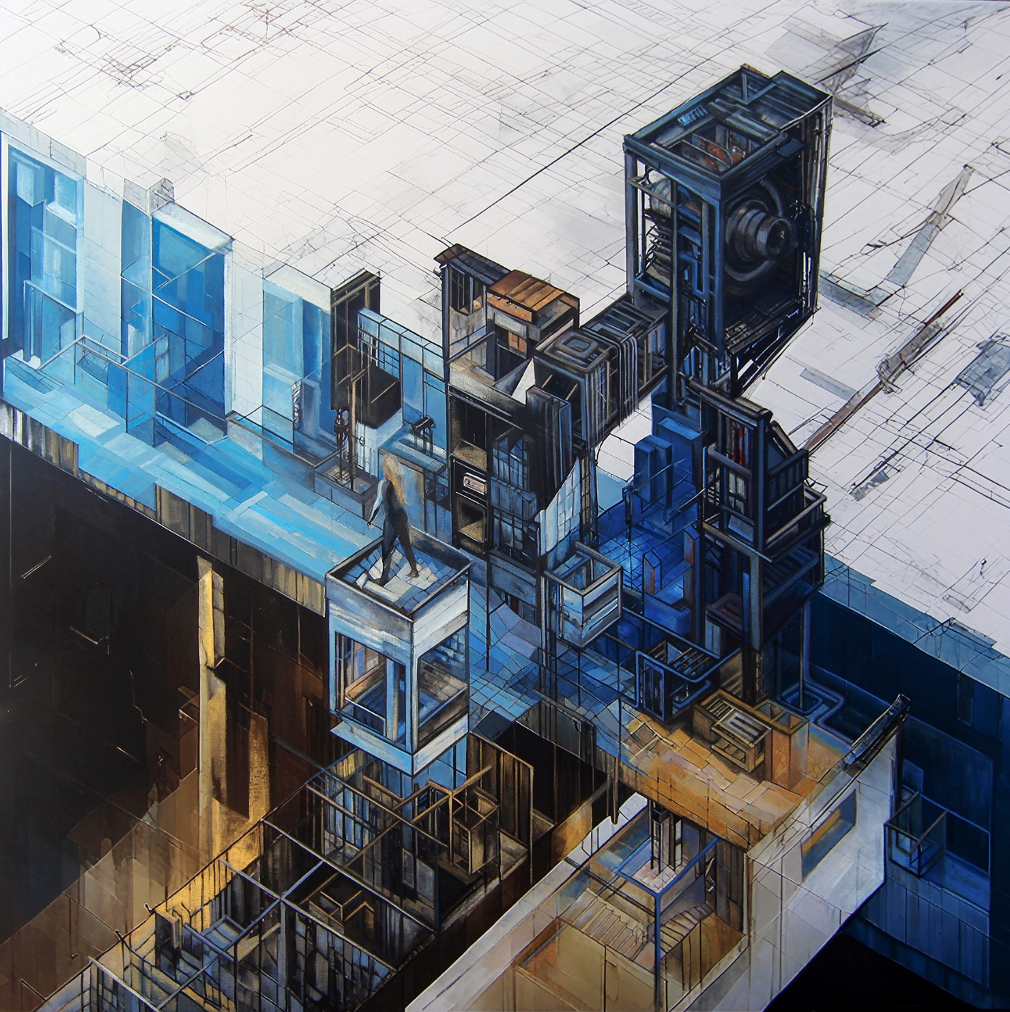
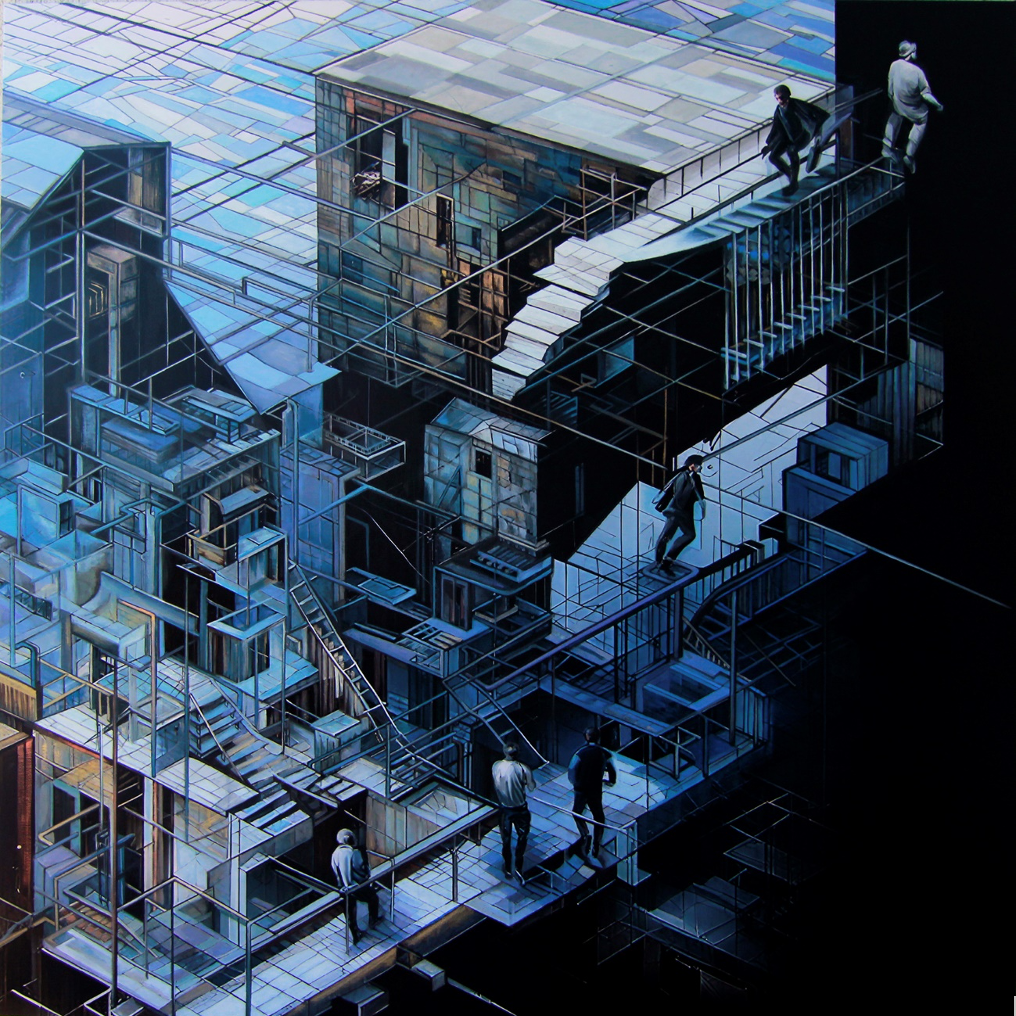
Katarina Andjelkovic. Blue city. A hyper-condition of water encounters, 2023-24. Acrylic and pasta on canvas, 100×100 cm.

Katarina Andjelkovic. Blue city. Re-collecting water encounters, 2023-24. Acrylic and pasta on canvas, 100×100 cm.

Katarina Andjelkovic. Blue city. Unfolding spaces in between building fragments, 2023-24. Acrylic and pasta on canvas, 100×100 cm.

Katarina Andjelkovic. Blue city. Re-collecting water encounters, 2023-24. Acrylic and pasta on canvas, 100×100 cm.

Katarina Andjelkovic. Blue city. A sequential journey through water processes, 2023-24. Acrylic and pasta on canvas, 100×100 cm.

Katarina Andjelkovic. Blue city, 2023-24. Acrylic and pasta on canvas, 100×130 cm.

The extreme conditions of an unprecedented rainstorm paralyze the city. Affected by post-apocalyptic floods, city infrastructure suddenly grows, congests and overwhelms buildings. In this way, the infrastructure supports the movement of water in horizontal and vertical directions and pumps water out of inhabited areas with a pipe system. The question is open: can color in painting offer a way to discover water as architecture, that is, how the elements of nature like water can become architecture using the language of art? By integrating various shades of blue into the city structure, infrastructure and abstract tectonics, I deal with the representation of architectural elements in relation to the polyvalent meaning of the color, the formal and material qualities of the image. In the game of mosaic abstract planes and collage fragments, the blue color grows into a constructive grid that carries the exposed decaying structures of the buildings. These congested infrastructural grids speculate on how water becomes an archetype of the city’s reconstruction process after flood disasters. The exploration of architectural representation reintroduced painting as a way of thinking about space, light and color. Nevertheless, the paintings are essentially modern: they are pictures of fragments, collages, assemblages, parts that represent the whole of mosaic abstract planes and rectangular forms. The project consists of 8 spatial sequences in which unexpected environments and places are transformed into active protagonists.

Exhibition program: 21-29 June 2024

The author will give a multimedia lecture entitled “Image making in the aftermath of the digital revolution.” All presented works were published in international scientific journals (Arts & Humanities Citation Index, Web of Science) and exhibited internationally.

BIOGRAPHY

Katarina Andjelkovic, with a Ph.D., M.Arch.Eng., M. Applied Arts, is a theorist, practicing architect, researcher and painter. She is a high-skilled draftsman, writer and researcher. Andjelkovic is simultaneously engaged in architectural practice, teaching, and research. Katarina’s research, writing and teaching, focus on how ideas can be translated across different media, crossing architecture, visual arts and film. Katarina is currently a MUSAE artist-in-resident (Politecnico di Milano). Katarina has extensive experience in teaching architecture and visual arts: as a Visiting Lecturer at Coburg University of Applied Sciences – Faculty of Design (Department of Architecture) in Germany (2023); as a Visiting Professor at Epidemic Urbanism Initiative (Columbia University and Morgan State University, U.S.); as the main instructor of the HAND-DRAWING COURSE at SMT New York, U.S. (2021), a Visiting Professor and Chair of Creative Architecture, University of Oklahoma (2017), Institute of Form Theory and History in Oslo, Institute of Urbanism and Landscape in Oslo, Norway, at The University of Belgrade – Faculty of Architecture. Katarina is guest-lecturing and mentoring at TU Delft – Faculty of Architecture and the Built Environment, AHO – Oslo School of architecture and design, FAUP Porto, DIA Anhalt Dessau, ITU – Istanbul Technical University. She lectures internationally at conferences in more than 40 countries in Europe, United Kingdom, North America, Canada, Australia, China, and South America. Katarina has published her research widely in international journals (Web of Science). She is a full author of the Preliminary Architectural Design, a national project supported by the government of Serbia. She won the Belgrade Chamber of Commerce Award for Best Master Thesis defended at Universities in Serbia in all disciplines. Katarina has published 3 monographs and book chapters with Intellect United Kingdom, University of Chicago Press (U.S.), Routledge, Taylor and Francis Group (London, United Kingdom), Büchner-Verlag eG, Marburg/Germany, etc. During her Ph.D., Andjelkovic’s research stays were all at European universities in Copenhagen, Ljubljana, Porto, Dundee U.K., Brighton U.K., Dublin, Madrid, etc. Andjelkovic exhibited her artwork at 8 Solo Exhibitions and at more than 80 international architectural, fine arts, and photography exhibitions, including group exhibitions at Pall Mall Gallery in London, Royal Hibernian Academy in Dublin, MAAT Museum in Lisbon, International Biennial of Illustration ”Golden Pen” in Belgrade, Loughborough University in the United Kingdom, TU Delft in the Netherlands, the Museum of Applied Arts in Belgrade, the National Museum in Belgrade, Prodajna Galerija “Beograd” (Kosancicev venac, Belgrade), Gallery Singidunum in Belgrade, Stepenište in Art Education Center ”Šumatovačka”, Gallery of the Central Military Club, Suluj Gallery, Pavillion Cvijeta Zuzoric of the Association of Fine Artists of Serbia, and Mala Gallery of the Association of Fine Artists of Applied Arts and Designers of Serbia. Katarina is a recipient of EDRA’S 2022 AMBASSADOR FUND AWARDS [California, U.S., Awarded in South Carolina], THE ULUS 2021 Spring Exhibition Award “INVISIBLE PORTRAIT” [awarded by Association of Fine Artists of Serbia], and won numerous awards for her architecture design and urban design competitions.

Exhibition opening: Friday, June 21, at 19h.

Visits: Mon-Fri 10-20h, Saturday 10-17h, Sunday: closed.

Access: from the ground floor, catalogue (print) available during the event, e-catalogue available on demand.

Contact: Katarina Andjelkovic: katarina.code@gmail.com

Address: Singidunum Gallery, 40 Kneza Mihaila Street, Belgrade 11000, Serbia

Sharon Walters: Seeing Ourselves

Sometimes You Just Need Time Away, 2024

Sharon Walters: Seeing Ourselves


Solo exhibition at HackelBury Fine Art, London

9th May – 4th July 2024

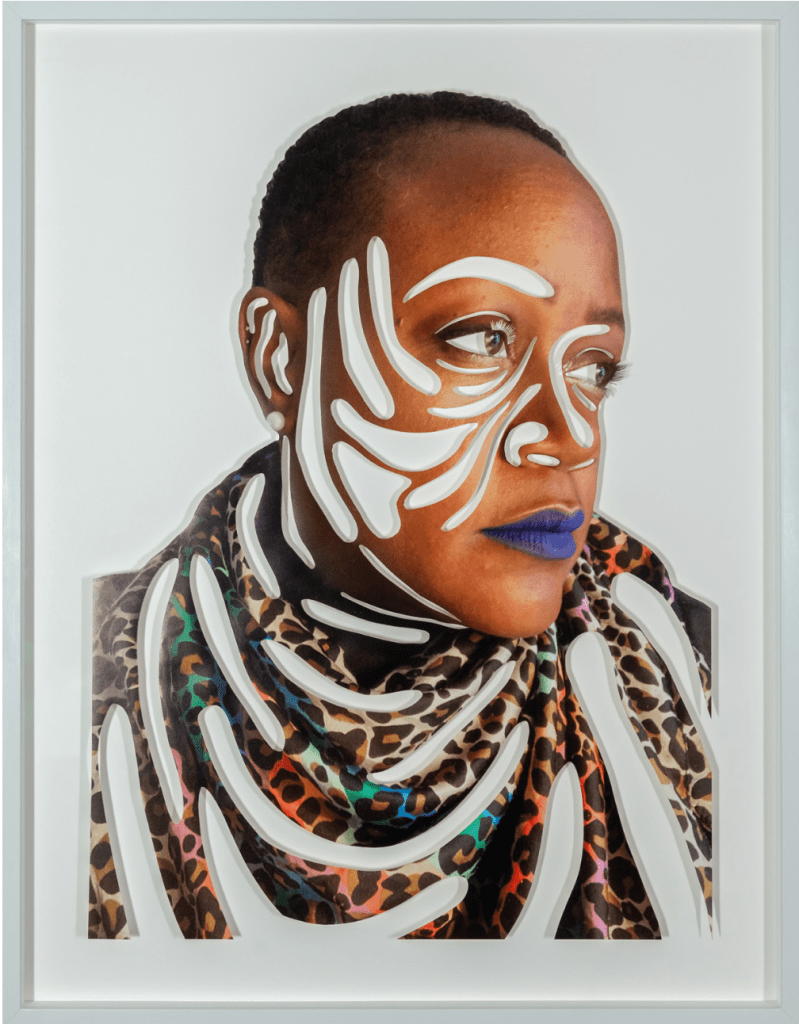
HackelBury Fine Art, London is pleased to present Sharon Walter’s first London solo exhibition. ‘Seeing Ourselves’ features work from the ongoing series, in which Walters creates intricate hand-assembled collages honouring Black Women – their history, culture and identity.

“My work aims to explore and indulge in the multiplicity of Blackness and the embrace of our non-monolithic experiences.”

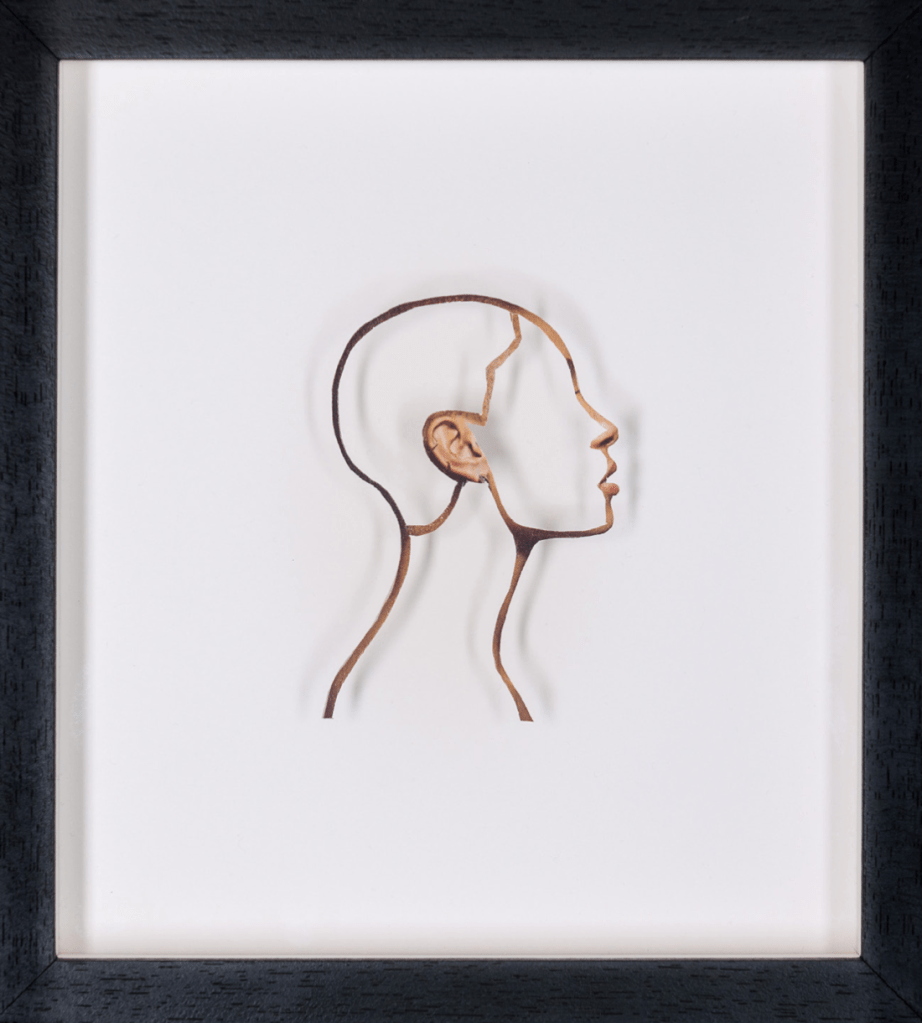
Walters explores themes of identity and representation through fragile and detailed paper cut-outs and collages where she creates multi-layered portraits in which she, literally and metaphorically, opens up space. These dimensional portraits provide a portal and empower those who are often excluded and unheard in mainstream Western society. She creates an alternative narrative which reflects the complexity of these women’s stories and experiences.

Letting Go, 2024

The title ‘Seeing Ourselves’ references the book by Frances Borzello which surveyed centuries of self portraits by white Western women artists. In her series ‘Seeing Ourselves’, Walters reclaims space to create a new inclusive way of seeing Black women. Her work is a response to this absence of their own reflections in mainstream Western media, arts and cultural life.

“I started making the work as a reaffirmation to take up space even in spaces where I did not see myself reflected back.”

Walters is an agent of change and notes that her own vulnerability allows her to create this work, motivated by a commitment to create visibility and accessibility for Black women.

“If we don’t see ourselves represented back, it can act as a barrier to not succeeding”

She draws on a myriad of material to create her portraits from magazine clippings to photos taken by herself, and other images donated by women globally and in this way she generates multiple conversations about empowerment, diversity and representation.

Unbroken, 2023

About Sharon Walters

Sharon Walters is a London-based artist, educator and project curator. She holds a Fine Art BA (Hons) from Central Saint Martins and has over 20 years experience working with marginalised communities. She regularly collaborates with organisations and communities organising and hosting workshops, talks, podcasts, events and curating projects.

In 2023 , Walters was included in ‘Like Paradise’ at Claridge’s ArtSpace, London, curated by Ekow Eshun and ‘Rites of Passage’ at Gagosian, curated by Péjú Oshin. She won second prize at the Mosaic Art Prize exhibited at Hauser and Wirth. She directed a short film, performed by actor Jyuddah James, using quoted extracts from ‘The Interesting Narrative of the life of Olaudah Equiano,’ displayed in the Black Atlantic exhibition at Fitzwilliam Museum, Cambridge (2023). This is currently being shown at the UN in New York (23 Feb – 28 March 2024). Previously, Sharon had a solo exhibition at Midlands Arts Centre, Birmingham, England (2022), and was included in the Black Minds Matter group exhibition at Sophie Tea Art Gallery, London (2020); The Chapel Gallery, London (2019); and Gunnersbury Park Museum, London (2019).

In 2022, she was commissioned by the National Portrait Gallery, London, to create a portrait of race equality campaigners and radical publishers Eric and Jessica Huntley. The piece was exhibited at the Gunnersbury Park Museum, London (2023) before joining the collection at the National Portrait Gallery.

Since 2020, Walters has worked in partnership with the National Maritime Museum to create and host the podcast series ‘Seeing Ourselves’ – alongside a series of live and online events exploring the representation and misrepresentation of the people of African descent in museum collections. She collaborated with historians, artists and prominent cultural thinkers and the project has had a significant impact and led to important change in the institution.

Walters works are in private and public collections including the National Portrait Gallery and the Soho House Art Collection.

About HackelBury

HackelBury was founded twenty-five years ago by Sascha Hackel and Marcus Bury. The gallery is committed to championing artists who push the boundaries of their medium to create meaningful and contemplative work.

Originally renowned for showcasing classic 20th-century photography, the gallery has embraced more conceptual and abstract art over the past 15 years, expanding its stable of artists to include those working in photography, drawing, painting and collage.

Hackelbury Fine Art represents a select group of artist whose work reflects a profound depth of thought and dedication to their craft.

FOR ALL PRESS ENQUIRIES PLEASE CONTACT

Camilla Cañellas – Arts Consultancy & PR
E: camilla@culturebeam.com M:+34 660375123

Phil Crook – HackelBury Fine Art
E: phil@hackelbury.co.uk T: +44 20 7937 8688

Instagram @hackelburyfineart

LuginsLand of Art launches the collective exhibition ‘Space & Time’

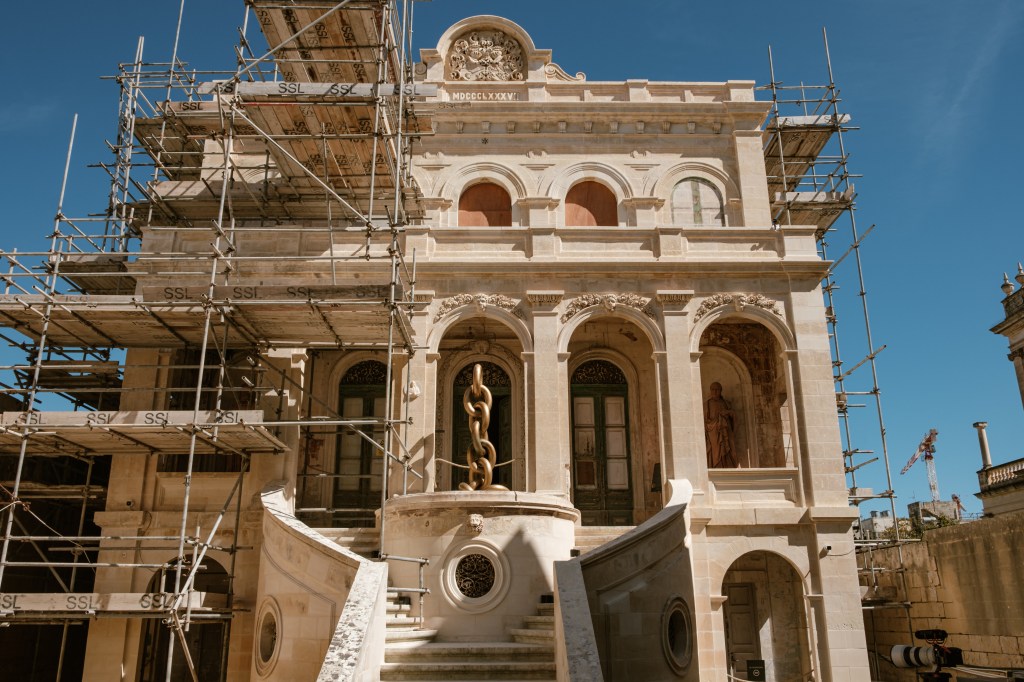
Villa Luginsland. Photo by Brian Grech.

LuginsLand of Art launches the collective exhibition ‘Space & Time’ and Educational Programme inviting the audience to witness the ongoing restoration of this historical, architectural gem in Malta.

The exhibition is open for visitors during the Educational Programme and on the selected days: May 20th-24th and May 27th-30th 12:00pm – 3:00pm.

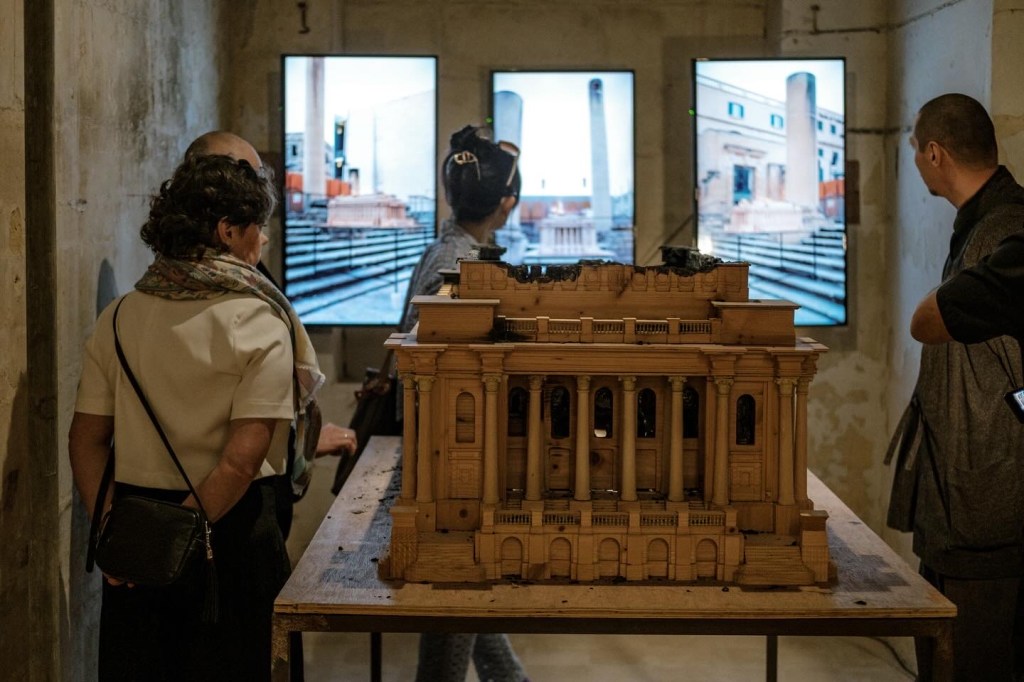
On March 15th, LuginsLand of Art, formerly known as Villa Luginsland, held an exhibition preview called “Space & Time.” The exhibition was curated by Boris Kudlička, a renowned set designer and architect from Slovakia. The event also marked the launch of a new concept to create dedicated spaces for the artistic community within the Villa, which is currently undergoing restoration.

Ministers Owen Bonnici and Minister Stefan Zrinzo Azzopardi graced the occasion, witnessing the restoration endeavours and visionary aspirations of the villa. The project is supported by OmenaArt Foundation, founded by Omenaa Mensah, Polish philanthropist, businesswoman, and art collector, who welcomed esteemed guests and artists to the villa.

“For the first time, we are happy to open the doors to LuginsLand of Art . My team and I have been working on this unique project for many months. We are excited to share the beginning of something truly special. I have always had a profound admiration for historic edifices. I am extremely excited to breathe new life into one of the most significant historical sites in Malta and provide an opportunity to share a dedicated area to the artistic community in the future” – says Omenaa Mensah.

Joanna Popiol, Director of LuginsLand of Art, underscored the meticulous conservation efforts and fruitful collaboration with the Superintendence of Cultural Heritage, highlighting the commitment to preserving and honouring the villa’s rich heritage and legacy.

‘Space & Time’ exhibition. Photo by Brian Grech.

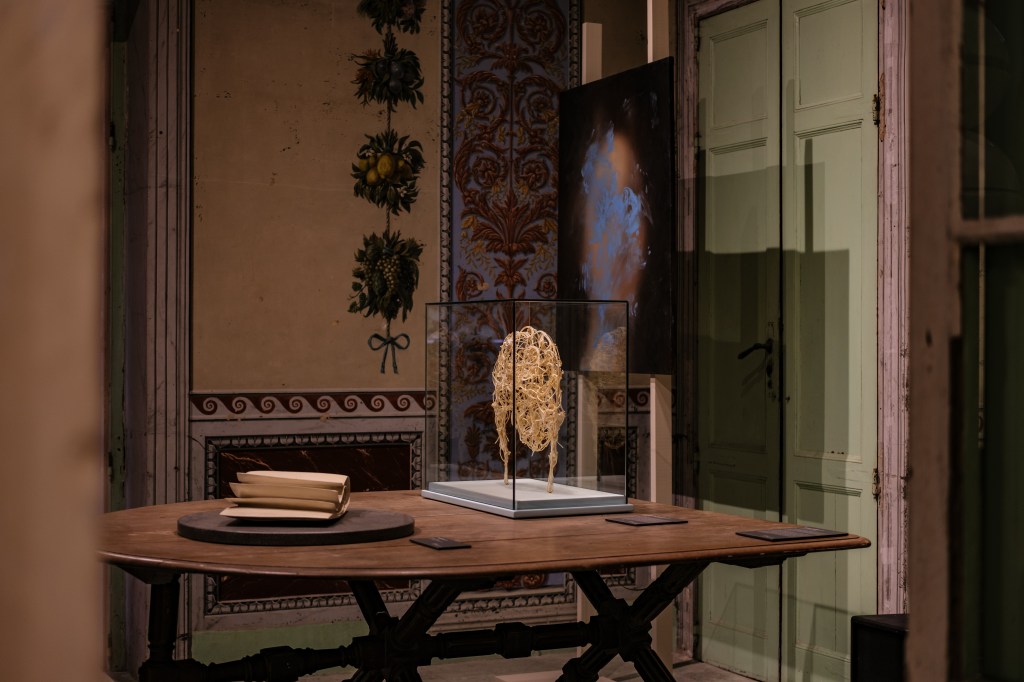
The front part of the villa was dedicated to its long history and showcasing the ongoing restoration works, research and efforts in preserving the historical aspects. The inaugural exhibition ‘Space & Time’ curated by a renowned Slovakian set designer and architect – Boris Kudlička with curatorial collaboration of Maria Galea and Joanna Szulc, showcases the works of renowned Maltese and Polish artists and encompass both site specific installations which have been created in line with the curatorial concept and the historic reference of the site, as well as a curated selection of works from pre-existing series by the artists. The visual narrative establishes an intriguing dialogue between Neo-Renaissance architecture and Contemporary Art, aiming to create an intersection between the past and present through intercultural exchange.

“The main inspiration for the exhibition is the villa itself, its profound history and marvellous architecture. We invited renowned Maltese artists to create site-specific works that represent the dialogue with the space and temporal dimensions of the villa. I am very happy with the diversity of the collection as the artists utilise different mediums and each of them presents their own unique perspective to the subject.“ – says the curator Boris Kudlička

Cultural Manager Maria Galea underlines the gratitude felt as Maltese citizen in appreciating the work being conducted to both preserve and revive such a magnificent historical space. “It is admirable that Luginsland of Art and OmenaArt Foundation are inviting artists to be part of it, creating an important intercultural exchange.”

Featured Artists:

Mario Abela, Victor Agius, Matthew Attard, Norbert Attard, John Paul Azzopardi, Austin Camilleri, Monika Falkus, Antoine Farrugia, Maurycy Gomulicki, Nicolas Grospierre, Michał Jackowski, Ida Karkoszka, Lia Kimura, Marcin Maciejowski, Karol Palczak, Janek Simon, Nikola Vudrag, Xawery Wolski, Jakub Julian Ziółkowski

Site specific works

The commissioned site-specific art installations at LuginsLand of Art feature the works of Maltese artists Matthew Attard, Victor Agius, Mario Abela, and Antoine Farrugia. These pieces integrate history, nature, and architecture, with the respect to villa’s profound history. Each artist brings a unique perspective to their work, aiming to blend with the villa’s architectural and archaeological elements. From Matthew Attard’s digital landscapes to Victor Agius’s sculptures, these works evoke a dialogue between the past and present. Mario Abela’s installation prompts viewers to reflect on their impact on the world, while Antoine Farrugia’s use of Maltese limestone pays homage to the villa’s architecture. Together, these pieces form an intriguing display of artistic expression, inviting visitors to explore the intersection of time and space at LuginsLand of Art.

‘Space & Time’ exhibition. Photo by Brian Grech.

Educational Programme

Alongside the exhibition, LuginsLand of Art is also organising the educational programme launched on the 23rd of March with the panel ‘Art & Architecture’, followed by the session ‘Art & Archaeology’ in April. The programme encompasses 5 discussion panels and workshops, each delving into various facets of art and its relationships, including architecture, archaeology, community, and artistic legacy. These panels feature distinguished Maltese and international artists, art historians, and art professionals who bring their perspectives on historical, social, and anthropological issues to the fore. The programme aims to foster an environment for discussion and offers an opportunity to explore the villa’s ongoing construction, restoration, and preservation efforts. The programme will extend until the end of May.

The Educational Programme:

Art & Architecture – 23th March

Art & Archaeology – 6th April

Art & Conservation – 4th May

Art & Technology – 18th May

Art & Legacy – 31st May

About Omenaa Mensah

Omenaa Mensah is a Polish philanthropist, businesswoman, art collector, and founder of OmenaArt Foundation. With her rich experience, Omenaa leads worldwide projects and initiatives in the realms of design, architecture and art. She passionately invests in emerging artists, bolstering their growth and creativity. Motivated by her deep-seated love for art, she takes on ambitious endeavours aimed at conserving and rejuvenating historical sites. Her expertise has garnered accolades from stalwarts in architecture and design, including luminaries like Boris Kudlička, Bruno Moinard, Alessandro La Spada, and Gio Pagani. Omenaa is also devoted to emphasising the importance of social responsibility within cultural realms. Her foundation is engaged in philanthropic activity, such as the coordination of the Grand Charity Auction TOP CHARITY, one of the most prestigious philanthropic events in Europe that promotes the best Polish and international artists. The initiative has been recognised and selected by Luxury Lifestyle Awards which celebrate the best luxury services all over the world.

Photo Credits: Brian Grech

Links:

LuginsLand of Art website
Educational Programme

Registration to view the exhibition
LuginsLand of Art Facebook

LuginsLand of Art Instagram
OmenaArt Foundation website

For more information contact: alicja@villaluginsland.com

Water, Light and Art Merge at the Water Light Festival 2024

Anish Kapoor. WATER LIGHT FESTIVAL Neustift 2024. Photo Zumtobel.

The Water Light Festival 2024 promises to be a celebration for the senses and the soul as it transports visitors to a world full of colour, fantasy and reflection. From 24 April to 12 May, the episcopal town of Brixen/Bressanone in South Tyrol and the Neustift monastery will shine in unique splendour thanks to the creative works of some outstanding artists from all over the world.

In the evening in Brixen

There are 15 light art installations in public spaces in Brixen, which can be admired in the evening from 9 pm to midnight. Public art has the power to transform the environment, bring it to life and offer people new ways of experiencing and understanding their surroundings. “Through art in public space, we can also address important social and environmental issues, bring communities together and make public space a place where creativity, dialogue and exchange can flourish,” says Werner Zanotti, Managing Director of the Brixen Tourismus Association and head of the event’s curatorial team.

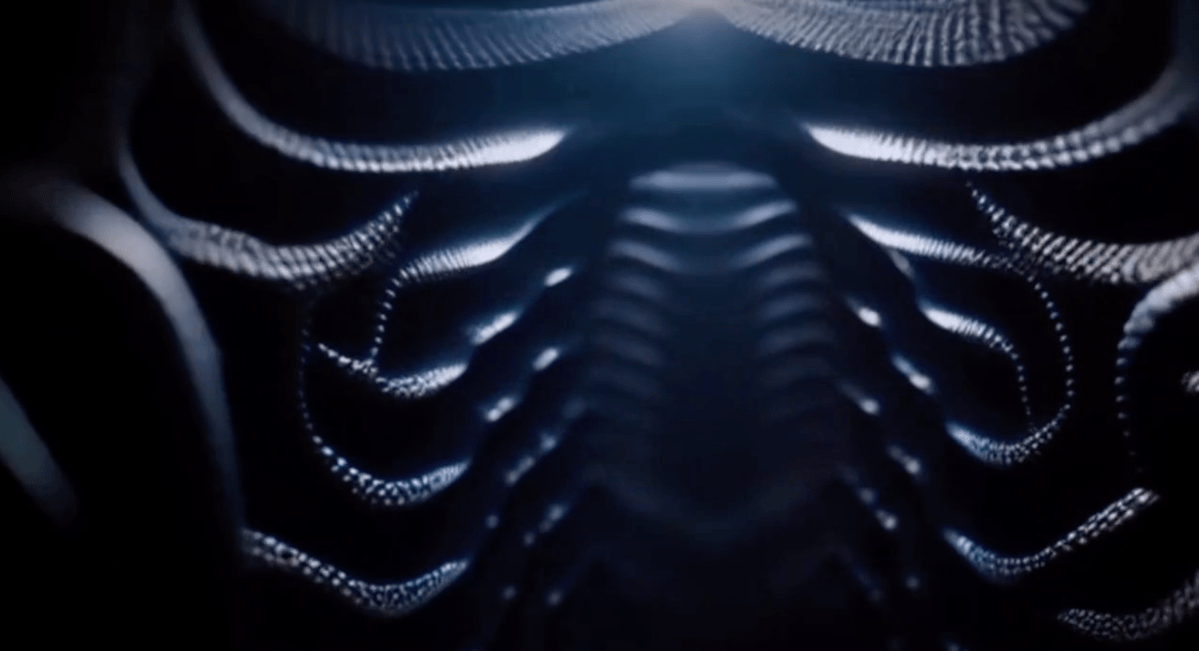
One of the highlights of the festival is undoubtedly the presentation by the Spanish multidisciplinary art and design studio Onionlab. On the imposing facade of the Brixen Cathedral, it presents the captivating work “Climate”. This nine-minute audiovisual piece confronts the viewer with a dilemma: which world do we want to inhabit? A gloomy, dry and grey world, marked by the consequences of the climate catastrophe, or a bright and harmonious future? An impressive projection encourages visitors to decide in favour of hope.

Another impressive work comes from the German light artist Tom Groll from the TENTAKULUM collective. His work “Green Washing” in front of the Brixen Tourismus building presents an installation that is fascinating both during the day and at night. Two washing machines and two IBC water tanks, connected by a network of hoses, symbolise green washing by circulating uranium-enriched, light green water. This visual metaphor for the perfect functioning of the economy encourages us to reflect on the reality of greenwashing.

Tom Groll, Greenwashing, 2024. Photo: TENTAKULUM collective.

The late Italian artist Piero Gilardi will also be honoured posthumously with his installation “Migration (Climate Change)” at the Hartwigplatz. This work, which was originally created in 2015, shows the silhouettes of migrating pelicans in flight, symbolising the animal migrations caused by global warming.

During this year’s festival, the international studio OCUBO from Portugal is presenting the interactive installation “Human Tiles” in the Brixen City Library. The installation allows passers-by to interact with the graphic pattern on the facade using the colours of their clothing. This pattern is reminiscent of traditional Portuguese “azulejos”. The installation not only emphasises joy and curiosity through a playful approach to different cultures and traditions, but also places people at the centre of a high-tech process that overcomes the boundaries between man and machine.

Thanks to the support of the Embassy and Consulate General of the Kingdom of the Netherlands, Studio Toer‘s ‘Firefly Field’ work enchants visitors to the Herrengarten with countless points of light floating above the ground, reminiscent of the movement of fireflies at night. The light points, moved by bioluminescence reflected on flowerbeds and shrubs, create an enthralling atmosphere, expressing Studio Toer’s fascination for luminous animals through specially developed LED light points. The unique composition of the points creates a natural and unpredictable movement, enriching the visitors’ experience.

During the day in Neustift

Also in this edition a part of the Water Light Festival takes place in the Neustift Monastery. An exhibition, which is accessible during normal museum opening hours, presents 19 artists who work with light and digital media and deal with the dialogue between cultural heritage and contemporary art. Entitled NOTATIONS, the exhibition addresses ecological challenges and climate change. The exhibition project is curated by Bettina Pelz. For the first time, the exhibition will be extended beyond the festival period until 29 June.

Thanks to the partnership with Zumtobel lighting brand, works by renowned artists such as Anish Kapoor, Keith Sonnier and Brigitte Kowanz are presented in Neustift Monastery, a few kilometres north of the Brixen old town centre.

The installation by Anish Kapoor can be seen in the Engelsburg. It is a field of experimentation for perception. Embedded in a surface of light is a rich, deep black surface that creates the impression of infinite depth in the human eye.

Anish Kapoor. WATER LIGHT FESTIVAL Neustift 2024. Photo Zumtobel.

Works by the French artist François Morellet and the American artist Keith Sonnier were also exhibited at Neustift Monastery in the last edition of the Water Light Festival. This year, “Recréation No. 7 (1994)” by François Morellet and “Chacahoula” (1997) by Keith Sonnier from the Zumtobel Collection will be on display, once again proven classics in the art history of light.

Two installations by Austrian artist Brigitte Kowanz from the Zumtobel Collection can also be seen in the cultural history museum at Neustift Abbey. Both installations thematise the connection between light as an electromagnetic wave and Morse code as the first code of electromagnetic space, telegraphy. The installation “Lichtwechsel” translates the title of the installation into light signals from colour fields, while the installation “Wir schwimmen in der Linie und tauchen sporadisch ins Mosaik” visualises a quote from Vilém Flusser. The media philosopher thematised how our world is becoming a highly complex network of signs and codes.

Another remarkable work comes from the Swiss artist Laurence Bonvin. Her work “Aletsch Negative” offers visitors a fascinating and unsettling journey into the interior of the Aletsch Glacier, the largest and longest glacier in the Alps. This visual experience questions spatial and temporal scales and emphasises the urgency of climate change.

Laurence Bonvin., Aletsch Negative (2019). Photo Laurence Bonvin.

Glaciers are regarded as archives of climate history. With the loss of glaciers, not only are climate conditions changing, but knowledge of nature is also disappearing. Nicolás Rupcich travelled to the Arctic Ocean in April 2022 to show the current changes from his perspective; the installation “Archipelago Archive” provides an insight into the video material that the artist recorded. The many screens are at the same time reporting, image library and knowledge repository.

Light, whether natural or artificial, has long inspired and fascinated people, especially artists. Over the last 200 years, light art has taken many forms and is now increasingly making its way into public spaces. Artists are experimenting with space, technology, light sources and surroundings, with light offering an almost endless palette of possibilities. The Water Light Festival in Brixen and Neustift Monastery will showcase impressive works that tell powerful stories, are visually appealing and address important issues such as sustainability, traces and nature conservation while showcasing contemporary creativity and new technologies.

The Water Light Festival 2024 is not only a display of art, but also a reminder to take action. Through the creative combination of water, light and art, important social issues are highlighted, and visitors are encouraged to reflect on their role in shaping a sustainable future.

More information on all the artworks: www.waterlight.it

World of Water by Spectaculaires. Brixen Tourismus.

Information:

Brixen

24. April – 12. May 2024

Mon – Sun: 21-24 h

Ticket: for 3 venues (Hofburg, Herrengarten and City Library)

Adults: 12€

Children: <15 years 0€

Guided visits: daily

Meeting point: 21:30 h at Ticketboth at the Hofburgplatz (reservation required)

Adults and children: 5€

Neustift Monastery

24. April – 29. June 2024

Mon-Sat: 10-17 h (last entrance at 16:15 h)

Ticket: 12€

BrixenCard: 0€

Guided visits: Tue, Thu, Sat with reservation

Meeting point: 14:30 h at the Museum Infopoint

Price: 17€ (entrance ticket included)

Joseph Beuys. Collection Presentation

Joseph Beuys in Hamburger Bahnhof, Berlin, 2024. @Jacopo La Forgia

Joseph Beuys. Collection Presentation

Hamburger Bahnhof, from 12 April 2024.

A collection presentation by Nationalgalerie, Staatliche Museen zu Berlin 

Opening: Thursday, 11 April 2024, 7 pm

Joseph Beuys – Works from the Nationalgalerie Collection

Hamburger Bahnhof presents its extensive holdings of works by artist Joseph Beuys (1921–86) in the Kleihueshalle, reopening on this occasion. The exhibition will include major pieces from the Nationalgalerie’s collection, which recently entered the collection thanks to the generous donation of the family of collector Erich Marx, who died in 2020. Visitors can explore the complex oeuvre and critical reception of the artist Beuys in a presentation comprising 15 works and a multimedia study island.


Joseph Beuys was a draftsman, sculptor, action and installation artist, teacher, politician and activist. Born in Krefeld in 1921, he grew up in Kleve. He died in Düsseldorf in 1986. Having grown up under National Socialism in Germany, and actively participated in the Hitler Youth and the armed forces, Beuys sought to transform the totalitarian society of his youth into one of warmth and radical democracy: by means of art, and in conversation and cooperation with all people. Beuys called the collective transformation of society he envisaged “social sculpture.” By that, he meant an expanded form of art, in which all human beings – as the artists they innately are – could and should participate. Beuys took his own personal transformation as his point of departure. The extent to which he actually achieved the inner change he was striving for is still highly contested today.

The collection presentation explores the ways in which Beuys explored the boundaries and responsibilities of art through his work. It also offers an insight into the mixed public response to the artist through books and audio contributions, while juxtaposing his vision of social renewal with the ideas of other people, such as the civil rights activist Angela Davis, the writer Ursula K. Le Guin, and the rapper and poet Kae Tempest. The exhibition celebrates the generous donation of works to the Nationalgalerie made by the family of collector Erich Marx.

Below are some of the works by Joseph Beuys that are presented in this exhibition.

Joseph Beuys, Capri-Batterie, 1985 

Several works by Joseph Beuys, such as the Capri Battery, are related to the concept of a “solar state,” or “city of the sun”. Beuys came across it in Civitas Solis (1623): a utopian work by political philosopher Tommaso Campanella. Like Campanella, Beuys placed the power and warmth of the sun at the center of his social utopia. Named after the island of Capri where it was conceived, Beuys’s tiny work resembles a miniature model of the sun. It combines a light bulb representing the light of the sun with a lemon symbolizing the energy of the sun. The result is a fruit battery – not unlike the ones you might have made in physics class at school. With this simple gesture, Beuys transformed Campanella’s rigid social model into a continuously changing one. The Capri Battery is among the artist’s final works. It can be thought of as his intellectual and political testament. 

Joseph Beuys, Capri-Batterie, 1985. Edizioni Lucio Amelio, Neapel. © Staatliche Museen zu Berlin, Nationalgalerie, 2009. Purchased by the Stiftung des Vereins der Freunde der Nationalgalerie für zeitgenössische Kunst. 

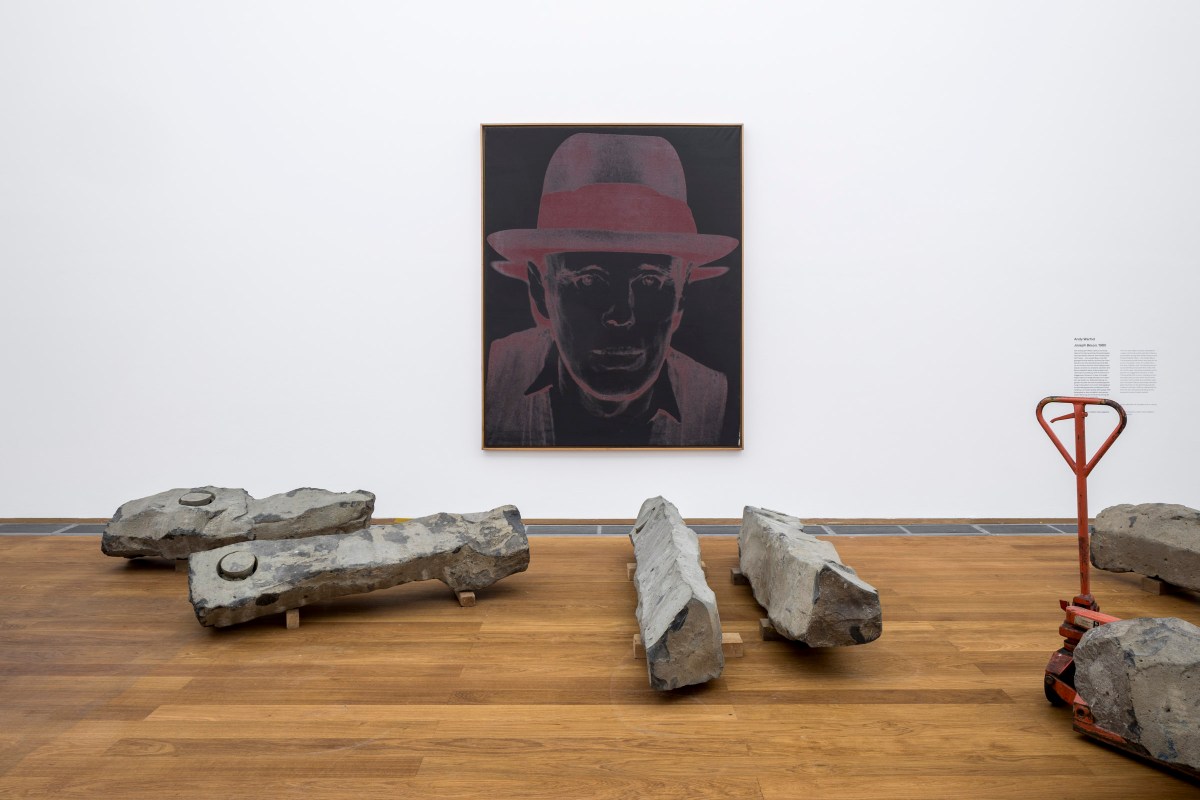
Andy Warhol, Joseph Beuys, 1980

From the early 1960s onwards, Andy Warhol created colorful silk-screen portraits of famous personalities, among them Marilyn Monroe, Elvis Presley, Elizabeth Taylor – and Joseph Beuys. The oversized portrait shown here casts him as an icon of popular culture. It is coated with a thin layer of glittery dust. The painting was produced after Beuys had spent time in New York for his first major international exhibition at the Solomon R. Guggenheim Museum in 1979. The two artists, both of whom cultivated a mythical public persona, had met for the first time only a few months earlier at an exhibition opening in Düsseldorf. Beuys presumably attached great importance to the advertising potential of Warhol’s portrait. In 1981, he claimed that his entire life was ultimately advertising: for the renewal of society through creativity.

Joseph Beuys, DAS KAPITAL RAUM 1970–1977, 1980

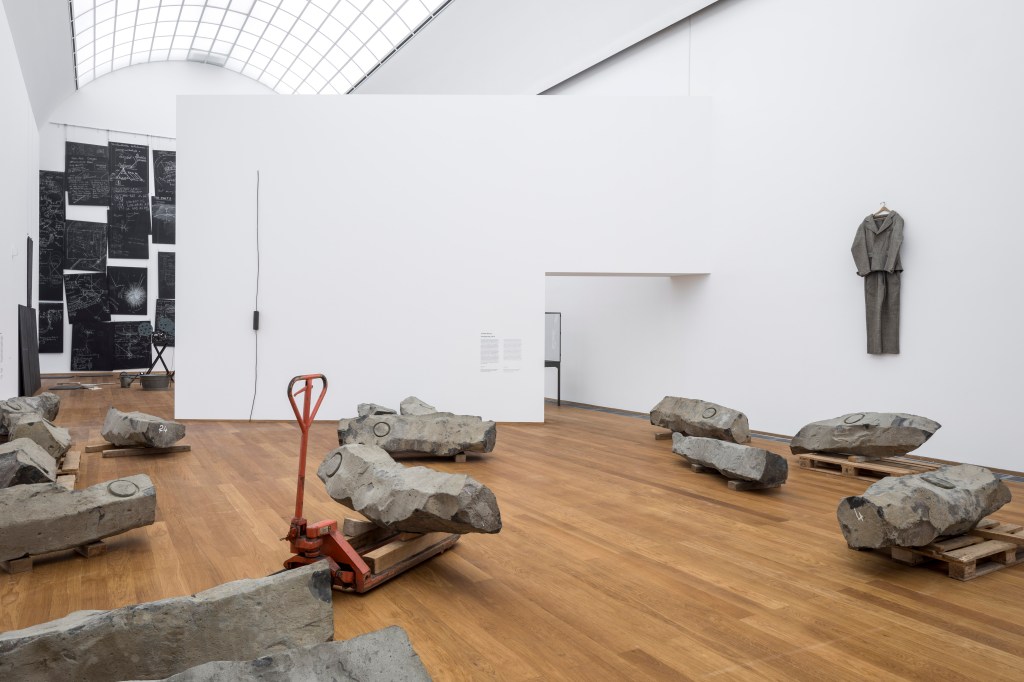
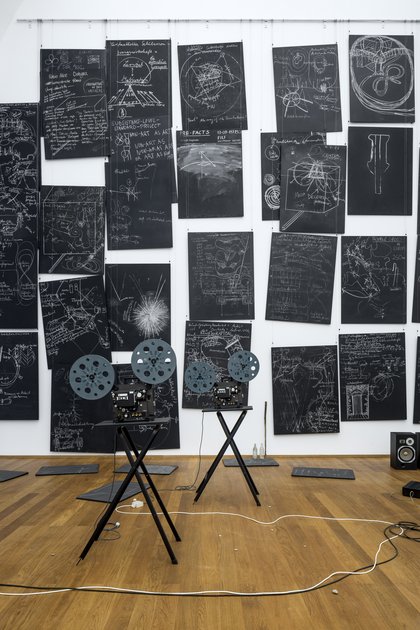
In the course of the 1970s Joseph Beuys realized that there could be no transformation of society without a fundamental rethinking of capital and economics. The installation displayed here explicitly refers to Das Kapital, Karl Marx’s critique of political economy. In contrast to Marx, Beuys equated capital with human creativity. This large-scale enigmatic work resembles an abandoned stage. It brings together objects and devices drawn from actions and projects largely carried out between 1970 and 1977, such as a concert grand piano and axe, film projectors and a screen, a microphone, tape recorders and loudspeakers. The blackboards with chalk drawings were produced in conjunction with teaching and learning situations that Beuys presented as artworks at two major exhibitions: the Organisation for Direct Democracy through Referendum at documenta 5 (1972) and the Free International University at documenta 6 (1977). In each instance the artist and the public spent 100 days discussing politics, society, and the economy.

Joseph Beuys, Das Kapital Raum 1970–1977 (Detail, 1980). Staatliche Museen zu Berlin, Nationalgalerie, Marx Collection (Property of the Stiftung Preußischer Kulturbesitz).

Comprising 15 works, the collection presentation brings together for the first time in one space Tram Stop. A monument to the future (1976), DAS KAPITAL RAUM, 19701977 (1980) and THE END OF THE 20TH CENTURY (1982) from the Nationalgalerie Collection. The study island offers visitors an insight into the ambivalent perception of the artist through audio contributions by well-known personalities and selected books and confronts his vision of social renewal with the civil rights activist Angela Davis, the writer Ursula Le Guin or the poet Kae Tempest, among others.

In addition to sculptures, environments, drawings and multiples the exhibi- tion also includes groundbreaking actions such as how to explain pictures to a dead hare (1964), Transsiberian Rail (1970) and I like America and America likes Me. In these works, Beuys developed and illustrated his idea of how everyone could actively contribute to the democratization of society as an artist. From 1963 onwards, he performed over thirty actions in various roles, among them a shaman, teacher, gangster or gardener. Beuys used materials such as felt, fat and copper, to which he attributed certain properties within his work. The Felt Suit (1970), for example, is made of a material that Beuys valued for its warming, insulating qualities. He also developed theories, as the Projekt Westmensch notebooks in the exhibition illustrate. From electromagnetism to quantum physics, he inten- sively investigated the properties of energy.

Energy-generating and energy-conducting processes played a central role in the development of his Theory of Social Sculpture, which he also referred to as the Energy Plan. The Energy Staff (1974) and Capri Battery (1985) attest to this in the exhibition.

The presentation probes the ways in which Beuys’s work questioned the nature, materiality, language and perception of the boundaries and tasks of art. He incorporated myths about himself into his work, actively integrated the public into his art in the spirit of social sculpture and ultimately moved outside the museum world. The model for Tram Stop. A monument to the future (1976) was a peace memorial made of decommissioned weapons and a railway track from Beuys’s hometown of Kleve. DAS KAPITAL RAUM, 19701977 (1980) refers to Das Kapital by Karl Marx (1867), although Beuys equates capital with human creativity. The installation consists of objects from actions from 1970 to 1977. The blackboards with chalk drawings were created as part of the Organisation for Direct Democracy through Referendum at documenta 5 (1972) and the Free International University at documenta 6 (1977). Here the artist and the public spent 100 days discussing politics, society and the economy. THE END OF THE 20TH CENTURY was created after 7000 Oaks for documenta 7 (1982) and also incorporates basalt steles. With this large-scale ecological sculpture in Kassel, in the realization of which thousands of people took part, Beuys left the conventional art space.

The Felt Suit (1970) already testifies to Beuys’s tendency to situate himself at the center of his artistic-political movement. The portrait by Andy Warhol from 1980 depicts Beuys as an icon of popular culture. Beuys was presumably aware of the advertising potential of Warhol’s portrait. In 1981, he claimed that his entire life was advertising: for the renewal of society through creativity.

The exhibition aims to actively involve the public. New voices on the subject of transformation and social renewal will be added to the study island every three months. Visitors are invited to enter suggestions in a notebook.

In addition to free guided tours on Sundays, which offer participants a basic overview of the artist’s issues and themes, the education and outreach program also includes new guided tours that can be booked individually. Schools have the opportunity to book exhibition talks on Beuys’s work, which deal with topics such as ecology, environmental protection and sustainability. The program also includes a range of workshops on political, sociocritical and utopian art. These interactive discussions offer high school students the opportunity to view and discuss Beuys’s art in the context of contemporary artistic positions shown at the museum. A school project with the Erika Mann primary school will create a program for beuysradio based on an intensive examination of his work.

In 2022, the family of the well-known Berlin collector Erich Marx, who died in 2020, donated the entire holdings of works by the artist Joseph Beuys from the Marx Collection to the Prussian Cultural Heritage Foundation. The donation included the following works, which are now in the collection of the Nationalgalerie: The secret block for a secret person in Ireland (1936–76); STELLE, 2nd Version (1967–76); Energy Staff (1974); Tram Stop, 2nd Version (1961–76); Untitled (Blackboard, 1977); Untitled (ART = CAPITAL, 1980); Untitled (Neutralied CapitaI, 1980); DAS KAPITAL RAUM 1970–1977 (1980). Of these works, the following can be seen in the new collection presentation: Energy Staff (1974); Tram Stop, 2nd Version (1961–76); and DAS KAPITAL RAUM 1970–1977 (1980).

The new permanent display is being held to mark the generous donation of works from the family of the collector Erich Marx. It will be accompanied by a rotating series of solo exhibitions featuring the work of contemporary artists – the first of whom will be Naama Tsabar with Estuaries (until 22.9.2024, curated by Ingrid Buschmann). From 8 November 2024, Andrea Pichl will follow with Wertewirtschaft (Values Economy, until 4.5.2025, curated by Sven Beckstette).

In addition to the new collection presentation in the Kleihueshalle, Beuys’s installation “Unschlitt/Tallow” (1977) from the collection of the Nationalgalerie is on display in the west wing of the museum as part of the permanent presentation Endless Exhibition.

Joseph Beuys. Works from the Nationagalerie Collection is curated by Catherine Nichols, curator at Hamburger Bahnhof – Nationalgalerie der Gegenwart.

Hamburger Bahnhof – Nationalgalerie der Gegenwart
Invalidenstraße 50/51, 10557 Berlin, Germany

Caspar David Friedrich. Infinite Landscapes

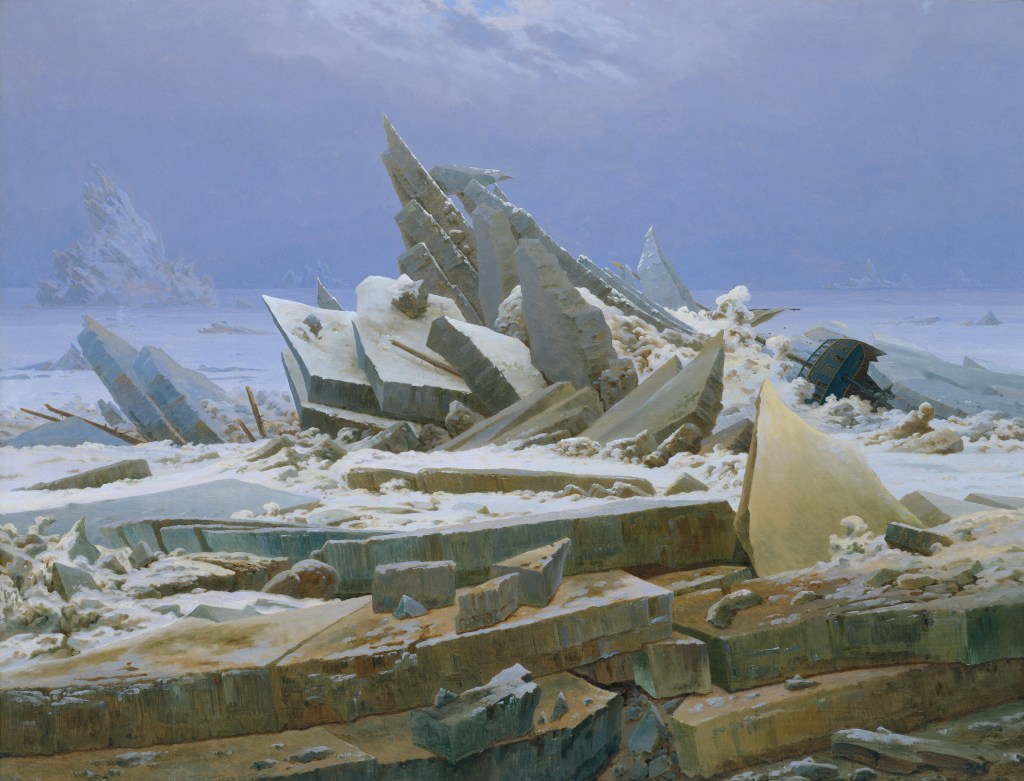
Caspar David Friedrich, Das Eismeer, 1823 – 1824.
Öl auf Leinwand, 96,7 x 126,9 cm, Hamburger Kunsthalle / bpk.
Foto: Elke Walford

EXHIBITION PREVIEW


Museumsinsel Berlin, Alte Nationalgalerie

Bodestr. 1-3, 10178 Berlin
Opening hours: Tue – Sun, 10 am – 6 pm

Caspar David Friedrich. Infinite Landscapes

19 April – 4 August, 2024
A special exhibition by the Nationalgalerie – Staatliche Museen zu Berlin

Press conference: Wednesday, 17 April, 2024, 11 am
Special opening hours: Fridays and Saturdays 10am – 8pm

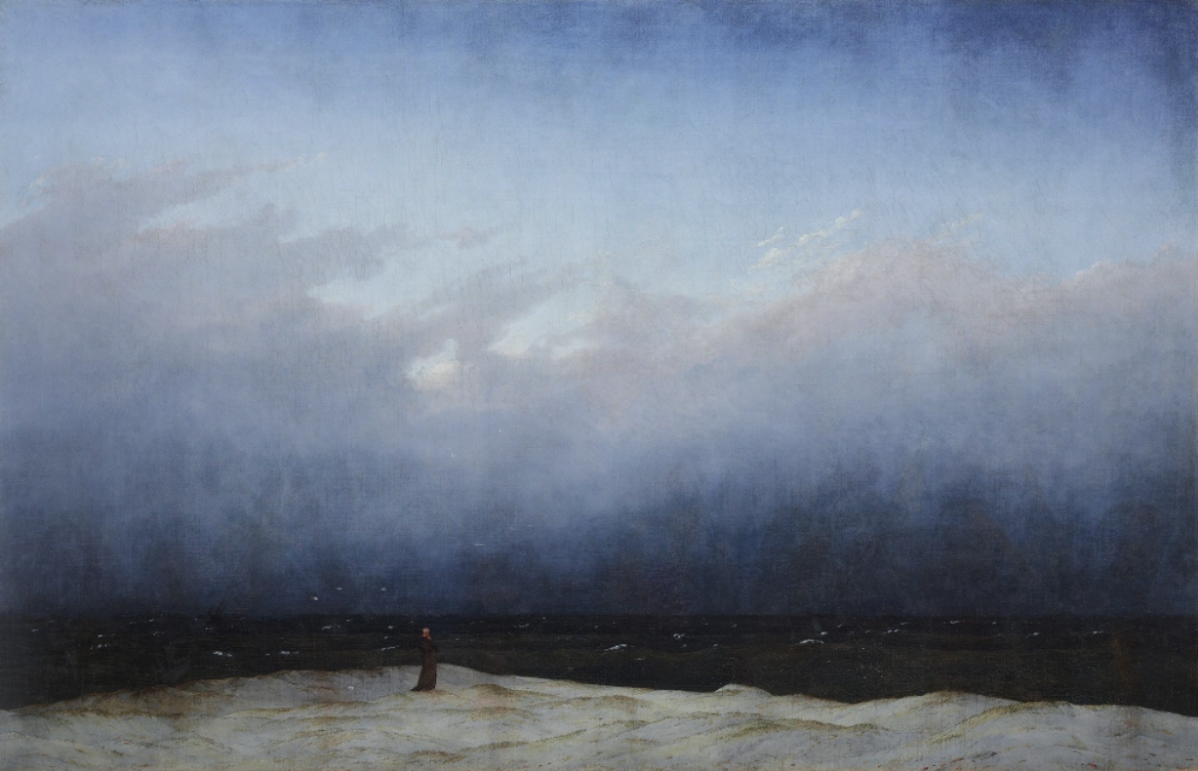
To mark the occasion of the 250th anniversary of the birth of Caspar David Friedrich (17741840), the Alte Nationalgalerie of the Staatliche Museen zu Berlin, in cooperation with the Kupferstichkabinett, will for the very first time present a comprehensive exhibition dedicated to the oeuvre of the most prominent painter of the German Romantic movement. More than 60 paintings and 50 drawings by Friedrich from Germany and abroad will be on display, including a number of world-famous, iconic works such as The Sea of IceChalk Cliffs on Rügen or Monk by the Sea.

Caspar David Friedrich, Mönch am Meer, 1808-1810. Öl auf Leinwand, 110 x 171,5 cm.
Staatliche Museen zu Berlin, Nationalgalerie.
Foto: Andres Kilger

An exhibition of this kind is long overdue in Berlin, if only by virtue of the fact that the numerous acquisitions and public exhibitions that occurred in the Prussian capital played a considerable part in fostering the artist’s initial renown during his own lifetime. After the painter had faded into obscurity during the second half of the 19th century, the Nationalgalerie paid tribute to him in 1906 in its most comprehensive retrospective to date, the legendary Deutsche Jahrhundertausstellung, which included 93 of the artist’s paintings and drawings. Friedrich was lauded as a painter with an extraordinary proficiency for capturing light and atmosphere, and as a pioneer of modern art.

Caspar David Friedrich, Weidengebüsch bei tiefstehender Sonne, 1830-1835.
Öl auf Leinwand, 22 x 30,6 cm © Freies Deutsches Hochstift / Frankfurter Goethe-Museum.
Foto: David Hall

The rediscovery of Friedrich’s art, his pairs of paintings, as well as the artist’s process and technique will be in the center of the exhibition. Based on these themes, an overview of the life and work of the painter will be presented. The essence of his art between the precise study of nature and romantic imagination will become palpable. Friedrich created landscapes of longing with wide skies and distant horizons in which the infinity of space and time becomes perceptible. His timeless images stimulate thought and feeling, which makes them so fascinating to this day.

Tickets are available from now on at: www.smb.museum/tickets

For guided tours please visit: www.smb.museum/ang

Curated by Birgit Verwiebe, Alte Nationalgalerie.

The exhibition will be accompanied by catalogues in both English and German at Prestel Publishing, ed. by Birgit Verwiebe and Ralph Gleis (hardcover circa 350 pages).

Please note the exhibition’s special opening hours: On Fridays and Saturdays the museum is open from 10 a.m. to 8 p.m.

The anniversary exhibitions marking the 250th birthday of Caspar David Friedrich in the Hamburger Kunsthalle, the Alte Nationalgalerie, Staatliche Museen zu Berlin and the Staatliche Kunstsammlungen Dresden are under the patronage of Federal President Frank-Walter Steinmeier.

The exhibition “Caspar David Friedrich. Infinite Landscapes” is made possible by the Freunde der Nationalgalerie.

In honor of the 250th anniversary of Caspar David Friedrich’s birth, the Metropolitan Museum of Art presents the first comprehensive exhibition dedicated to the artist held in the United States (“Caspar David Friedrich: The Soul of Nature”, February 7–May 11, 2025). It is organized in cooperation with the Alte Nationalgalerie of the Staatliche Museen zu Berlin, Staatliche Kunstsammlungen Dresden, and Hamburger Kunsthalle.

Reimagining Art through Immersive Technologies: The Digital Renaissance

Extract of The Universe Within

Reimagining Art through Immersive Technologies: The Digital Renaissance

By Jean Arnaud

Our society is currently undergoing rapid changes that are profoundly redefining our perception of the world and our relationship with it. The fields of art and culture are no exception. Innovative technologies, often referred to as “new media,” are introducing revolutionary paradigm shifts in art, heralding the inexorable triumph of a new era, a “digital renaissance.”

These new works, primarily developed using immersive technologies such as 3D video, holography, virtual reality (VR), augmented reality (AR), and the metaverse, distinguish themselves from traditional static works through their dynamism and their ability to evoke more intense emotions. They also stand out for their power to deepen and expand our reality. These works are meant to be lived and experienced rather than passively observed, continuing the advances initiated by revolutionary artists like Marcel Duchamp, whose kinetic art challenged traditional norms by introducing movement into art, or artists like Mark Rothko, whose abstract and suggestive expressionism increase the viewer’s role in the artistic experience by encouraging active interpretation.

Indeed, the art produced by new media immerses viewers in a dynamic, and multisensory experience that goes beyond mere observation and interpretation. Not only does it transport them into a perpetually transforming world that invites exploration of the artwork’s depth and complexity, by blending sensations, it also opens up new horizons of perception and self-awareness into the immeasurable abyss of one’s inner being, or to borrow from Pessoa, to “travel while remaining still.” These new genre works are created to be contemplated and admired, in addition to being experienced, and above all, to be transcended.

Exhibitions of video or reflective art, like Yayoi Kusama’s Infinity Mirror Rooms, have gradually made way for light displays and immersive experiences dedicated to the works of artists such as Klimt, Van Gogh, Cézanne, and Matisse, as seen in the Atelier des Lumières in Paris, for example, or the Hall of Lights in New York City. While novel and refreshing, these retrofitted works do not hold nearly the same value as those aesthetically conceived experiences in which technological tools were employed in the service of an artistic vision and integrated into the creative process.

In my immersive video experience, The Universe Within, various technologies were used to bring my aesthetic vision to life. This allegorical piece represents the forces at play within an individual during the act of creation. It also seeks to embody the very movement of a being simultaneously creating itself and shaping its work. Depicting a gradual awakening and a powerful universe of colors, scents, and harmonious orders, when projected, The Universe Within envelops viewers, inviting them to contemplate the surges occurring within their inner selves, like mirrors reflecting the ever-shifting complexity of their psychic life, urging them to transform themselves through an act of creation. This synesthetic and multisensory experience creates a strange and cathartic impression for the viewer: Imagine being carried by an indomitable wave toward the shores of a more accomplished self – the supreme being that assimilates with destiny, one shaped and polished through perseverance, one to which all the power of existence aspires. This demiurgic act is made possible by combining artistic vision with immersive technologies, and the beauty that constitutes the true purpose of any work of art becomes enriched with a dimension both mystical and metaphysical.

Extract of The Universe Within

Other artists have also explored this dynamism in their work. For example, Refik Anadol’s stunning piece, Unsupervised, recently joined the permanent collection of the prestigious MoMA in New York. Anadol’s offering examines the idea of art creating itself, a process in which moving forms attempt to break free from their boundaries. Ultimately, machines, like human beings, are still constrained by their own nature and the physical reality in which they are rooted and upon which they depend. Thus, while these phygital works can create unprecedented experiences due to their dynamic, immersive, and multisensory nature, and while they foster the development of deeper, more vivid emotions and ideas, they are limited by physical constraints that only virtual reality and augmented reality can transcend.

Students at MIT’s Computer Science and Artificial Intelligence Laboratory have developed an augmented reality experience that presents the viewer with a digital canvas on which a creature moves through a lush jungle, and they can interact with it by scanning a QR code. When the viewer solves the artist’s riddle, the artwork comes to life, and the environment flourishes. Augmented reality not only frees an artwork from physical constraints such as frames, walls, or spheres, but it also places the viewer at the center of the artistic experience, where they can actively participate. However, while the viewer can have an impact on the work, their actions are still restricted and guided by the artist-engineer, or the artist assisted by computer engineers. If a piece of art is developed within a VR or AR environment, true transcendence can only take place within the metaverse, a more open digital world where each participant can interact and collaborate with friends in the form of avatars, redefining the entire artistic experience. In the metaverse, boundaries between the realms of art and play blur, and the possibilities for artists and viewers are infinitely expanded.

The metaverse allows artists to create dynamic art that defies the laws of physics, whether it be inverted, floating pyramids, immersive digital art spaces that transport viewers, the synesthetic integration of visuals and music, interactive philosophical, historical, technical, or cultural elements, or animated discussions by avatars representing both the artwork’s characters and the artist. Such metaverse-based work transcends traditional boundaries that define artistic genres, offering an impression of limitless possibilities and experimentation, as well as introducing ludic elements like escape games, which invite viewers to participate actively, even in the creation process. Within the metaverse, art is no longer akin to Greek columns carved from marble destined to exist eternally in petrified beauty; it can now take on the vibrant and colorful appearance of living trees, whose multiplying branches ignite the infinite motion of worlds, life, and the creative soul, offering a boundless universe of possibilities.

My work, Prometheus Ἑωσφόρος, is an interactive 3D sculpture in the metaverse, inspired by ancient mythology. After stealing the sacred fire from the gods, Prometheus, the divine rebel, offers it to human beings, granting them the ability to break free from the constraints of a predetermined, imposed, and disputable order. Now free to be sovereign, humans must shape their existence with the fire of love, ardently stoked by the breath of will, guided by the high visions of creative imagination, and shaped, sculpted, and polished by the skilled hands of reason. Beyond the beauty of art that each demiurgic soul aspires to, there are underlying philosophical messages, encouraging humans to be the sculptor of themselves and their destinies, to elevate the powers inherent in their being, and to be present in the world, open to its mystery and complexity, as the architect of a more enlightened humanity by employing technology in service of their vision.

My digital statue represents the first level of meaning, containing an experience hidden within. Prometheus Ἑωσφόρος is located inside a futuristic 3D triangle that moves through the air and can only be accessed after deciphering a symbolic and mysterious poem, a kind of enigmatic relic guarding the “threshold of intrusion,” to borrow Novalis’s vocabulary. To answer the call of the humanist artists of the digital renaissance, one must draw upon their inner strength to move beyond mere aesthetic contemplation and delve into their own depths to rise to the creative act: “What [every artist] seeks when they cast these sparkling fragments of themselves onto the world are beings of their rank, filled with a supreme love for life, entirely devoted to their sacred mission, miners of knowledge, hallucinators and seers, inventors of values, creators of the future… To these magnificent beings falls the enormous, sublime, and superhuman task of raising, in the skies of the future, the star their predecessors sketched in dreams, of shaping and perfecting the star whose rays they have outlined” (Soliloquies, foreword). Thus, the viewer is called upon to participate and interact with my sculpture by taking the torch held by the cybernetic titan that it depicts. A circle with mysterious inscriptions moves, revealing a cryptic poem – a bridge to another experience, the recreation of the sculpture in a different way. The goal is then to encourage the viewer to enrich the artwork with their own vision, so that they become a creator themselves.

Extract of Prometheus

The artwork made possible by new media is no longer meant solely for observation; it is designed to be lived and experienced. These innovative technologies offer the opportunity to create dynamic, immersive, synesthetic, palimpsest, interactive, and participatory artistic experiences that have brought about profound paradigm shifts in the field of art. It is a total art that requires artists to be versatile and master complex technologies, transforming themselves into technical artificers or visionary philosopher-poets surrounded by talented experts, painters, musicians, and engineers. The artists of the Renaissance were masters in various disciplines; Michelangelo excelled in sculpture, painting, and poetry, and Leonardo da Vinci excelled in philosophy, sculpture, painting, and engineering, relying on the most talented individuals of their time in order to execute their work. The new art of the digital renaissance is thus open to an infinity of possibilities and meanings, surpassing the notion of artistic genre and allowing the viewer to adopt a new role beyond that of a mere observer or exegete by participating in the creative process and rising to the level of the artist. The artwork itself can now offer in its structure the means of its own transcendence and present itself to posterity as a moving temple dedicated to change and successive metamorphoses, challenging the old artistic hubris that glorified the illusion of immortality in opposition to time. There is no being that does not become, or, to put it differently, there is no being but in the process of becoming. This philosophical principle is embraced by this new art, even defining it as the ideal. 

A new era has opened, one in which humanity, thanks to advances in technology, is compelled to question its limits, a practice that must be embraced if one wishes to push these limits and transcend them. The makers of the impossible owe much to limitation, as it became an invitation to act with invention. Art, more than ever, is not only a manifestation of these existential questions but also the most refined and spiritual way to answer them. It also then becomes the most sophisticated means of self-fulfillment and improvement, of becoming more oneself and more than oneself. By accumulating and mobilizing the powers of existence through philosophy, science, art, and technology, and by becoming more of what they must be, the artist of the digital renaissance ensures that their being fulfills its destiny (or that their being is fulfilled as destiny) and shapes, at the same time, that of humanity, which always shines above, guiding our supreme aspiration toward higher beauties and the skies of the sublime. 

Jean Arnaud, also known as Jean Arno, is a Boston-based tech entrepreneur and the founder of Nova, a company dedicated to developing interactive AI solutions to accelerate academic research and enhance its efficiency. In addition to his entrepreneurial pursuits, Jean is a published author and an artist renowned for his innovative work at the intersection of technology and art. He is recognized for pioneering new approaches that push the boundaries of both fields.

Publishing in Art Style Magazine is free of charge for anyone. There are no article processing charges or other publication fees. Art Style Magazine is independent and supports the Open Access Movement. The editors of Art Style Magazine cannot be held responsible for errors or any consequences arising from the use of information contained in essays and articles published on the Art Style Magazine’s website and editions. Authors agree to the terms and conditions and assure that their submissions are free of third parties’ rights. The views and opinions expressed in the essays and articles are those of the author and do not reflect the views of Art Style Magazine. The authors of Art Style Magazine’s essays and articles are responsible for its content. The Art Style Magazine‘s website provides links to third-party websites. However, the magazine is not responsible for the contents of those linked sites, nor for any link contained in the linked site content of external Internet sites (see Terms & Conditions).
HackelBury Fine Art, London, presents Coral Woodbury’s second solo exhibition

CORAL WOODBURY – Revised Edition

Solo exhibition at HackelBury Fine Art, London 7 March – 4 May 2024

Dora Maar, 2021

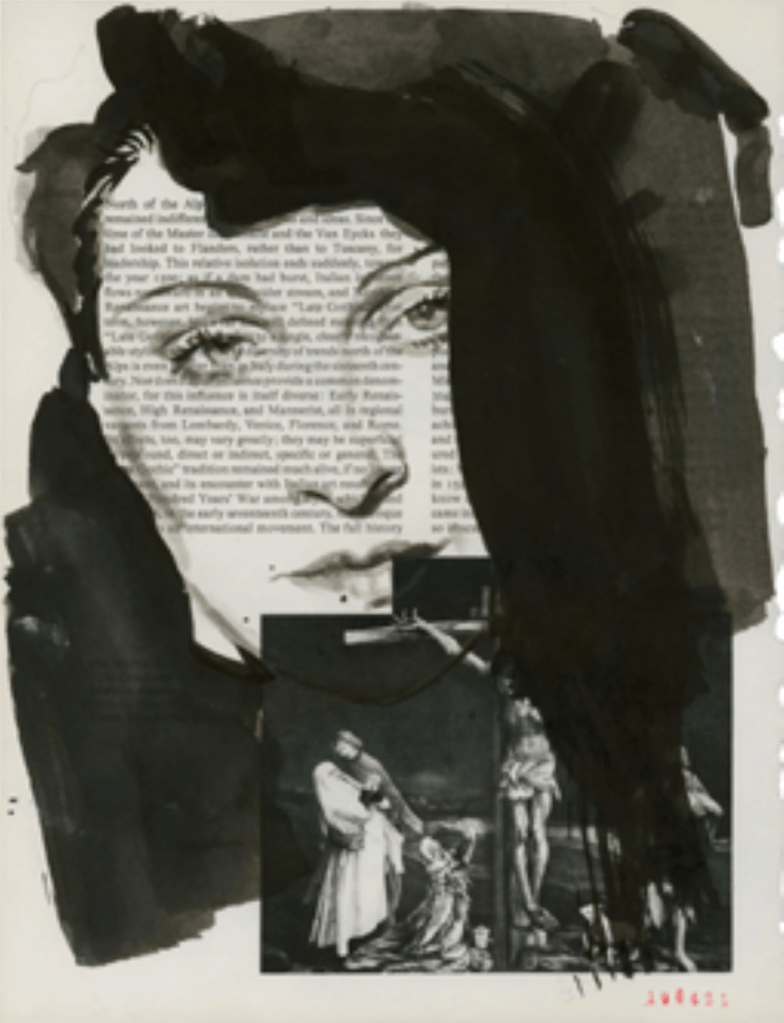
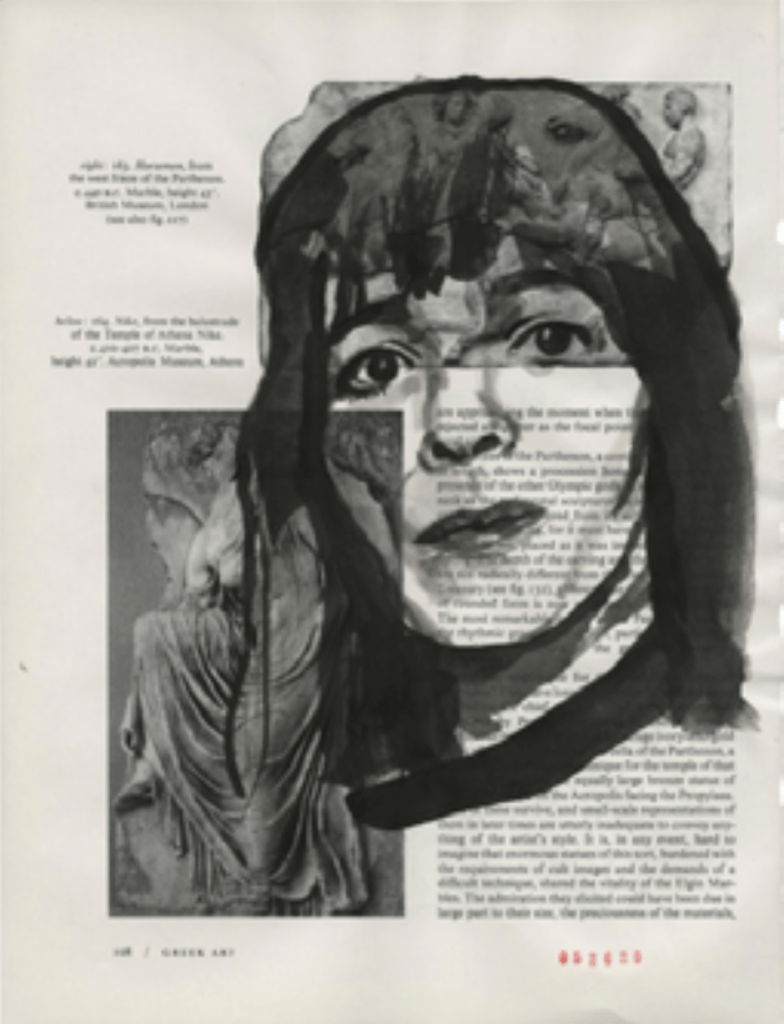
HackelBury Fine Art, London, presents Coral Woodbury’s second solo exhibition, Revised Edition, featuring new work from three series, all inspired by the form and substance of the book. Woodbury uses recurring motifs such as ashes, palimpsests, and remnants of material culture to evoke themes of absence and memory, and bridge human connection across time.
In her series, Revised Edition, Woodbury enacts a feminist intervention in the art history canon. On pages torn from the seminal Janson’s History of Art – which entirely omitted artist women from its first 29 printings – she, with sumi ink, paints women back into the history which excluded them. Her work renders the invisible visible.

“When complete, Revised Edition will encompass 617 paintings and will stand as testimony against the erasure of others which reaches deeply into our culture.”

Susan Rothenburg, 2020

Oil paintings from the Broken Spine series continue this same exploration of the vagaries of memory, time, and history. Translucent layers of paint and obscured writing lend an ephemeral quality which suggests the fading, forgetting, and fragmenting of the past. From parchment manuscripts, to authors’ galley proofs, to the current US book banning epidemic — the traces and erasures of thought become part of the process of painting.

“These paintings originated when I was recovering from a fractured spine. Themes of brokenness and repair entered my work, and I began exploring the metaphorical connections between book and body.”

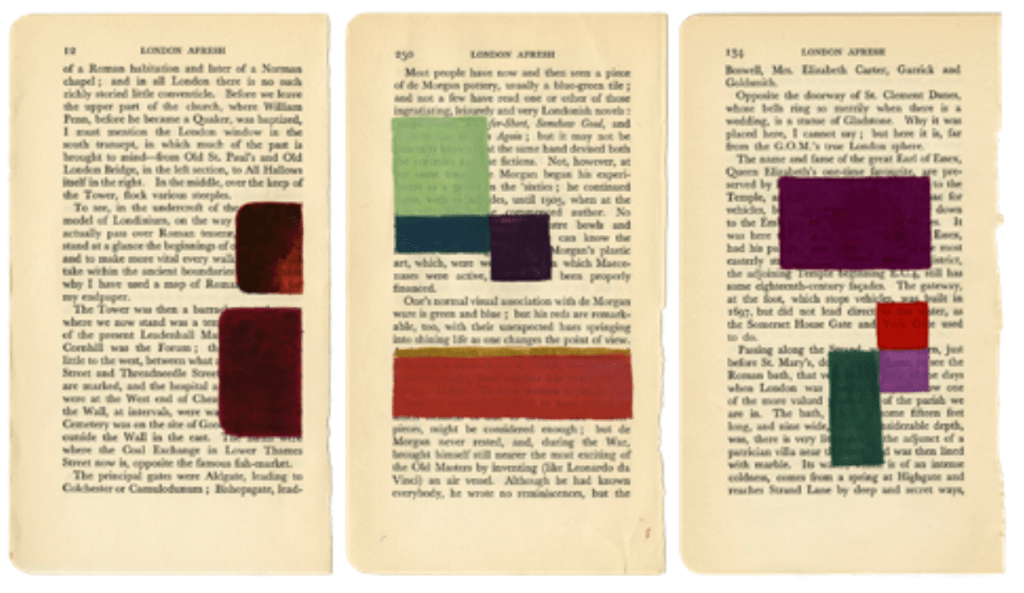
The series In Place is Woodbury’s personal travelogue, noted in colour rather than writing. Finding a timeworn book specific to the location has become an orienting ritual upon arrival. The pages, swatched in various hues of gouache, record fleeting experiences in the language of color.

Broken Spine V, 2021

Triptych: Hoop and Grapes, Leather and Stout; Mary Seton Watts Cemetery Chapel; Bentley 8 Litre Mirror with Velvet Scrunchie, 2022 (London)

About Coral Woodbury

Boston-based artist Coral Woodbury (b.1971) exhibits nationally and internationally and in 2020 was a finalist for the international Mother Art Prize, culminating in the Procreate Project exhibition at Cromwell Place in London. In 2018 she took part in the International Travelling Art exhibition at Taragaon Museum, Kathmandu, Nepal; #00Bienal de la Habana, Cuba; and VANITAS#IMPERMANENCE, Travelling Exhibition in Genova and Trieste, Italy. Woodbury was recently included in the group exhibition ‘Medium & Memory’ curated by Griselda Pollock at HackelBury Fine Art and its accompanying catalogue.

Her work is held in public and private collections, including The Katrin Bellinger Collection, The Cross Steele Family Collection and The Women’s Art Collection, University of Cambridge.

About HackelBury Fine Art

HackelBury Fine Art was founded twenty-five years ago by Marcus Bury and Sascha Hackel. The gallery is committed to championing artists working with the visual arts who push the boundaries of their medium to create meaningful and contemplative work.


The London based gallery initially showcased classic photography from the 20th century including Henri Cartier-Bresson, Berenice Abbott, Willy Ronis, Malick Sidibe, Sebastião Salgado and Edouard Boubat. The transition from traditional photography to more conceptual work was as intuitive as it was organic, beginning with artists such as William Klein, Pascal Kern, Doug and Mike Starn, Garry Fabian Miller, Katja Liebmann, Ian McKeever, Stephen Inggs and Bill Armstrong. In recent years the gallery has also taken on emerging artists such as Oli Kellett, Nadezda Nikolova, Alys Tomlinson and Coral Woodbury.

Each artist, whether emerging or established, creates work defined by a depth of thought and breadth and consistency of approach. The small group of artists with whom HackelBury work, represent a diversity of practice yet share an artistic integrity which the gallery is fully committed to supporting in the long-term.

FOR ALL PRESS ENQUIRIES PLEASE CONTACT

Camilla Cañellas – Arts Consultancy & PR
E: camilla@culturebeam.com M:+34 660375123

Phil Crook – HackelBury Fine Art
E: phil@hackelbury.co.uk T: +44 20 7937 8688

Instagram @hackelburyfineart

HACKELBURY FINE ART

4 LAUNCESTON PLACE, LONDON W8 5RL

T: 020 7937 8688

www.hackelbury.co.uk

© 2021 HackelBury Fine Art, Ltd. Copyright for all images is held by the respective artist or estate and they may not be reproduced in any form without express permission. All rights reserved.

APPENDIX

Medium & Memory exhibition links:

Publication | Exhibition

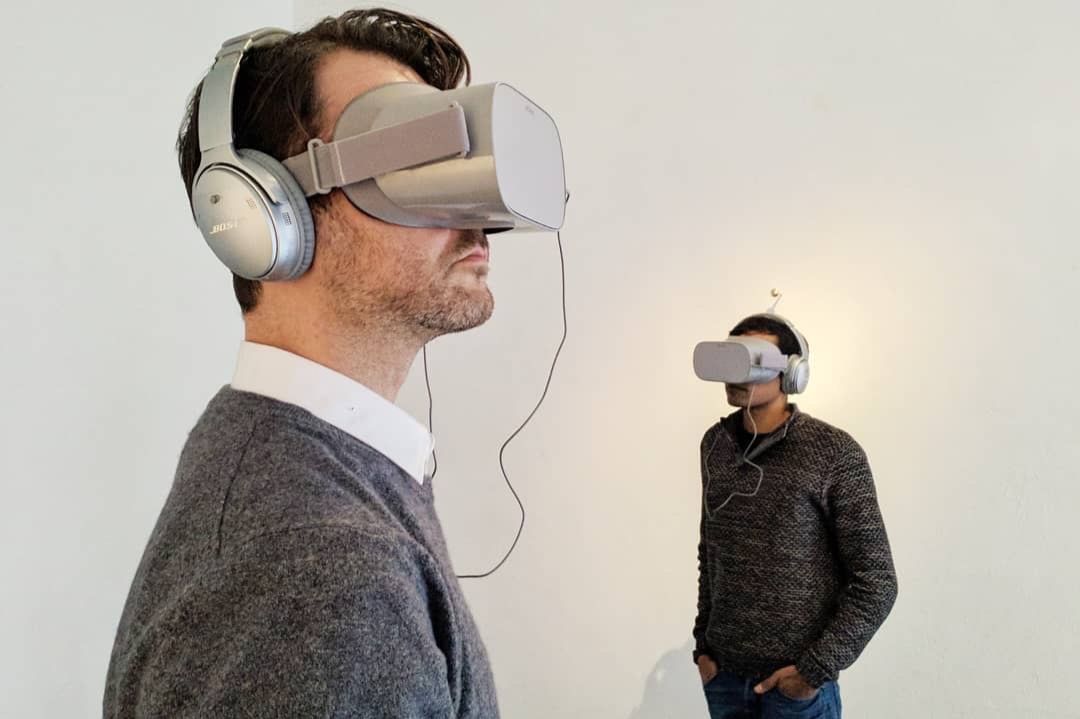
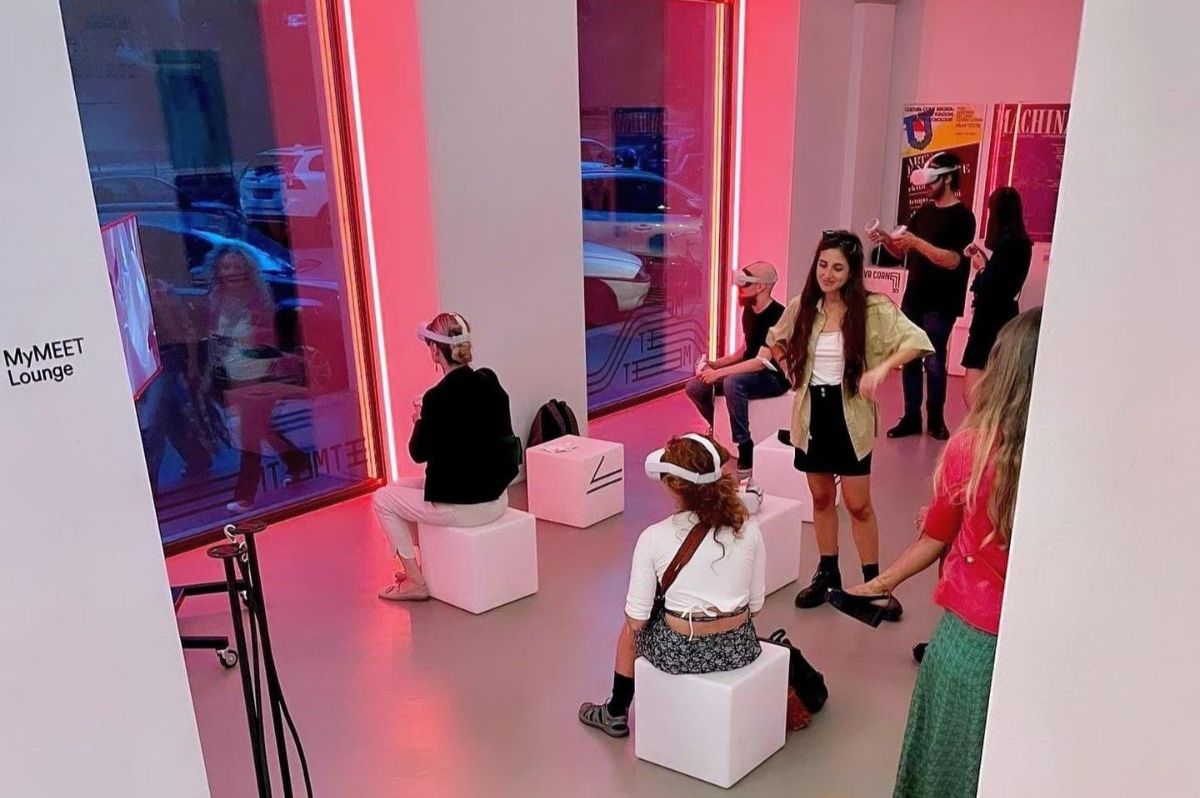
Synthesis Gallery is celebrating a momentous occasion – five years of showcasing exceptional art.

Synthesis Gallery is proud to announce its fifth anniversary of art exhibitions.

Marc Lee, installation view, Same but different opening show, Berlin, 2018.
Adam Broomberg and Oliver Chanarin, Woe from Wit premiere, Berlin, 2019.
The work was later exhibited at Eye Filmmuseum and Biennale für Aktuelle Fotografie.

synthesis gallery has come a long way since its inception in New York City in 2017. The gallery has always been committed to showcasing immersive art, and in 2018, it expanded its reach by opening a new location in Berlin. Synthesis has been instrumental in promoting emerging artists and collaborating with established names in the digital art world, helping to launch and support their careers. The gallery’s focus on VR, AR, and XR works has been a significant contribution to the art world, and it continues to play a pivotal role in nurturing new talent.

Over the course of five years, Synthesis Gallery has organized more than 20 shows, cementing XR as a significant medium. In 2021, they transformed into a non-profit organization, expanding their focus to include new media and digital art. Their mission is to position the digital art community within the rich tapestry of art history while promoting critical discourse about the potential of technology without perpetuating binary thinking or singular theories.

Synthesis Gallery has been successful in showcasing its exhibitions in leading cultural institutions across the globe. They are now actively seeking new international platforms to expand their reach and bring their unique exhibitions to a wider audience.

synthesis x Vodafone: panel and intervention for European Union Presidency, Brussels, 2019.

Nancy Baker Cahill LEGACY, installation view, Tempelhofer Feld, Berlin, 2021.

Sound Becomes Site: Symphony For The Metaverse,
group show presented at MEET Digital Culture Center, Milan, 2022.

AES+F Lynx avatar, installation view, synthesis x Feral File I KNOW, Berlin, 2023.
The work was acquired by NFT Museum of Digital Art as part of their relevant collection.

synthesis is a genre-defining cultural institution working with new media. Since its inception in 2017, the gallery has produced over twenty exhibitions of new media art in Berlin and abroad, online and on chain and is dedicated to exhibiting internationally renowned, well-established artists alongside emerging ones.

For press inquiries, please contact giorgio@synthesis.gallery or call +49 174 2747 842.