Fernando Menis wins the AHI European Award for Intervention in Architectural Heritage for El Tanque Garden

Spanish architect won the Exterior Spaces category for El Tanque Garden of Santa Cruz de Tenerife, the Built Heritage category was won by David Chipperfield for the Renovation of the iconic Neue Nationalgalerie in Berlin.

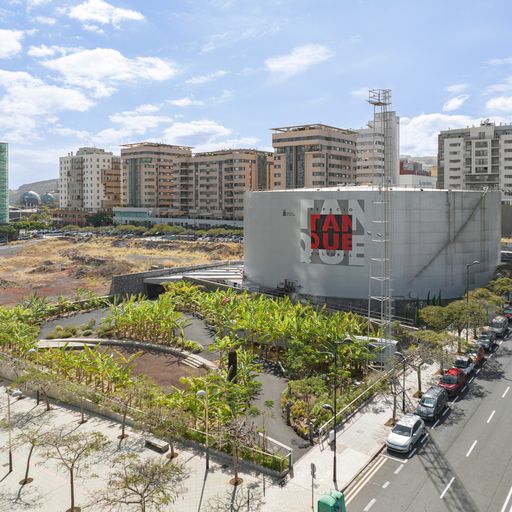
El Tanque Garden of Santa Cruz de Tenerife won the Exterior Spaces category in the AHI European Awards for Intervention in Architectural Heritage. Designed by the Spanish architect Fernando Menis, this is the ecological restoration of a former industrial area, which has endowed the Cabo Llanos neighborhood with its first green public space. Around a former refinery tank, repurposed as a cultural space since 1997, and listed since 2014, this banana trees orchard recalls the agricultural landscape prior to industrialization, staging the city as a place of coexistence of different eras, cultures and sensibilities that have been shaping its identity.

 “El Tanque Garden works with ecology and heritage to offer a creative, cultural and socially inclusive public space. It demonstrates sensitivity on all scales, including the reuse of industrial waste for the design of furniture and lighting”. It is complete in terms of sustainability, social benefits and in relation to local identity and landscape design” – stated the Jury.

The Award in the category of Built Heritage went to the rehabilitation of the Neue Nationalgalerie in Berlin, carried out by the office of David Chipperfield, the last Pritzker winner. In the Urban Planning category, the Jury has awarded the Regeneration of the Gràcia neighborhoods in Barcelona, by the firm Jornet Llop Pastor Arquitectes, together with the Urban Planning Department of the Barcelona City Council. Finally, in the Dissemination category, the Prize has been awarded to the documentary “La vie en kit”, by the Belgian architect and filmmaker Elodie Degavre.

In addition, the non-profit Asociación Amigos del Espacio Cultural El Tanque has been a finalist in the Dissemination category for its incessant activism over 25 years to rescue, defend and protect El Tanque as an element of the industrial and cultural heritage of the Canary Islands.

The Award is a biennial initiative of the Barcelona platform AHI Architectural Heritage Intervention;  the Colegio Oficial de Arquitectos de Cataluña COAC (Architects Association of Catalonia ); Barcelona City Council; and the Barcelona Metropolitan Area. In its sixth edition, a total of 241 projects have been entered by architecture firms from 28 European countries, the highest figure ever achieved.

The Cultural Space El Tanque in Santa Cruz de Tenerife is a former refinery deposit, used as a cultural space since 1997:

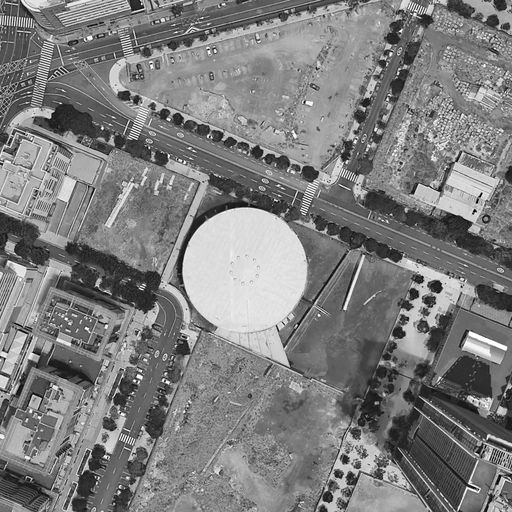
The El Tanque Cultural Space of Santa Cruz de Tenerife is the former tank 69, a huge container long used for the refining and storage of crude oil that was part of the CEPSA refinery, the first built in Spain around 1930. It is a 20 m high cylindrical piece with a 50 m diameter that represents one of the last vestiges of an industry that, in the last half century, has been part of the urban geography of the Tenerife island.

The adaptive reuse as a cultural space carried out in 1997 preserved its original appearance thanks to a minimal architectural intervention based on recycling. Thus, an old ferry bridge abandoned in the city’s port was upcycled for the access; the entrance door to the space and the interior ramp were built with large metal sheets retrieved from other dismantled containers; and the skylights were made with empty CEPSA barrels adapted to their new use.

The El Garden Tanque is the ecological restoration of a post-industrial area in Santa Cruz de Tenerife:

Coinciding with the preparation of the 25th anniversary in 2022 of this singular cultural space, the non-profit Asociación Amigos del Tanque and the Government of the Canary Islands promoted planting a garden that would cover its surroundings, to produce the first green public space in the neighborhood of Cabo Llanos.

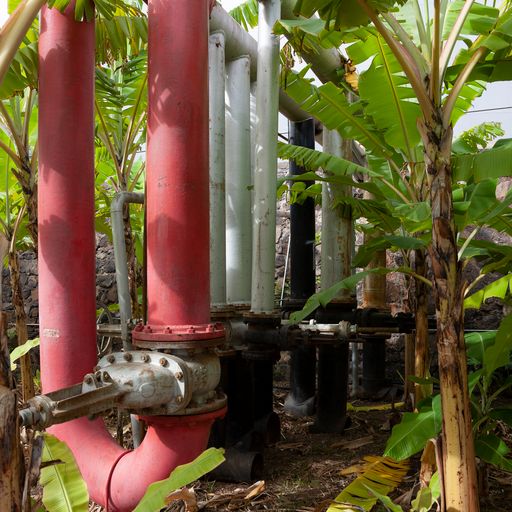
The perimeter of El Tanque has been covered with banana trees as a way of remembering the agricultural activity that existed in this area before the CEPSA refinery was located here in the 1930s. As time passes by the exuberant subtropical vegetation colonizes the industrial relic, framing its fascinating presence while restoring the memory of the agricultural past to build a sense of cultural continuity and belonging.

The new garden respects the original layout and stone wall of the site, while the base of a dismantled adjoining tank is now the perimeter of a new semi-circular plaza. The exterior of the Tank and its elements have been rehabilitated and integrated into the general redesign concept that combines industrial heritage and nature.

Menis’s landscape design seeks to create a highly biodiverse garden based on native flora with more than 700 trees and shrubs, as well as aromatic plantes areas. There are mostly banana trees as a way to recall the banana plantations that grew on the site before it was converted to industrial use.

“Our research work has confirmed that this area was agricultural. There used to be banana and tomatoes, as well as coast plants such as tabaibas, cardones, verodes, etc., all of them native plants of the Canary Islands, which require little watering, are resilient and durable. By looking back into the agricultural history of Santa Cruz, we decided that the area around El Tanque should be planted again with banana trees. And, the tomatoes have simply sprouted, since there must have been vines over 90 years old, incredible survivors of an entire industrial era, which, after having prepared and watered the land, have grown again because the earth, the soil, can recall, although sometimes we forget it”, explains the architect Fernando Menis.

Following the same line of re-use and recycling that he already applied in the rehabilitation of the El Tanque Cultural Space, the architect designs the outdoor lighting and furniture of the Garden with waste. Thus, divers’ oxygen bottles were recovered from the garbage and adapted to be used as lamps. And, since one of the main users of the garden are children, the lamps resemble the Minions, the cartoon characters who are heavy banana consumers. Care for the environmental impact is also perceived in the orientation of the lamp so that it avoids light pollution, as well as in the watering of the greenery, which is supplied with recycled water.

What used to be contaminated and underused land, although part of a protected heritage compound, is now a lush garden that will only improve as biodiversity recovers, offering a public space for social cohesion, reconnection with nature and the cultural heritage of Tenerife.

“In short, it is an action with multiple implications since we have got now an accessible plaza, which is also a new green public space, a first one in the Cabo Llanos neighborhood, the agricultural history of Santa Cruz de Tenerife is evoked and, at the same time, biodiversity is recovered. It is an action that can be an example to ecologically recover other spaces in the city and on the island”, emphasizes Dulce Xerach, a lawyer and president of the Association Los Amigos del Tanque.

El Tanque Garden Facts:

Address: C/Adán Martín Menis s/n 38003 Santa Cruz de Tenerife, Canary Islands, Spain

Completion: 2022

M2 site: 5.714,55 m2 (2.210 m2 garden)

M2 : 2.563,75m2 (environment 1.989,63 m2+ tank 574,12m2)

Cost: 480.086,74 €

Architect: Fernando Menis

Client: Consejería de Educación, Universidades, Cultura y Deportes del Gobierno de las Islas Canarias, Dirección General de Patrimonio Cultural (The Government of the Canary Islands)

Initiative: Association Amigos del Espacio Cultural El Tanque

Design project team: Jesús Montejano, Javier Espílez, Joanna Makowska-Czerska, Yanira León

Consultants: Ruperto S. Hernández González (Technical Architect and Director of building works); Prisma Ingenieros SLP (Building services engineer); Interjardín SL (Gardening); Cristina Saavedra (Logo Graphic Design)

Companies: Señalizaciones VillarPlantas (asphalt); Interjardín S.L (soil and plants); Zumtobel (lighting); Refinería Cepsa (elements for recycled furniture); Eco Steel (locksmith); Hernández de la Guardia (paint); Fachadas Dimurol S.L (painter)

Construction companies: UTE Señalizaciones Villar S.A and Interjardín S.L.

Fernando Menis (1951, Tenerife). Witha professional career spanning more than 40 years, Menis’s architectural production includes works of various scales and typologies, as well as long-term research projects. An expert in designing concert halls and auditoriums, he is internationally recognized and awarded for conceiving an innovative variable acoustics system for the CKK Jordanki Concert Hall (2015, Poland). Among the projects completed, alone and in co-authorship: the Church of the Holy Redeemer of Las Chumberas (2022), El Tanque Cultural Space Public Garden (2022), CKK “Jordanki” Concert and Conventions Hall, in Poland (2015) , Plaza Bürchen in Switzerland (2015), Insular Athletics Stadium (2007), Magma Arte & Congresos (2007), Floating pool in the Spree River of Berlin (2004) and the Presidency of the Canary Islands Government in Tenerife (2000). Among the ongoing projects, the following stand out: the Rehabilitation of the Viera y Clavijo Cultural Park, the Masterplan in Boa Vista, the Pájara Conventions and Concert Hall in Fuerteventura, the Rehabilitation of the Cultural Center in La Guanche, the Rehabilitation of the Teobaldo Power Performative Arts Hall in La Orotava. Distinguished on 10 occasions with the Canary Islands Architecture Prize, Menis also won: the Prize for the Best Cultural Building in Poland 2015 from the National Council of Architects of Poland; the CEMEX Award for Universal Accessibility 2016; the 2016 Taipei Design Award to the Best Public Building Award; the Stone Award at the VIII International Stone Architecture Award 2005; and the Prize of the V Spanish Biennial of Architecture 1998, among others. Architect Doctor from the Polytechnic of Valencia, his works have been shown in several editions of the Venice Biennale, at the Museum of Modern Art in New York, at the Aedes Berlin gallery and the GA gallery in Tokyo. His project Iglesia del Santísimo Redentor is part of the permanent collection of the MoMA Museum of Modern Art in New York.

Gerlinde, a solo exhibition of new work by Royal Academician Ian McKeever

IAN MCKEEVER – Gerlinde

2 June – 5 August 2023

No 5, 1995-2023

HackelBury is pleased to present Gerlinde, a solo exhibition of new work by Royal Academician Ian McKeever. This new body of work, his most personal to date, is the portrait of a woman, a love letter to his wife. Drawing on abandoned drawings and his archive of photographs which capture everyday objects in a domestic setting, his black and white photographs are filled with light and shadow, providing evocative glimpses of the human presence which merge with silhouetted objects and structures from their home.

McKeever’s emphasis on an abstract language fosters ambiguity. His interest is in pushing the conventional notion of photography as a literal, figurative representative of reality away and establishing a visual language providing only transitory glimpses of reality. This invites the viewer to focus on the compositional elements such as the quality of light and balance of shadow, the drawn line and assembled object, the ‘aura’ of the edge between gouache and photograph, the silhouetted form and the gestural mark.

McKeever is intrigued as to ‘where the image begins and finishes’ and the glimpse of a fleeting moment in which nothing is fixed. His work explores meeting point between the ‘truth’ of photography and the language of painting. The gap between the photograph’s instant reality and the slow incremental process of mark-making in painting.

In some of the work, McKeever has photographed objects against strong sunlight to evoke an almost gestural painting imbued with a calligraphic quality reminiscent of Japanese Shoji screens which were traditionally used to provide visual privacy.

The artist’s exploration of the domestic setting could also be said to be as a meditation on such artists as American photographer Charles Sheeler, whose work in the 1930s, after documenting local buildings for architects, took a new direction when he began photographing the interior of his home, drawing out compositions of solids and spaces. Also, in his use of torn or cut papers, McKeever draws on the poetic language of Matisse’s ‘cut-outs’, to explore the balance and boundaries between abstraction and representation, photography and painting, edge and space, and shadow and light. This new body of work has a cinematic quality in which the artist captures the essence of someone’s presence through objects in the space around them. As Marcel Proust wrote,

‘….I am myself again. Pleasure in this respect is like photography. What we take, in the presence of the beloved object, is merely a negative, which we develop later, when we are back at home, and have once again found at our disposal that inner darkroom the entrance to which is barred to us so long as we are with other people’.

In Search for Lost Time, Volume II

No 7, 1995-2023
No 3, 1995-2023

About Ian McKeever

Ian McKeever (born 1946) is primarily known as one of the leading British painters of his generation. However, photography has always played an important part in his practise. His early work grew out of a conceptual interest in landscape leading in the mid-1980s to his engaging more fully with the practise of painting. Concurrently over the last twenty years, he has pursued his commitment to photography in such groups of works as Eagduru and Against Architecture. The new Gerlinde series takes further this exploration between photography and its affinity to painting.

In 1989, McKeever received a DAAD scholarship to live and work in Berlin. In 1990 he had a major retrospective at the Whitechapel Art Gallery, London. Since 1971 he has exhibited extensively including major exhibitions at the Kunstverein Braunschweig in 1987, the Porin Taidemuseo in 1997, the Kunsthallen Brandts Klaederfabrik, Odense in 2001 and 2007, the Morat Institute, Freiburg in 2005 and 2007, the New Carlsberg Glyptotek, Copenhagen in 2006, the Royal Academy of Arts, London in 2010, the Sønderjyllands Kunstmuseet in 2011 and the Josef Albers Museum, Quadrat Bottrop in 2012. McKeever has taught extensively in Great Britain, Germany, and the USA. He has held several teaching positions including Guest Professor at the Städel Akademie der Kunst in Frankfurt, Senior Lecturer, Slade, University of London and Visiting Professor at the University of Brighton. In 2003 he was elected a Royal Academician. He has also published many texts and essays primarily concerning the nature of painting. Ian McKeever’s work is represented in leading international public Collections, including Tate, British Museum, Royal Academy of Arts, London; Museum Moderner Kunst, Vienna; Museum of Fine Art, Budapest; Louisiana Museum of Modern Art, Humlebæk; Glyptotek, Copenhagen; Museum of Contemporary Art, Helsinki; Brooklyn Museum of Art, New York; Metropolitan Museum of Art, New York; Boston Museum of Fine Art and Yale Center for British Art, Connecticut.

About HackelBury Fine Art

Established in 1998, the London gallery in Launceston Place is committed to nurturing long-term relationships with both artists and clients. It continues to evolve and progress through an expanding program of gallery exhibitions, museum projects and publishing ventures.

The small group of artists with whom HackelBury work, represent a diversity of practice, pushing the boundaries of various media. The work and practice of these artists encompasses the worlds of photography, painting, drawing, sculpture, architecture and performance. Each artist, whether emerging or established, creates work defined by a depth of thought and breadth and consistency of approach.

FOR ALL PRESS ENQUIRIES PLEASE CONTACT

Camilla Cañellas – Arts Counsultancy & PR
E: camilla@culturebeam.com M:+34 660375123

Phil Crook – HackeklBury Fine Art
E: phil@hackelbury.co.uk T: +44 20 7937 8688

Instagram @hackelburyfineart

The Berlin Synthesis Gallery presents ‘Unstable Objects’

Mures Nicoleta, An Employee-Owned Company, 2020

The Berlin Synthesis Gallery presents UNSTABLE OBJECTS

UNSTABLE OBJECTS | The screenings, a video screening program opening June 1, 2023, at Molt (Berlin) and running through June 20, 2023.

UNSTABLE OBJECTS | Online, an online exhibition on New Art City running through July 6, 2023.

The contemporary visual universe has become an uncanny, quirky, mixed up place: gifs, photoshopping, GAN, remixes, deep fakes and memes have made their way from the depths of the digital world into our everyday lives. Images have become unstable objects, as art historian Valentina Tanni refer to them: “They are made, sent, resent, distorted, manipulated by human and non-human life forms, and the growing and accelerating dissemination of their contents and contexts affects systems of power and changes the way we perceive reality.”

UNSTABLE OBJECTS | The screenings is presented physically at MOLT, a Berlin-based project space, through June and presents video works by Sara Bezovšek, Casey Kauffmann, Valerie Leya and Lorna Mills. Lorna Mills’ “Ways of Something” is a collaborative four-episode remake of John Berger’s influential 1972 documentary Ways of Seeing, which explored the hidden forces of power, wealth and desire at work in traditional notions of art. For “Ways of Something”, Mills crowdsourced over 115 digital and new media artists to produce minute-long videos inspired by every minute of the original documentary, creating a stunning homage that takes the viewer on a tour of art in a post-internet age. Valerie Leya’s “Powers of Cringe: An Essay on Aesthetics of Degradation” explains the cringe aesthetic in internet culture. It attempts an aerial view of cringe, using art historical and post-Marxist frameworks to explain how cringe emerged in today’s technological paradigm. Casey Kauffmann’s “Knowing Others and Wanting to be Known” is a video collage piece created using found videos, after effects and a variety of phone-based applications, addressing the archival nature of the online performance of the self. Sara Bezovšek’s “False Utopia” embraces new remix culture to speculate on the possibility of utopia in our society, extrapolating snippets from the internet with a strong visual awareness.

Bringing together works by Casey Kauffmann, Katherine Mills Rymer, Nicoleta Mures and Romain Thibault, UNSTABLE OBJECTS | Online highlights this new era of images and their power to reflect our fragmented, hybrid, hyper-stimulated selves. Either taken from popular culture or created from scratch, distorted upon themselves or remixed in the primordial swirl of the internet, the works on display stand as a form of critique and celebration. Romain Thibault’s project “Cognitive Distortions” is about automatic thought patterns that cause individuals to perceive reality inaccurately and negatively. This phenomenon is explored through the lens of our current image culture. Katherine Mills Rymer’s sister works “Face Like A Cave” and “Hairy Melty” explore ideas of the socialized self, the private self and the paradisiacal online self. Each work seeks to understand internal shame, infinite circularity and digital entanglement. Casey Kauffmann’s “Cursed AF” series of GIFs explore the concept of cursed content, a type of online content and popular subculture that is considered disturbing, unsettling or even frightening. Nicoleta Mures’ collages explore the overwhelming nature of our always-connected society, highlighting the alienation that comes with living in a world where we are always online but never truly present. The artworks are placed in dialogue with a virtual environment architecturally designed by Mohsen Hazrati, to recall the overflowing and breached out stream of the web.

UNSTABLE OBJECTS is curated by Rebecca Manzoni and co-curated by Giorgio Vitale.

UNSTABLE OBJECTS | The screenings

Venue: Molt – Tempelhofer Ufer 1A, 10961 Berlin

June 1, 6pm CET: Valerie Leya, Lorna Mills
June 8, 6pm CET: Sara Bezovsek, Lorna Mills
June 13, 6pm CET: Casey Kaufmann, Lorna Mills
June 20, 6pm CET: Lorna Mills

UNSTABLE OBJECTS | Online


Online exhibition: May 25, 2023 – July 6, 2023
Venue: New Art City – https://newart.city/show/unstable-objects-synthesis
Private tour: email to register

On the occasion of the exhibition I Know presented with Feral File and featuring works by aaajiao, AES+F, Cibelle Cavalli Bastos, Claudia Hart and Yehwan Song, curator Giorgio Vitale speaks with Lívia Nolasco-Rozsas, scientific associate of Hertz-Lab at ZKM Karlsruhe, and Boris Magrini, head of program and curator at HEK (House of Electronic Arts Basel), about the entanglements of politics and aesthetics, the role of new technologies in regards to social issues, and which problems NFTs have the potential to solve. Read the editorial here

We are pleased the exhibition was reviewed by Lyndsey Walsh for CLOT Magazine. Walsh describes the exhibition: “I KNOW takes a bold step forward with this call and endeavors to navigate how creativity and aesthetic truths can be used to stop us from following the governance of algorithms and find our own voices to guide us forward.” Read the review here

Synthesis is a genre-defining cultural institution working with new media. Since its inception in 2017, the gallery has produced over twenty exhibitions of new media art in Berlin and abroad, online and on chain and is dedicated to exhibiting internationally renowned, well-established artists alongside emerging ones.

For press inquiries, please contact

 giorgio@synthesis.gallery  or call +49 174 2747 842

Weisestrasse 8, Berlin 12049, Germany 

Botanical Legacies, a solo exhibition by South African artist Stephen Inggs

Orchid, 2023

STEPHEN INGGS – Botanical Legacies

19 April – 27 May 2023

HackelBury is pleased to present Botanical Legacies, a solo exhibition by South African artist Stephen Inggs. Inggs’ work focuses on material objects which become symbols of transience and history. His images of flowers are beautiful but belie more sombre themes around colonialism and migration. Inggs is interested in the ‘archaeology of identity’ and how ‘the emblems of cultural history and the circulation of objects’ are given new meanings.

Inggs creates his large-scale black-and-white artwork by hand, using silver gelatin emulsion on cotton rag paper to create a painterly effect giving the work a timeless quality. The soft tactile nature of the watercolour paper acts as a trompe l’oeil, blurring the boundaries between photography, drawing and printmaking. This reflects his concern with the ‘dematerialisation of the digital age’ and his need to be involved in the physical making of an image, not simply reproduce one.

His contemporary still lifes are intended to ‘slow-down time’ and allude to the historical vanitas still-life paintings which were woven with allegories around the transience of life, the passing of time and human fragility. This ‘disguised symbolism’ creates a pictorial language in which an ordinary object can convey a deeper meaning, often touching on culture, politics and society.

Inggs grew up in South Africa in the Western Cape surrounded by vineyards and farms. His interest in the environment is a recurring theme. With Botanical Legacies, he explores the relationship that flowers have with our everyday life. The flora he chose to photograph are deliberate and considered. They range from the protea, an indigenous flower which is the symbol of South Africa, to the hydrangea, an invasive species from Asia, and the rose – brought to South Africa by the first Dutch settlers and planted as an early warning system to alert the farmer to aphids before they reach the vines.

Inggs is strongly influenced by the notion of rhopography – ‘the depiction of those things that lack importance’ – and the writings of Norman Bryson in which he says ‘painting is an art made not only of pigments on a surface, but of signs in semantic space’. For Inggs, the photographic still life takes on the exploration of what ‘importance tramples underfoot.’

Inggs uses ubiquitous flowers and plants to explore these complex issues around colonialism, migration, land ownership and ecology. For him, the ‘garden becomes the site of cultural critique’.

Protea in Bottle, 2023
Ranunculus, 2023

About Stephen Inggs

Stephen Inggs (South Africa, b.1955) is a printmaker and photographer who focuses on the visual representation of overlooked material objects and places as emblems of transience and history. Through collecting and photographing everyday objects, his work interrogates both signifier and signified, surfacing the potency that lies in their associations and traces of history, society, nature and culture. He speaks of his still life works as a way of exploring the history of objects, their ‘cultural residue and meaning’.

“My interest lies in transforming an intrinsically humble genre from merely representing reality to presenting the image so that it seems more wonderful, more intriguing and better than the found objects themselves.”

About HackelBury Fine Art

Established in 1998, the London gallery in Launceston Place is committed to nurturing long-term relationships with both artists and clients. It continues to evolve and progress through an expanding program of gallery exhibitions, museum projects and publishing ventures.

The small group of artists with whom HackelBury work, represent a diversity of practice, pushing the boundaries of various media. The work and practice of these artists encompasses the worlds of photography, painting, drawing, sculpture, architecture and performance. Each artist, whether emerging or established, creates work defined by a depth of thought and breadth and consistency of approach.

FOR ALL PRESS ENQUIRIES PLEASE CONTACT

Camilla Cañellas – Arts Counsultancy & PR
E: camilla@culturebeam.com M:+34 660375123

Phil Crook – HackeklBury Fine Art
E: phil@hackelbury.co.uk T: +44 20 7937 8688

Instagram @hackelburyfineart

HACKELBURY FINE ART

 4 LAUNCESTON PLACE, LONDON W8 5RL T: 020 7937 8688

 www.hackelbury.co.uk

The Brixen Water Light Festival builds bridges between Copenhagen and Italy

Celestial Garments by Mads Vegas, Julian Angerer and Nora Pider at the Copenhagen Light Festival

The Brixen Water Light Festival © powered by Durst in Northern Italy has developed over the past few years into an event that enjoys great popularity throughout South Tyrol and beyond its borders, so much so that it has been reported in headlines all over the world. 2022 marked the beginning of a close cooperation between the Water Light Festival © and the Copenhagen Light Festival. Italian artists exhibited their art installation during the festival in February in the Danish capital.

For this new edition, the collaboration will be strengthened by bringing together local artists from the respective light festivals to create a joint artwork for both events.

Celestial garments is an artwork for all free spirits. Sit back and enjoy your own light. The Danish light artist Mads Vegas met the Italian musicians Julian Angerer and Nora Pider for the first time on the Reffen Bridge in the Danish capital. The second time in the Italian Alps. The jointly created installation builds a bridge between North and South, between light and music, between expression and sound under the wings of the “celestial garments”.

The Brixen Water Light Festival connects creative artists across borders. From 3 to 21 May, the art installation will be on the Widmann Bridge as part of the Brixen Water Light Festival ©.

“We are thus building a virtual artistic bridge between Denmark and South Tyrol in Italy and encouraging South Tyrolean artists to be able to present themselves internationally,” says Werner Zanotti, Managing Director of the Brixen Tourism Cooperative. Not only do Brixen and Copenhagen share water as an important part of their origins and city life, but both cities also represent common values. Denmark, in fact, is an excellent example of a country that lives sustainability in many sectors in a successful and forward-looking way. The Brixen Water Light Festival focuses on spreading a respectful awareness in the sustainable use of nature and water resources and sees its task, among other things, in raising awareness for conscious and environmentally friendly consumer behaviour.

“We are excited and happy to be part of the Copenhagen Light Festival again”, say Nora Pider and Julian Angerer. “There is always something very liberating about Copenhagen for us, with all the water and its open architecture. There are no mountains there, but it reminds us of Brixen because sometimes the same rough wind blows, and you feel the connection to nature strongly. Together with Mads Vegas, we have created connections between the two cities in different ways. Connections between light and music, between north and south, between heaven and earth. We are very proud of our joint work and look forward to showing it to the audience in Copenhagen this February and in Brixen in May” the two comment on the collaboration with the Danish capital.

Erica Kircheis, Press & PR

Tel. dir.: +39 0472 27 52 15 – Mob.: +39 335 28 30 62

E-Mail: erica.kircheis@brixen.org

Brixen Tourismus Gen. / Bressanone Turismo Soc. Coop.

Regensburger Allee 9 Viale Ratisbona

39042 Brixen Bressanone

Mwst. Nr. / P. IVA IT 00397760216

Tel: +39 0472 27 52 52 info@brixen.orgwww.brixen.org

Facebook – Instagram

“Beauty is Truth, Truth is Beauty” – Nadezda Nikolova’s homage to John Keats

Elemental Forms, Landscape no. 183, 2023

NADEZDA NIKOLOVA – Unique Works

4 February – 1 April 2023

HackelBury Fine Art, London is pleased to present Unique Works, a solo exhibition of work by Nadezda Nikolova in which the artist seeks to capture a singular sense of oneness and universal connectivity in her work through multi-layered compositions.

Nikolova’s profound love of nature and concern about the detrimental human impact on the environment is a recurring theme. There is a palpable sense of loss and fragility in her work in which she expresses a desperate plea for change and for “a radical shift in collective values in the way we live our lives and coexist on this planet.”

“I believe that we need to create new templates for how we relate to ourselves, to one another, to the living planet.” – Nadezda Nikolova

However, Nikolova’s belief in humanity and a deep sense of spirituality provide hope, expressed through her desire to reimagine the landscape. She deconstructs the landscape, creating “frames of perception” – the reimagining of the new possibilities articulated through her compositional use of openings, portals and doorways.

“My work becomes a portal to place outside of space and time… the work aims to evoke mystery and awe, inviting contemplation and stillness, so that on some level, it speaks to beauty and hope.”

– Nadezda Nikolova

Throughout her work, there is a fascination with balance and harmony of contrasts – the balance between positive and negative space, movement and stillness, definition and gesture, solidity and softness, static and fluid shapes, etc.

“I have always been intrigued by the idea of finding beauty and balance in apparently opposite, disparate or contrasting phenomena…. I believe that the recogniton of beauty and our search for beauty speaks to our yearning for hope.”

– Nadezda Nikolova

Elemental Forms, Landscape no. 30, 2018

Nikolova’s search for beauty in all its guises is deeply felt. John Keats’s phrase “‘Beauty is Truth, Truth Beauty.’ – that is all. Ye know on earth, all ye need to know” in his Ode on a Grecian Urn resonates strongly with her. Through her work she seeks that which is always true, the essence of life, that which remains and is permanent, is innate and sacred.

“In my work, I seek to approach this essence as I experience and reflect on the landscapes, the forces that shape it, the energetic confluences and imprints, in the play between light and dark.”

– Nadezda Nikolova

Using wet plate collodion chemistry, paper masks, and light, Nikolova creates photogram silhouettes working with a complex set of variables and the precise timing of exposure and development – factors which fundamentally determine the outcome. Her compositions are built incrementally using multiple exposures to create a layering in which time is suspended and becomes almost elastic. This speaks to her interest in the notion of everything existing in constant flux – cycles of nature and elasticity of forms as they transform and metamorphise over time. Her process and compositions may be seen as a metaphor for illuminating the dark. “The idea that nothing can ever change unless it is first exposed to the light.”

– Nadezda Nikolova

As Nikolova’s landscapes become more abstract so her gaze shifts further outward and becomes more esoteric and spiritual to consider the cosmos, embodiment and alchemy.

Immanent Forms, Waves: Transposition, 2023


“I have been steeped in metaphysical and mystical teachings in the last five years and these insights naturally flow into my artwork and the way I create, as they permeate every other aspect of my life.” “My work is about training oneself to notice that leaf, the quality of light, the shape of the mountain.”

– Nadezda Nikolova

Elemental Forms, Landscape Rearticulated no. 12, 2020

About Nadezda Nikolova

Nadezda Nikolova (b. 1978, former Yugoslavia) is a Croatian-Bulgarian-American photographic artist working with wet plate collodion photograms – a historical technique dating back to the 1850s which uses light-sensitive salts to cover a glass plate before exposing it to the light in a darkroom. Her practice is informed by an experimental approach to early photographic processes and her interest in the image as an object.

Captivated by the fluidity of wet plate collodion, she manipulates the medium while simultaneously courting chance intrinsic to handmade photography:

“I spray, dab and brush on the chemistry in a performative enactment rather than an image capture. (Sometimes, the brush strokes leave physical marks on the emulsion.) In essence, I am negotiating with the chemistry, guiding it. But only to a point. The chemistry has a say in the final image.”

– Nadezda Nikolova

The abstract landscape series, Elemental Forms, Landscapes and Elemental Forms, Landscape Rearticulated, emerged as the artist’s direct response to her surroundings and to feeling a sense of well-being and security within the landscape. She believes that each locale has its specific identity, history, and emotional imprint.

Nadezda Nikolova studied 19 th century photographic printing processes at the University of Kentucky and the George Eastman Museum. She has a Bachelor’s degree in Environmental Science & Conservation and a Master’s degree in Policy Analysis. She currently lives and works in Oakland, California.

About HackelBury Fine Art

Established in 1998, the London gallery in Launceston Place is committed to nurturing long-term relationships with both artists and clients. It continues to evolve and progress through an expanding program of gallery exhibitions, museum projects and publishing ventures.

The small group of artists with whom HackelBury work, represent a diversity of practice, pushing the boundaries of various media. The work and practice of these artists encompasses the worlds of photography, painting, drawing, sculpture, architecture and performance. Each artist, whether emerging or established, creates work defined by a depth of thought and breadth and consistency of approach.

FOR ALL PRESS ENQUIRIES PLEASE CONTACT

Camilla Cañellas – Arts Counsultancy & PR
E: camilla@culturebeam.com M:+34 660375123

Phil Crook – HackeklBury Fine Art
E: phil@hackelbury.co.uk T: +44 20 7937 8688

Instagram @hackelburyfineart

HACKELBURY FINE ART LTD 4 LAUNCESTON PLACE, LONDON W8 5RL T: 020 7937 8688 www.hackelbury.co.uk

HackelBury Fine Art presents the exhibit Art + Books

HackelBury, London, until 28 January 2023  

HackelBury Fine Art presents the exhibit Art + Books, exploring the art book in all its’ many guises. The exhibition celebrates the art/artists’ book as a form of collaboration – between art and text and between artists, writers, galleries, and publishers.

For many years, HackelBury has worked with artists to produce art books. Their publishing arm, Imprint, has seen five books produced in collaboration with numerous artists who often document important work which would otherwise go unseen.

Art + Books highlights a selection of these collaborations, including Doug and Mike Starn’s Gravity of Light, the first book to celebrate the full breadth of the Starns’ innovative photographic career, Alys Tomlinson’s Lost Summer and Willy Ronis’ Willy Ronis: The Master Photographer’s Unpublished Album, a photo-book which retraces his career and contributions to photography and photojournalism.

Elliott Erwitt’s Personal Best is a collection of photographs spanning his career, gathering together many of his most remarkable images alongside many which have never before been published. Ojeikere Photographs explores J. D. Okhai Ojeikere’s photographs of Nigerian hairstyling. Captured in meticulous detail, the images are ethnographic documents of this evolving aspect of Nigerian culture.

California Kiss, 1955 © Elliott Erwitt (courtesy of HackelBury Fine Art, London)

Star Koroba, 1971, J.D. Okhai Ojeikere
Attracted to Light – B, 1996 – 2000, Doug and Mike Starn

Artist Biographies:

Elliott Erwitt

Born in France in 1928, Erwitt moved to the United States in 1939, where he studied photography and filmmaking. He began working as a photographic assistant while serving in the Army Signal Corps unit in Germany and France. While in New York, Erwitt met Edward Steichen, Robert Capa and Roy Stryker, the former head of the Farm Security Administration. He was initially hired to work on building a phot graphic library for the Standard Oil Company and on the project documenting the city of Pittsburgh. In 1953, Elliot Erwitt joined Magnum Photos and worked as a freelance photographer for “Collier’s”, “Look”, “LIFE” and “Holiday”. He photographed many prominent figures, including John F. Kennedy, Charles de Gaulle, Muhammad Ali, Marilyn Monroe, and Jack Kerouac. Conjointly with his commercial practice, Elliott continued working on his personal work which distinguishes itself through its humorous and often satirical character. His works are held in many prominent collections including the Art Institute of Chicago, the National Gallery of Art in Washington, D.C., and the Cleveland Museum of Art, among others.

“Photography is an art of observation – it’s about creating something extraordinary out of the ordinary. You choose a frame and then wait until the right time for something magical to come along and fill it.”

William Klein

William Klein’s celebrated career encompasses street photography, fashion photography, abstract photography, filmmaking and painting. Klein is lauded for his revolutionary approach to fashion photography, taking models out of the studio and onto the streets. He is also know for his abstract pieces which he descibed as “drawn by light and its trajectory” that he produced in his darkroom in the 1950s.

A major retrospective, William Klein: YES – Photographs, Paintings, Films, 1948 – 2013 was recently held at the International Center of Photography in New York. Other major exhibitions were in the institutions including Georges Pompidou, Paris; Gallery Lumiere in Seoul, South Korea; Tate Modern, Lodon; and the The Espacio Fundacion Telefonica, Madrid.

Klein’s works are in the permanent collections of the Metropolitan Museum of Art, New York; the Museum of Modern Art, New York; the Whitney Museum of American Art, New York; the J. Paul Getty Museum, Los Angeles; Yokohama Museum of Art, Nishi-ku, Yokohama; the Japan National Museum of Modern Art, Tokyo; the Centre Pompidou, Paris; the Museum of Photography, Seoul; the National Portrait Gallery, London, among many others.

“I have always done the opposite of what I was trained to do… Having little technical background, I became a photographer. Adopting a machine, I do my utmost to make it malfunction. For me, to make a photograph is to make an anti-photograph.”

Ian McKeever

Born in 1946, Ian McKeever is a photographer and painter who often juxtaposes the two mediums in his practice. While his early work as a painter grew out of a conceptual interest in landscape, his later works give prominence to more abstract forms. In focusing on elements of the human body, architectural structures, and the qualities of light, McKeever pushes the notion of photography as a literal, figurative epresentation of reality. His photographs are often extreme close-ups, cropped, or turned upside-down before being over-painted, de-emphasising their figurative qualities. McKeever has received numerous awards including the prestigious DAAD scholarship and has exhibited extensively including major exhibitions at the Whitechapel Art Gallery, London; Moderna Museet, Stockholm; Museo d’Art Contemporarie, Barcelona; National Gallery, Beijing; Shanghai Art Museum; Royal Academy of Arts, London and Tate Britain, London. McKeever has taught extensively in Great Britain, Germany, and the USA. He has held several teaching positions including Guest Professor at the Städel Akademie der Kunst in Frankfurt, Senior Lecturer, Slade, University of London and Visiting Professor at the University of Brighton.

“I am interested in the nature of light – working with paint to imbue a surface with an implicit light. Not simply a depicted light, but an implicit light that is held inside the piece. As a painter of large paintings, working on small canvases can be very difficult. Cutting up the canvases and affixing them onto small wooden panels, I was able to create an artwork that really functioned. The compact size and physical relationship between the paint, the canvas, and the quality of the wood, creates an interrelationship that I really like.”

Doug and Mike Starn

Doug and Mike Starn, American, identical twins, were born in 1961. They first received international attention at the 1987 Whitney Biennial. For more than twenty years the Starns were primarily known for working conceptually with photography. Major themes of their work include chaos, interconnection and interdependence. ‘Attracted to light’ explores the theme of light – its role in the process of seeing an photographing but also more metaphorically as a symbol of power and knowledge. Major artworks by the Starns are represented in public and private collections including: The Museum of Modern Art (NYC); San Francisco Museum of Modern Art (SF); Solomon R. Guggenheim Museum, (NYC); The Jewish Museum, (NYC); The Metropolitan Museum of Art (NYC); Moderna Museet (Stockholm); The National Gallery of Victoria (Melbourne); Whitney Museum of American Art (NYC); Yokohama Museum of Art (Japan); La Bibliothèque Nationale (Paris); La Maison Européenne de la Photographie (Paris); Los Angeles County Museum of Art, among others.

”We want to show the guts of photography – mainly because we love it so much. Each step in the process has its own beauty and limitless potential.”

Alys Tomlinson

Alys Tomlinson was born in 1975 and grew up in Brighton, UK. After a degree in English Literature, she went on to study photography at Central Saint Martins and recently completed an MA (Distinction) in Anthropology at SOAS, University of London. Her major body of work Ex-Voto (2016-2018) explored Christian pilgrimage sites in Europe. The works encompass formal portraiture, large format landscape and small, detailed still-life shots of the ex-voto objects and markers left behind. Ex-Voto was published as a book by GOST in Spring 2019. An later body of work Lost Summer captures the teenagers whose school proms have been cancelled due to COVID. Three works from Lost Summer – Samuel, Jameela and Jack – won the 2020 Taylor Wessing Portrait Prize. Recently, Alys has been working on Gli Isonalni – a series in which she explores the lives of islanders in modern-day Italy, capturing little-known rituals and tradition inspired by paganism, fables and folklore.

“I suppose I didn’t set out with a clear idea of how I wanted to portray the students, but I wanted them to have this kind of inner strength that would come through. I was really struck at how resilient they were. I didn’t want them to look Like they were victims of the pandemic, I wanted them to look like young people who are self-possessed and confident, but also have this slight fragility and vulnerability about them.”

Willy Ronis

Willy Ronis (1910 – 2009) was a French photographer renowned for his images of post-war life in Provence and Paris. Ronis was interested in music and dreamt of becoming a composer. In 1932, after his conscription in the military, Ronis had to put his music on hold as he had to take over the family photography studio. Four years later, his father died and business closed down. Ronis had become interested in photography and began working as a freelancer. He joined Rapho, a photography agency, with Ergy Landau, Robert Doisneau, and Brassaï. In 1953, Henri Cartier-Bresson, Izis, Robert Doisneau,Brassaï, and Ronis were exhibited by Edward Steichen, in Five French Photographers at MOMA in New York. The exhibition took place at Museum of Modern Art. Two years later, Ronis’s work was included in the travelling retrospective, Family of Man. In 1957, he was given the Gold Medal at the Venice Biennale. “Most of my photographs were taken on the spur of the moment, very quickly, just as they occurred. All attention focuses on the specific instant, almost too good to be true, which can only vanish in the following one.”

J.D.’ Okhai Ojeikere

J.D.’ Okhai Ojeikere (born 1930, died 2014) was raised in a small village in rural southwestern Nigeria. In 1950, he bought a modest Brownie D camera, and a neighbour taught him the rudiments of photography. Just as Nigeria was shedding colonial rule in 1961, he became a still photographer for Television House Ibadan, a division of the Western Nigerian Broadcasting Services, the first television station in Africa. In 1963 he moved to Lagos to work for West Africa Publicity. In 1967 he joined the Nigerian Arts Council, and during their festival of the following year he began to take series of photographs dedicated to Nigerian culture. This body of work, now consisting of thousands of images, has become a unique anthropological, ethnographic, and documentary national treasure. The Hairstyle series, which consists of close to a thousand photographs, is the largest and the most thorough segment of Ojeikere’s archive. For Ojeikere, this is a never-ending project as hairstyles evolve with fashion.

“All these hairstyles are ephemeral. I want my photographs to be noteworthy traces of them. I always wanted to record moments of beauty, moments of knowledge. Art is life. Without art, life would be frozen.”

About HackelBury Fine Art

Established in 1998, the London gallery in Launceston Place is committed to nurturing long-term relationships with both artists and clients. It continues to evolve and progress through an expanding program of gallery exhibitions, museum projects and publishing ventures.

The small group of artists with whom HackelBury work, represent a diversity of practice, pushing the boundaries of various media. The work and practice of these artists encompasses the worlds of photography, painting, drawing, sculpture, architecture and performance. Each artist, whether emerging or established, creates work defined by a depth of thought and breadth and consistency of approach.

FOR ALL PRESS ENQUIRIES PLEASE CONTACT

Camilla Cañellas – Arts Counsultancy & PR
E: camilla@culturebeam.com M:+34 660375123

Instagram @hackelburyfineart

Carl Hopgood’s Powerful Neon Sculptures

Carl Hopgood’s Powerful Neon Sculptures Acquired by Beth Rudin DeWoody, One of America’s Most Celebrated Art Collectors

Originally from Wales, sculptor and video/installation artist Carl Hopgood earned his BFA from London’s Goldsmiths College. He has shown from New York to Australia and all over Europe. In 2015, Hopgood relocated to Los Angeles’ Hollywood Hills, where he continues to find inspiration in his surroundings.

Hopgood’s most recent exhibition, at Beverly Hills’ UTA Artist Space this summer, combined new and existing works of neon (the first time ever exhibited in this gallery), found objects, and video to explore the themes of identity, masculinity, and today’s socio-political climate. The exhibition, Fragile World (curated by Arthur Lewis), drew in the gallery’s largest-ever attendance.

Following the success of Fragile World, well-known art collector and curator Beth Rudin DeWoody made the move to acquire one of Hopgood’s most talked-about pieces: a neon assemblage sculpture titled “Just Say Gay.” Hopgood created the piece in response to Florida’s ‘Don’t Say Gay’ bill, now in effect, which bans discussion of sexual orientation in schools. “Just Say Gay” will soon be on display at DeWoody’s West Palm Beach gallery The Bunker.

My Pain Today Is My Strength Tomorrow, 2022 © Carl Hopgood

Hopgood has also announced that private members gym Dogpound has acquired another one of his neon works, “My Pain Today Is My Strength Tomorrow,” which will go on display this fall. The idea for this piece came to Hopgood while driving past stores that had caught fire in North Hollywood during the pandemic; everything had burned to the ground except for some burned chairs. The piece offers an affirmation to stay hopeful in challenging times.

“You Think You Buried Me But I Was A Seed” is another work from Hopgood’s Fragile World exhibition. The title of this piece was inspired by a quote from poet Dinos Christianopoulos (“‘What didn’t you do to bury me, but you forgot that I was a seed”), who was sidelined by the Greek literary community in the 1970s for being gay. Hopgood is currently working on a series of other ladders with different messages of hope and survival, which will be on display in the California desert next year.

Hopgood is also currently in production of a short film called Fragile World, in collaboration with UTA Artist Space. The film will take viewers through the lead up to Hopgood’s UTA exhibition, the opening night of Fragile World, and the upcoming installation of “Just Say Gay” at The Bunker.

Learn more at carlhopgood.com and @carlhopgood.

The art space of documenta fifteen

© documenta fifteen 2022

The art space of documenta fifteen

By Christiane Wagner

The current edition of one of the most renowned contemporary art exhibitions, documenta fifteen, opened its doors to the public, questioning: “In light of the alarming consequences of climate change worldwide, how can a globally oriented art exhibition that attracts visitors from all over the world and lasts 100 days minimize harm to the environment and, at the same time, be economically and socially fair?” In this sense, it is essential to put into practice the principles of sustainability, which involves social, political, and economic aspects in search of a balanced and fair development that can be sustained. Also, the ethical notions that should be considered as core values regarding interculturality and its moral and political impacts on individuals and society. documenta fifteen highlights the non-Eurocentric view. For this purpose, documenta fifteen is curated by Ruangrupa, a non-profit organization based in Jakarta, Indonesia, to promote artistic ideas in urban and cultural contexts by involving artists and other disciplines such as social sciences, politics, technology, and media, to open critical reflections and perspectives on contemporary urban problems. The Indonesian word “ruangrupa” means “art space” or “spatial form.”

Ruangrupa was unanimously selected by the documenta fifteen international commission in 2019. This decision was justified, among other important issues, in the essence of the collective work: “At a time when innovative power emanates in particular from independent, collaborative organizations, it seems logical to offer this collective approach a platform in the form of documenta.” The international committee of documenta fifteen is represented by Frances Morris, Amar Kanwar, Philippe Pirotte, Elvira Dyangani Ose, Ute Meta Bauer, Jochen Volz, Charles Esche, and Gabi Ngcobo.

In this sense, documenta presents its fifteenth edition of contemporary art with the proposal of Ruangrupa: “We want to create a globally oriented, collaborative and interdisciplinary art and culture platform that will remain effective beyond the 100 days of documenta fifteen. Our curatorial approach strives for a collaborative model of resource use — in economic terms but also concerning ideas, knowledge, programs, and innovations.” Therefore, documenta fifteen highlights the principles of collectivity, resource building, and equitable distribution as fundamental to the curatorial work highlighting the entire process. Collectivity follows an alternative, community-oriented model for sustainability in ecological, social, and economic terms, where resources, ideas, knowledge, and social participation are shared.

The focus on postcolonial art discusses the challenges of art in overcoming the pervasive notions of modern European thought with artists and artworks from non-Western nations seeking a break with hegemonic Western forms of globalization. Among the selected artists and groups, the presence of the Global South stands out, including Más Arte Más Acción (MAMA), a Colombian non-profit organization founded in 2011 by artist Fernando Arias and entrepreneur Jonathan Collin.  Representing Brazil is the artist Graziela Kunsch, along with Britto Arts Trust from Dhaka, and The Nest Collective, a multidisciplinary arts collective living and working in Nairobi. Founded in 2012, the group has created film, music, fashion, visual arts, and literary work. Also included is  Wajukuu Art Project, a community-based organization situated in the Lunga-Lunga neighborhood of the Mukuru slum in Nairobi.

Furthermore, documenta fifteen presents The Black Archives, a historical archive documenting the history of black emancipation movements and individuals in the Netherlands. Generally, “14 lumbung members and 53 lumbung artists participate in documenta fifteen. They were invited by ruangrupa and the Artistic Team to practice lumbung together and collectively take part in creating documenta fifteen. The lumbung members and lumbung artists were asked to involve their ecosystem of artists, activists, and community members in such a way that documenta fifteen and the common resources benefit the sustainability of that shared local practice on the long term. Thus, not only ruangrupa but a constantly expanding network shapes documenta fifteen.”

documenta fifteen’s postcolonial approach involves all knowledge (including aesthetic) presenting cultural diversity and recognizing otherness in various artistic forms. These postcolonial cultural practices consider a structured set of concepts, assumptions, and discursive approaches to produce, interpret, and evaluate knowledge about non-European people. Differences are present in all situations of public space construction and seek the meaning of interculturality through the arts and aesthetics of everyday life, representing all its subtleties related to the decolonial movement. That is the possible meaning of postcolonial aesthetics when considering overcoming differences in alternative forms of coexistence with new perspectives concerning cultural diversity in urban spaces of the Global South.

© documenta fifteen 2022

Duration of the exhibition: June 18–September 25, 2022

Artistic Direction by ruangrupa

Artistic Team

Andrea Linnenkohl, Ayşe Güleç, Frederikke Hansen, Gertrude Flentge, and Lara Khaldi

Finding Committee

Ute Meta Bauer, Founding Director NTU Centre for Contemporary Art Singapore

Charles Esche, Director Van Abbemuseum Eindhoven
Amar Kanwar, artist, filmmaker, New Delhi
Frances Morris, Director Tate Modern London

Gabi Ngcobo, Curatorial Director Javett Art Centre at the University of Pretoria
Elvira Dyangani Ose, Director MACBA Contemporary Art Museum in Barcelona
Philippe Pirotte, Professor at Städelschule, Frankfurt a. M., Associate Curator Gropius Bau Berlin, Associate Curator Berkeley Art Museum and Pacific Film Archive

Jochen Volz, Director Pinacoteca do Estado de São Paulo

Organized by documenta und Museum Fridericianum gGmbH

Shareholders: State of Hessen, City of Kassel

Director General documenta und Museum Fridericianum gGmbH

Dr. Sabine Schormann

documenta fifteen is organized under the auspices of documenta und Museum Fridericianum gGmbH with the City of Kassel and the State of Hessen in their capacity as shareholders.

Funded by the Kulturstiftung des Bundes (German Federal Cultural Foundation). Funded by the Beauftragte der Bundesregierung für Kultur und Medien (Federal Government Commissioner for Culture and the Media).

The lumbung network is supported by Goethe-Institut.

Main partner of documenta fifteen: Sparkassen-Finanzgruppe (Savings Banks Finance Group), Volkswagen AG

www.documenta-fifteen.de

HackelBury Fine Art, London is pleased to present ‘Can’t, Won’t, Don’t Stop’

Can’t, Won’t, Don’t Stop

An exhibition of new work by Doug and Mike Starn

9th June – 6th August 2022

“Order never persists, the only constant is change” D+M Starn

HackelBury Fine Art, London is pleased to present ‘Can’t, Won’t, Don’t Stop’, an exhibition of new work by Doug and Mike Starn. The Starns have been working conceptually with photography for over 30 years. This series of work, begun in 2021, sees the Starns returning to some of the techniques which they pioneered in the 1980s when they explored the three dimensionality and physicality of photography and combining the more recent inclusion of painting. This body of work also continues the Starns’ fascination with the passage of time. They make visible aging process and deterioration of the material with which they work and examine how the meaning of what was created or conceptualised changes with time.


SCP 2228b, 2021
Acrylic paint on Ultrachrome K3 Epson ink jets prints on gelatin hand-coated Zerkal

‘A photograph is not simply an image of a thing, but an image on a substrate – the photograph is a thing in itself. The same way a photograph is not only a captured instant but exists in time and deteriorates and expands with time, just as all things and all ideas change their meanings through time”. D+M Starn

The exhibition is made up of two contrasting but interconnected photographic bodies of work, Seascapes and their monumental sculpture series – Big Bambú, reflecting the central belief in the Starns’ work that everything in life is interconnected, interdependent and in constant flow. The Starns grew up on the coast of New Jersey. The ocean has long held a fascination for them as it is always changing but always the same. The Starns see an innate connection between the Seascapes and Big Bambú photographs as they reflect the dynamic forces of nature and the progression of time. They describe the construction of the Bambú as “taking the form of a cresting wave, we’re constructing a slice of a seascape (like our photographs), a cutaway view of a wave constantly in motion”. D+M Starn

‘Seascapes’ focuses on the ever changing yet ever constant sea, a body of water in perpetual motion, crashing against itself and captured in a fraction of a second by a camera – always the same but always different. The photographs of their Big Bambú installations also embody these contradictions – the sculpture is always complete, yet always unfinished. These works provide a visual metaphor for the interconnections of life – that of cultures, societies, relationships and individual and collective growth.

Big Bambú represents the invisible architecture of life and living things. It is the random interdependence of moments, trajectories intersecting, and actions becoming interaction, creating growth and change” D+M Starn

1000 Arms to Hold You_6.13.14_0647, 2015-2020 Ultrachrome inkjet prints on pigmented gelatin hand-coated Zerkal

A recurring theme in the Starns’ work is that in the midst of chaos is an order and an essential structure. In the Big Bambú sculptures the Starns create an architecture of random interconnections which becomes a self-supporting structure and takes on a life of its’ own – like a living organism. Adapting to circumstances spontaneously as the structure grows and “each knot is a decision”, it is philosophic engineering. The structures work because, as in life, everything depends upon one another and the loads are distributed throughout, fluidly and naturally.

For the Starns the Big Bambú structures are never finished and they often re-use sections of earlier pieces when creating new structures, which provides continuity and progress. This idea of interconnection and transformation is at the heart of all the Starns’ work and brings with it philosophical and spiritual reflections. The physicality and tactile nature of their work (such as scotch taping photographic pieces together) ensures that they reflect the concept of time through incorporating dust, debris and discolouration that occurs over time. The photograph is both the medium and a document – the images frozen in time, yet time continues to pass.

Seascape 5L, 2020
Archival inkjet prints on gelatin hand-coated Zerkal watercolor paper

About Doug and Mike Starn

Doug and Mike Starn, American, identical twins, were born in 1961. They first received international attention at the 1987 Whitney Biennial. For more than twenty years the Starns were primarily known for working conceptually with photography. Since 2010 their Big Bambú structures, built from “random chaos” with thousands of bamboo poles lashed together with miles of rope, have been installed in public institutions such as the Metropolitan Museum of Art, the MACRO Museum in Rome, at the 54th Venice Biennial and the Teshima Triennial. Major themes of their work include chaos, interconnection and interdependence.

“Our vision is that nothing in the world is monolithic, nothing is one thing—everything is interconnected (…) life is created through interconnected random moments (…) the invisible interconnected factors make us who we are, and culture what it is”

About HackelBury Fine Art

Established in 1998, the London gallery in Launceston Place is committed to nurturing long-term relationships with both artists and clients. It continues to evolve and progress through an expanding program of gallery exhibitions, museum projects and publishing ventures.

The small group of artists with whom HackelBury work, represent a diversity of practice, pushing the boundaries of various media. The work and practice of these artists encompasses the worlds of photography, painting, drawing, sculpture, architecture and performance. Each artist, whether emerging or established, creates work defined by a depth of thought and breadth and consistency of approach.

FOR ALL PRESS ENQUIRIES PLEASE CONTACT

Camilla Cañellas – Arts Counsultancy & PR
E: camilla@culturebeam.com M:+34 660375123

Phil Crook – HackelBury Fine Art
E: phil@hackelbury.co.uk T: +44 20 7937 8688

Instagram @hackelburyfineart