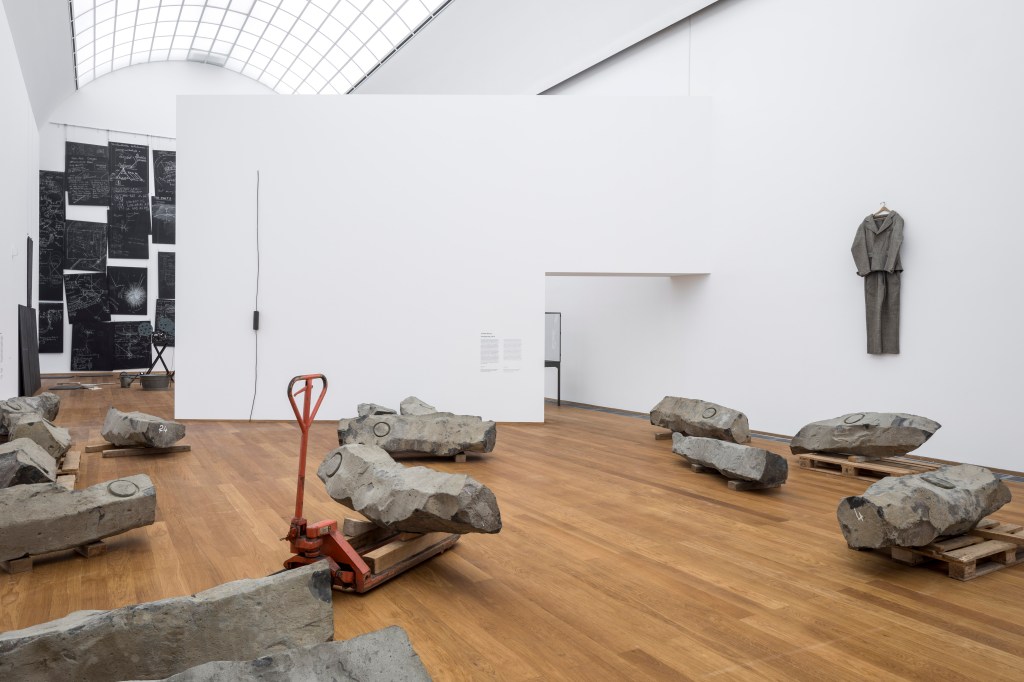
Edvard Munch: Trembling Earth 

The Museum Barberini in Potsdam is currently showcasing the exhibition:

Edvard Munch: Trembling Earth

The exhibition is scheduled to run until April 1st, 2024.

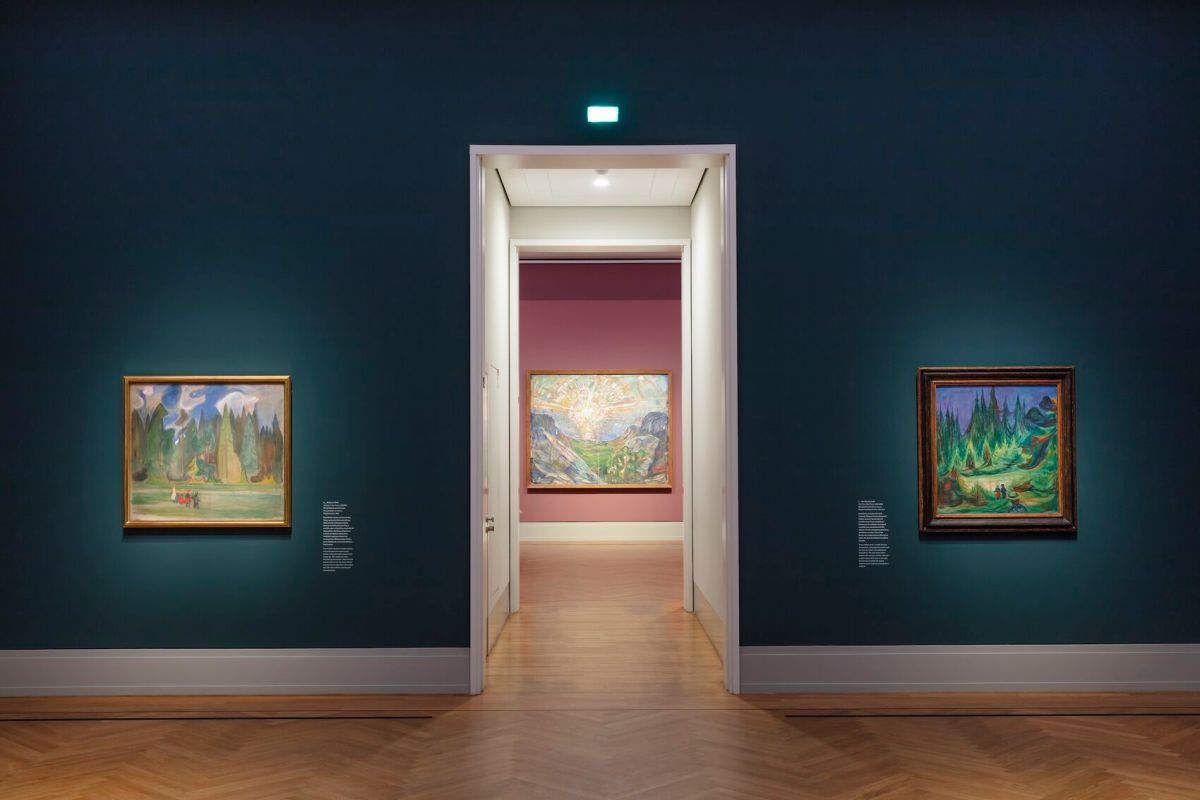
View of the exhibition
Edvard Munch: Trembling Earth
© David von Becker

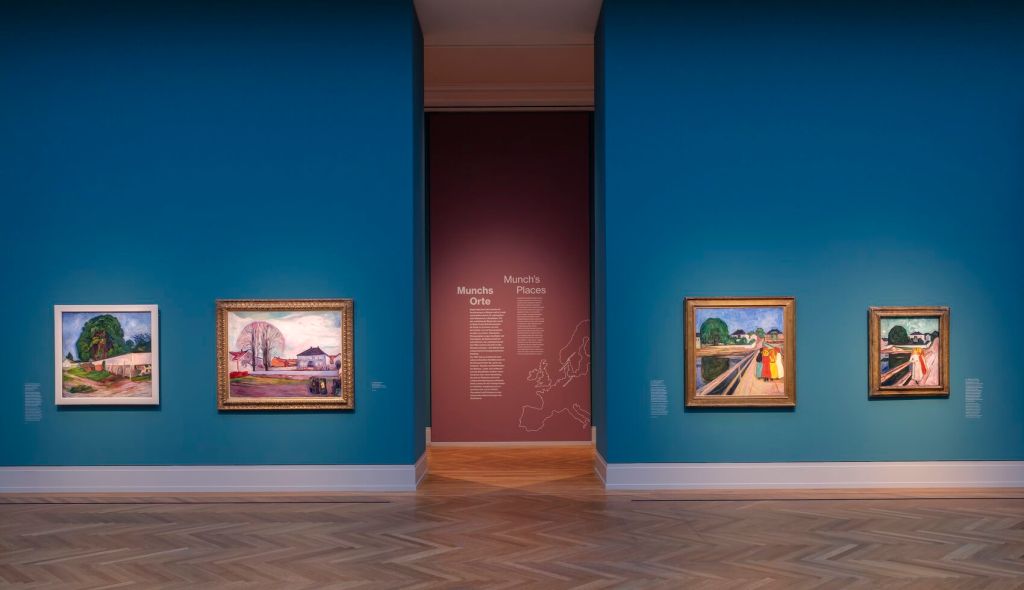
On November 18, the exhibition Edvard Munch: Trembling Earth was opened at the Museum Barberini. Organized in cooperation with the Clark Art Institute in Williamstown, USA, and the MUNCH in Oslo, the exhibition is the first to focus on Edvard Munch’s fascination with nature. The show features over 110 works by the Norwegian artist, with some of his most famous motifs as well as unknown works. Also on view are the monumental preliminary studies for Munch’s paintings for the Aula at the University of Oslo, which have not been exhibited in Germany for over a century. Lenders include the MUNCH in Oslo, the Museum of Modern Art in New York, the Dallas Museum of Art in Texas, the Musée d’Orsay in Paris, the Museum Folkwang in Essen, the Kupferstichkabinett of the Staatliche Museen zu Berlin, and the Von der Heydt Museum in Wuppertal. The exhibition in Potsdam is curated by guest curator Jill Lloyd, an expert on modern European art. 

The first exhibition of Edvard Munch’s landscapes 

Edvard Munch is known for his haunting images of primal human emotion. His interest in the psychological dimensions of existence, however, was matched by an equally strong fascination with nature. Employing his unique sensibility and power of imagination, Munch explored motifs taken from nature, seeking to fathom humanity’s place in the cosmic cycle of life. The image of the landscape in Munch’s work, however, has received little systematic attention up to this point. Now for the first time, the exhibition Edvard Munch: Trembling Earth and the accompanying catalogue investigate the meaning of such images in Munch’s oeuvre, questioning common assumptions and examining the contemporaneous artistic, scientific, and philosophical influences that contributed to his understanding of nature. With motifs ranging from undulating coastlines and fairy-tale forests to snow-covered or stormy landscapes, luxuriant gardens, and the exuberant play of sun, air, and water, Munch’s work also resonates with the present-day climate crisis against the backdrop of current natural catastrophes. 

“Although Edvard Munch devoted almost half of his works to motifs from nature, until now he has not been perceived as a landscape painter. With Edvard Munch: Trembling Earth, our desire is to open up this perspective on his work,” says Ortrud Westheider, director of the Museum Barberini. “Especially in conjunction with the Impressionist landscapes in the Hasso Plattner Collection, it is fascinating to see how Munch, a Norwegian contemporary of the Impressionists, connected landscape with the inner life and how such different perspectives on nature could develop at the same time in Europe. While the goal of the Impressionists was to recreate the sensory experience of nature through light and color, for Munch nature was always also a mirror of his own inner turmoil, giving his landscape images a greater sense of drama. We are especially fortunate that the exhibition Edvard Munch: Magic of the North at the Berlinische Galerie overlaps with our Munch show for eight weeks. The public thus has the opportunity to experience the dimensions of the oeuvre of one of the most important artists of the modern era in all its facets in both Berlin and Potsdam. With the preliminary works for the Aula paintings, which were exhibited at the Berlin Secession in 1913 and were enthusiastically received by audiences in Berlin, we also have a direct thematic connection to the exhibition of our Berlin colleagues.” 

116 paintings, woodcuts, lithographs, and drawings from twenty-one lenders in eight exhibition chapters 

View of the exhibition
Edvard Munch: Trembling Earth
© David von Becker

From June 10 to October 15, 2023, the exhibition was on view at its first station, the Clark Art Institute in Williamstown, Massachusetts. Curated by Jay A. Clark, it received outstanding reviews: “A revelatory exhibit” (The Wall Street Journal); “Magnificent . . . Munch the landscapist coexists with the connoisseur of affliction” (Financial Times); “Glorious . . . It’s a revelation” (The Atlantic); “a major modern painter in a new, broader, enlivening light” (The New York Times). The Potsdam exhibition, curated by guest curator Jill Lloyd, features 116 works in eight exhibition chapters. In late April 2024, the show will travel to its third station, the MUNCH in Oslo, where it will be curated by Trine Otte Bak Nielsen. 

The chapters of the exhibition engage with a variety of natural spaces to explore the active role played by the landscape in the art of Edvard Munch. While the chapter In the Forest exemplifies Munch’s sense of nature as a mysterious realm and a place of romantic growth and decay, the chapter Garden and Field reveals his fascination with the interaction between humanity and nature. In Between Land and Sea, coastal landscapes serve as a backdrop for separation, attraction, and solitude, while the beaches of Åsgårdstrand, Warnemünde, Hvitsten, and Ekely—locations where Munch lived and worked for many years—symbolize a Summer Retreat. The chapter The Scream of Nature addresses existential questions of the relationship between man and nature: here, a lithograph of what is probably Munch’s most famous work, The Scream, is juxtaposed with the explosive color of his monumental painting The Sun. The chapter Storm and Snow explores the degree to which early twentieth-century climate fears, marked by anxiety over the dawn of a new ice age, are reflected in Munch’s landscapes. In a Cosmic Cycle shows how Munch assimilated new scientific discoveries that revealed nature as a dynamic force, visualizing it as vital and ever-changing and interweaving it with the human body and fate. The exhibition concludes with the chapter Light and Knowledge, featuring the designs for Munch’s monumental Aula paintings. For the presentation of these works, some of which are six meters long, the Museum Barberini has installed a special “room within a room,” facilitating a presentation similar to the hanging of the works in the Aula at the University of Oslo. 

Tone Hansen, director of the MUNCH, states: “In 1940, Edvard Munch bequeathed the entirety of his oeuvre still in his possession to the city of Oslo. This legacy, now housed in the MUNCH, includes not only texts, letters, photographs, and personal items, but over 26,000 works of art—an extraordinary oeuvre that we can now also spatially accommodate since the opening of the new museum building in 2021. Our primary aim is not only to conserve the collection, but also to investigate and interrogate it again and again, and for us, too, it made sense to focus on his landscape images for the first time. The tremendous interest in the three exhibition stations in the United States, Germany, and Norway demonstrates that even 160 years after Munch’s birth, his work continues to be relevant.” 

The works in the exhibition come from twenty-one lenders, including the MUNCH and the Nasjonalmuseet for kunst, arkitektur og design in Oslo, the Museum of Modern Art in New York, the Dallas Museum of Art in Texas, the Musée d’Orsay in Paris, the Finnish National Gallery in Helsinki, the Kupferstichkabinett of the Staatliche Museen zu Berlin, the Museum Folkwang in Essen, the Staatsgalerie Stuttgart, and the Von der Heydt-Museum in Wuppertal. 

The exhibition is accompanied by a 228-page English catalogue published by MUNCH, Oslo, with essays by Jay A. Clark, Nanna Leander, Jill Lloyd, Trine Otte Bak Nielsen, and Arne Johan Vetlesen. 

For the duration of the exhibition, the Museum Barberini will extend its opening hours: beginning November 18, the museum will open at 9:00 a.m., Wednesday through Sunday. On Mondays, the museum open at 10:00 a.m. as usual. 

Concurrent with the show in Potsdam, a second exhibition on Munch and Berlin, Edvard Munch: Magic of the North, is on view at the Berlinische Galerie until January 22, 2024. A combination ticket for admission to both exhibitions is available from the museums for € 20 (reduced admission € 12). 

Both exhibitions are under the joint patronage of Federal President Frank-Walter Steinmeier and His Majesty King Harald V of Norway. 

An exhibition of the Museum Barberini, Potsdam, the Clark Art Institute, Williamstown, Massachusetts, and the Munchmuseet, Oslo. In Williamstown, the exhibition was curated by Jay A. Clark and was on view June 10–October 15, 2023. The MUNCH in Oslo will present the exhibition April 27–August 25, 2024, curated by Trine Otte Bak Nielsen. 

Structure of the Exhibition 

In the Forest: Myths and Fairy Tales 

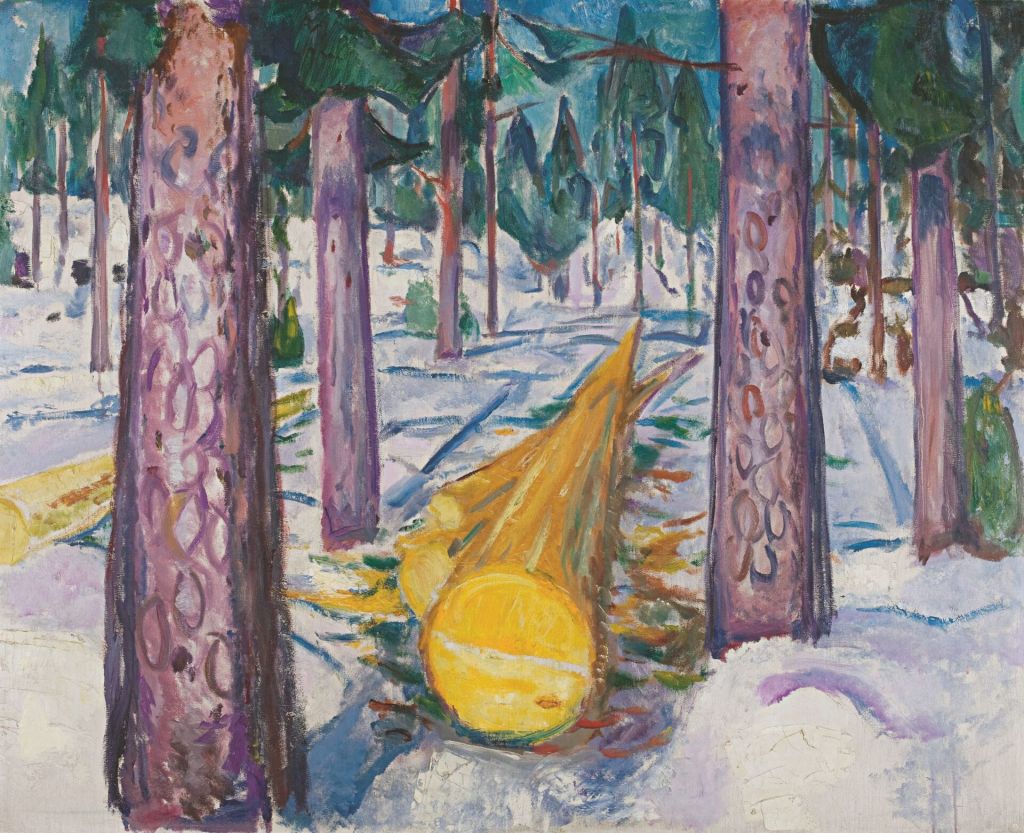
Munch’s depictions of trees and forests include romantic encounters between couples, children wandering into dense woods, and scenes of Norway’s logging industry. His images of lush Norwegian elm and pine forests capture their beauty throughout the varying seasons. Timber was among Norway’s largest exports in the early twentieth century, and while many of these paintings celebrate nature’s bounty, they also document the depletion of the country’s national resources. Throughout his life, both at home and abroad, Munch portrayed trees and forests as representations of mystery. Inspired by the forests near Åsgårdstrand, Norway, the elm trees near his home at Ekely, outside of Oslo, and the Thuringian Forest in Germany, Munch celebrated the cycle of life in paintings and prints. 

Edvard Munch, The Yellow Log, 1912. © Munchmuseet, Oslo

Gardens and Fields: Cultivated Landscapes 

Munch’s paintings of cultivated landscapes—land cleared of vegetation and then planted with crops, orchards, or gardens—reflect his keen interest in human interaction with nature. These motifs were inspired by the fertile coastal peninsula around the Oslo Fjord where he owned several properties. Reflecting a horticultural boom in Norway, Munch created flower and kitchen gardens at his various homes; he planted fruit trees, maintained orchards, and kept animals such as hens, doves, and horses. The artist regarded his gardens and fields as places of refuge overflowing with life. They can also be understood as liminal zones between nature and civilization and as symbols of fertility and rejuvenation. During a time when Norwegian agriculture was undergoing modernization and mechanization, Munch depicted traditional small-scale farming practices, celebrating the farmer’s way of life in opposition to industrialization and encroaching urbanization. 

View of the exhibition
Edvard Munch: Trembling Earth
© David von Becker
Edvard Munch, Young Girls on a Bridge, 1902. Private collection.

Between Land and Sea: Spaces of Melancholy 

The shoreline was an important motif for Munch, living as he did on or near the coast of the Oslo Fjord for most of his adult life. Munch depicted a characteristically curving shoreline in his paintings, drawings, and prints from the 1890s through the 1930s. It became a recurring theme in his work, one he identified with the “perpetually shifting lines of life.” In some depictions, the shoreline itself, on a moonlit evening, is the subject; in others it is a backdrop for human emotion. The shoreline features most prominently in Munch’s works depicting themes of melancholy, human isolation, and physical separation. As the Norwegian writer Sigbjørn Obstfelder (1866–1900) remarked in 1896: “He sees in wavelengths; he sees the shoreline weave next to the ocean. . . . he sees women’s hair and women’s bodies in waves.” By setting his depictions of separation, attraction, and loneliness against the undulating shoreline of the Oslofjord the shore became an active agent in his depictions of nature. 

Edvard Munch, Summer Night by the Beach, 1902/03. Private collection.

Summer Retreat: Back to the Coast 

From 1889 onwards Munch’s family often rented a house in Åsgårdstrand for the summer. The rocky, curving shoreline became a frequent motif for the artist’s work. In 1907 to 1908, Munch spent a period in Warnemünde, on the northern coast of Germany, where he sought water cures and rest before being hospitalized for alcoholism and a nervous breakdown. In Warnemünde, Munch became acquainted with the Lebensreform movement and its belief in the beneficial effects of sunbathing and exercise in the fresh sea air. 

He focused on outdoor bathing scenes. Returning to Norway in 1910, Munch bought a summer house on the Oslo Fjord in Hvitsten, where he continued to create bathing scenes and built outdoor studios for his monumental works. His color palette brightened, and his contemporaries began to perceive the artist as happier and in tune with nature. 

The Scream of Nature: Humankind and Environment 

In the lithographs Anxiety and The Scream, Munch evokes an atmosphere of anxiety that is in stark contrast to his quiet scenes of country life. The people in these images confront the viewer directly, and nature is in a state of turmoil. The Sun, on the other hand, conveys positive, vital energy. Despite the differences between the images, The Scream and The Sun can be seen as pendants. Munch repeatedly depicted the sun. In the cycle that he created for the ceremonial hall of the University of Oslo it serves as a symbol of knowledge. Both The Scream and The Sun show the existential influence of nature on humans. While The Scream raises questions about humankind’s interaction with nature, the composition of The Sun, which is devoid of people, concentrates on the star as an elemental force, a provider of energy, and the foundation of all life on earth. The Scream and The Sun communicate the unity of humans and nature. The cycle that Munch designed for the Aula of the University of Oslo is displayed on the ground level in Wing B. 

Edvard Munch. The Sun, 1910–1913. © Munchmuseet, Oslo.

Storm and Snow: Nature in a State of Turmoil 

Munch’s fascination with metamorphosis, together with his faith in nature’s cyclical renewal, led him to depict each changing season. His paintings of snowy landscapes celebrate the mystery and wonder of Norway’s long, dark winters. The large-scale evening scenes painted in hues of white and blue feature starry night skies and sturdy pine trees that have survived the winter cold. His snowcapped forests, townscapes, and moonlit winter skies convey a sense of quiet awe. Munch also depicted extreme weather events such as storms during the warmer months, allowing him to explore tumultuous conditions such as windblown trees and clouds scurrying across the sky. For all his awareness of humankind’s imprint on nature and interconnectedness with the universe, Munch’s paintings of snow, storm, and ice present nature as a force that is ultimately beyond human control. 

Edvard Munch, Stormy Landscape, 1902/03. Private collection.

In a Cosmic Cycle: Art and Philosophy 

Edvard Munch’s artistic practice was impacted by his overlapping interests in philosophy, religion, and the natural sciences. Raised in a staunchly Christian household, Munch’s religious views in adulthood were shaped by scientific theories such as Charles Darwin’s evolution and Ernst Haeckel’s Monism, a philosophical belief that all existence—both organic and inorganic—is unified. The position of humans as part of a cosmic cycle is a recurrent theme in his art. 

Light and Knowledge:

Monumental Paintings for the University of Oslo 

Munch represents scientific disciplines such as chemistry, physics, and botany as explorations of a world permeated by light and energy. The overarching theme of his designs for the monumental works of the ceremonial hall known as the Aula at the University of Oslo is enlightenment. The Sun, which casts its prismatic rays across the landscape, is the central motif. It is both a symbol of enlightenment and a vitalistic celebration of nature’s inherent life force. The decorative project of the Aula was the first major art commission in Norway after the country achieved independence from Sweden in 1905. Munch’s concept for the series included romantic and national ideas of vitalism and renewal. History and Alma Mater show old Norwegian peasants who pass on their knowledge to the young. Past, present, and future are thus united, while humankind fuses with the transformative forces of nature in a radiant universe.


View of the exhibition
Edvard Munch: Trembling Earth [Edvard Munch’s The Scream, 1893]
© David von Becker

Edvard Munch: Trembling Earth

Curator:

Jill Lloyd, Guest curator Museum Barberini

Exhibition design:

Gunther Maria Kolck, Hamburg, and BrücknerAping, Bremen

Exhibition:

November 18, 2023 – April 1, 2024

Museum Barberini, Alter Markt, Humboldtstraße 5–6, 14467 Potsdam

21 Lending Institutions:

Staatliche Museen zu Berlin

Kupferstichkabinett Dallas Museum of Art, Texas
Museum Folkwang, Essen
Kimbell Art Museum, Fort Worth, Texas
Finnish National Gallery, Ateneum Art Museum, Antell Collections
Kunsthalle Mannheim
Museum of Modern Art, New York
Canica Art Collection, Oslo
Christen Sveaas Art Collection, Oslo
Munchmuseet, Oslo
Nasjonalmuseet for kunst, arkitektur og design, Oslo Frank Mosvold
Musée d’Orsay, Paris
Staatsgalerie Stuttgart
Von der Heydt-Museum, Wuppertal
and private collectors who wish to remain anonymo

“The creative boldly approaches the unknown.” Willi Baumeister and his network

“The creative boldly approaches the unknown.” Willi Baumeister and his network


12 November 2023 – 4 February 2024
Museum Gunzenhauser

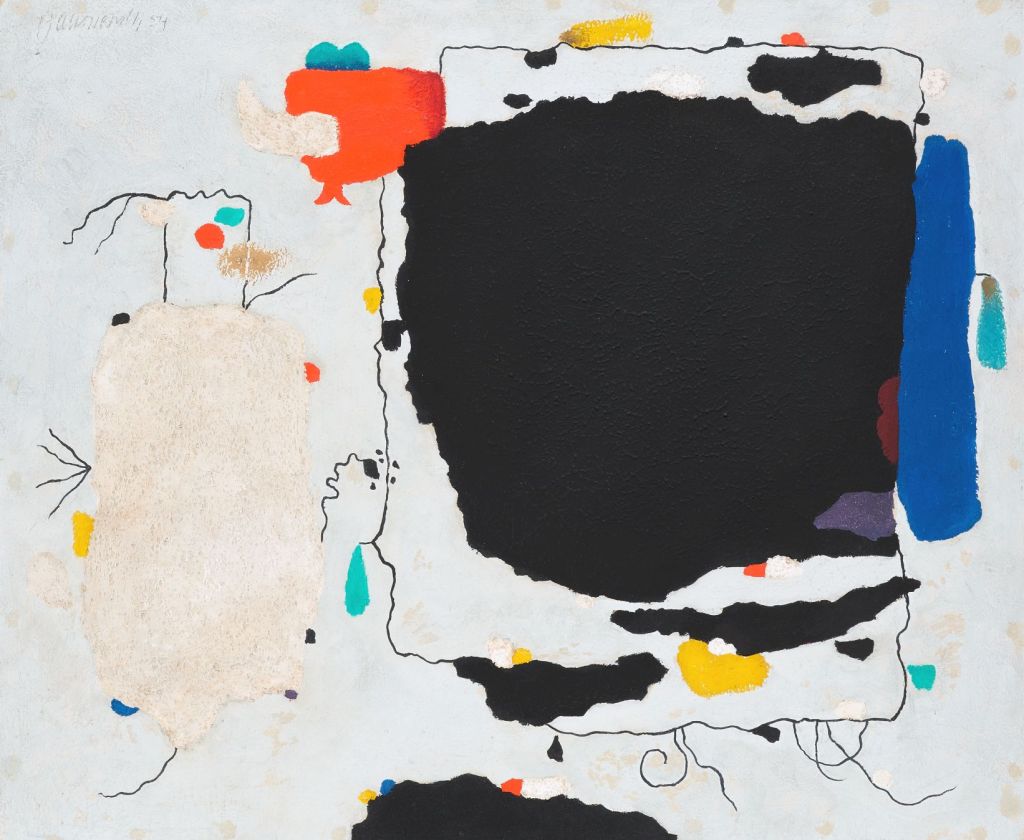
Willi Baumeister, Taru-Turi, 1954. Oil with synthetic resin and sand on hardboard 54 x 65 cm
Kunstsammlungen Chemnitz – Museum Gunzenhauser
Property of the Gunzenhauser Foundation
© VG Bild-Kunst, Bonn 2023

The exhibition reflects the entire spectrum of Willi Baumeister’s (1889-1955) artistic oeuvre. Baumeister was an exceptional artist in many respects. His artistic path was characterised by constant change and renewal. One of his specialities was his ability to use a wide variety of media for his purposes at a time when a strict, classical separation of artistic genres still prevailed.

Hannelore Paflik-Huber and Hans Dieter Huber (curators of the exhibition): “Baumeister—this visionary of abstraction—is worth to be rediscovered. We are showing him as a masterful networker of his time.”

From today’s perspective, Willi Baumeister can be characterised as a “social hub.” He was an excellent networker throughout his life, establishing important international contacts very early on in his artistic career, which he was largely able to maintain during the Second World War. His circle of friends included Hans Arp, Hanna Bekker, Max Bill, Robert Delaunay, Sonja Delaunay-Terk, Karl Otto Götz, Camille Graeser, Alexej von Jawlensky, Wassily Kandinsky, Paul Klee and Oskar Kokoschka. But his extensive contacts in architecture (such as Le Corbusier, Alfred Roth and Richard Döcker) and in the world of commercial art (Ella Bergmann-Michel, Robert Michel, Kurt Schwitters and others) also proved to be extremely fruitful for the wide-ranging development of an essentially intermedial oeuvre that was not limited to painting.

Willi Baumeister, Bild mit Muschelform, 1932. Oil and sand on canvas, 80,5 x 64,5 cm Kunstsammlungen Chemnitz – Museum Gunzenhauser Property of the Gunzenhauser Foundation
© VG Bild-Kunst, Bonn 2023. Photo: Kunstsammlungen Chemnitz/PUNCTUM/Bertram Kober

Together with the Domnick Collection in Nürtingen the Museum Gunzenhauser in Chemnitz owns the third largest public collection of Willi Baumeister paintings in Germany after the Staatsgalerie Stuttgart. Today, the collection comprises 39 works from the artist’s various stylistic phases. This collection, which has never been shown in its entirety before, offers an ideal starting point for a large-scale Willi Baumeister exhibition dedicated to this exceptional artist and all of his work phases and media, his art theory and artistic attitudes. The show has a particular focus on the visualisation of works from artists’ estates that have rarely been shown to date. The exhibits are supplemented by items on loan from other museums.

Furthermore, a wide-ranging selection of films, letters, postcards and photographs sheds light on the artist as a cultural-political cosmopolitan, advocate of abstract art and exceptional university teacher. Supplementary documents and artworks by third parties illustrate the high esteem in which he was held.

Next to works by Willi Baumeister, the following artists are presented in the exhibition: Max Ackermann, Gerhard Altenbourg, Hans Arp, Hanna Bekker, Ella Bergmann-Michel, Karl Bohrmann, Peter Brüning, Carlfriedrich Claus, Le Corbusier, Lily Hildebrandt, Adolf Hölzel, Marta Hoeppfner, Johannes Itten, Alexej von Jawlensky, Wassily Kandinsky, Ida Kerkovius, Franz Krause, Fernand Léger, Charlotte Mayer-Posenenske, Kasimir Malevich, László Moholy-Nagy, Otto Meyer-Amden, Robert Michel, Gonn Mosny, Margarete Oehm-Baumeister, Amédée Ozenfant, Oskar Schlemmer, Kurt Schwitters, Hermann Stenner, Ludwig Wilding.

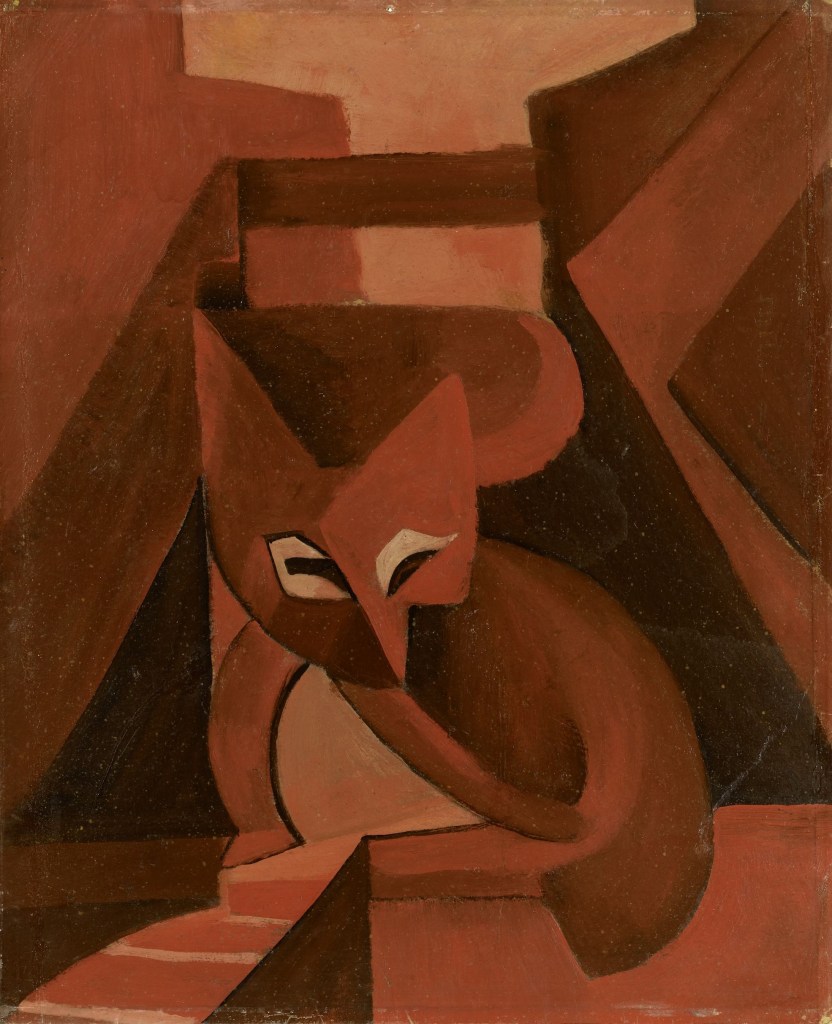
Hanna Bekker, Roter Fuchs, um 1920. Oil on cardboard, 29,5 x 24,5 cm
Estate Hanna Bekker/Archive Hanna Bekker vom Rath, Frankfurt/Main
Photo: Fotostudio Herbert Fischer Frankfurt
Wassily Kandinsky, Rot im Quadrat, 1931
Watercolour, pen and ink on paper,34 x 33,9 cm. Private collection
Photo: Archiv Baumeister im Kunstmuseum Stuttgart

The exhibition was curated by:

Hannelore Paflik-Huberand Hans Dieter Huber

Press and public relations by Carolin Nitsche
T +49 (0)371 488 4474 carolin.nitsche@stadt-chemnitz.de

Provisional Directorate General:
Julia Hoppen-Magerle und Anja Richter

Museum Gunzenhauser Anja Richter

Stollberger Straße 2, 09112 Chemnitz T +49 (0)371 488 7024 gunzenhauser@stadt-chemnitz.de | kunstsammlungen-chemnitz.de

Guided tours info.kunstsammlungen@stadt-chemnitz.de

The exhibition is funded by:

Annual Exhibition of the Painting and Graphic Section of ULUPUDS

The Museum of the City of Belgrade, Princess Ljubica’s Residence, 8 Kneza Sime Markovića Street in Belgrade, and The Association of Artists in Fine Arts, Applied Arts and Designers of Serbia (ULUPUDS) is pleased to present: 

Annual Exhibition of the Painting and Graphic Section of ULUPUDS

7th – 20th November, 2023

The Association of Artists in Fine Arts, Applied Arts and Designers of Serbia organizes the Annual Exhibition of painting and graphic arts, which, through the presentation of artistic concepts and their elaborations in diverse media, techniques and formats, aims to provide insight into ways of thinking about the very concept of artistic presentation.

The Annual Exhibition, showcasing the individual artistic creativity within the framework of contemporary aesthetic, anthropological, cultural, political, economic, feminist, historical and sociological dimensions, aim to examine the expressive capacities of contemporary Serbian artists dealing with technologically and materially complex ideas.

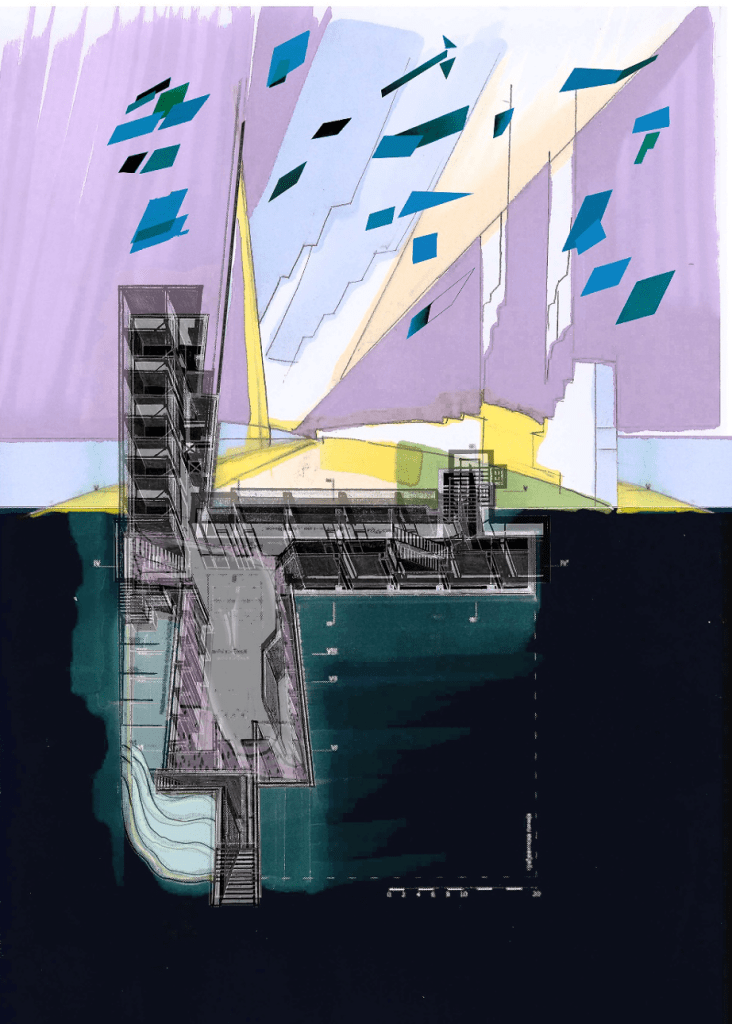
One of the featured works is Katarina Andjelkovic’s digital graphics, The Levitation Scene, which is a part of the decade-long drawing project called War [Un]Story

Katarina Andjelkovic, The Levitation Scene (from The Sequence of explosion of architectural orders: patterning of relations). Digital graphics, 76 x 55 cm, 2021.

Katarina Andjelkovic’s digital graphics The Levitation Scene has championed a decade-long drawing project War [Un]Story. The author of this collection has offered an aesthetic reflection on the aftermath of war by appropriating the concept of architecture as a visual resource to (un)tell the apocalyptic scenario of NATO-sanctioned bombings of the former Federal Republic of Yugoslavia. A series of digital graphics deal with an aesthetic reflection on political bodies and conditions, asking how they have re-territorialised the material reality of the Serbian Military Headquarters in Belgrade (Generalštab building, architect Nikola Dobrović, built between 1956 and 1965) as a cultural artifact into the performativity of its political function. The project is seen as an opportunity to rethink political power through the analytics of physical sciences. It is revealed as a type of image which, instead of reproducing architectural reality, rather produces new perceptions of the event through the power of the energy and forces war unleashes. To animate the viewing encounter, the author chose to transcribe the energetic event of explosion into visual forms. Material decay of the building granted access to the immateriality of perceptual fields and delineated a multi-layered untold story in a fusion of energy (the fundamental concept in physics), power (the fundamental concept in social science) and transformation. The resulting choreographic notations can be registered and apprehended through the universe of image representation that negotiates physical boundaries by energy and forces. In Boccioni’s early twentieth-century references to the ‘electric theory of matter’, according to which matter is only energy, the exhibition shifts away from representational images to a more abstracted non-representational forms, the fragments of broken structure that are represented in a flow, bearing a striking resemblance to electrons in their ‘bareness’ or lack of materiality.

About Katarina Andjelkovic

Katarina Andjelkovic, with a Ph.D., M.Arch.Eng., M. Applied Arts, is a theorist, practicing architect, researcher and painter. She is a high-skilled draftsman, writer and researcher. Andjelkovic is simultaneously engaged in architectural practice, teaching, and research. Katarina’s research, writing and teaching, focus on how ideas can be translated across different media, crossing architecture, visual arts and film. In Spring semester 2021, Katarina is the main instructor of the HAND-DRAWING COURSE: THE FACE[S] OF ARCHITECTURE at SMT New York in New York City. She served as a Visiting Professor, Chair of Creative Architecture, at the University of Oklahoma U.S.A., Visiting Lecturer at Coburg University of Applied Sciences – Faculty of Design (Department of Architecture) in Germany, Institute of Form Theory and History in Oslo, Institute of Urbanism and Landscape in Oslo, Norway, at The University of Belgrade – Faculty of Architecture. Katarina is guest-lecturing and mentoring at Master Studies of TU Delft – Faculty of architecture and the built environment, Doctoral studies of AHO – Oslo School of architecture and design, FAUP Porto, DIA Anhalt Dessau, SMT New York, and Bachelor studies of ITU – Istanbul Technical University. She lectures internationally at conferences in film, photography and architecture, urban space and visual representation, exploring architecture with image technologies: from film to VR and AR, modern aesthetics of architecture, film-philosophy, drawing research, teaching-research frameworks, artistic research, and visual culture in more than 35 countries in Europe, United Kingdom, North America, Canada, Australia, China, and South America. Katarina has published her research widely in international journals (Web of Science). She is a full author of the Preliminary Architectural Design, a national project supported by the government of Serbia. She won the Belgrade Chamber of Commerce Award for Best Master Thesis defended at Universities in Serbia in all disciplines. Katarina has published two monographs; an upcoming book chapter and several journal articles with Intellect United Kingdom, University of Chicago Press (U.S.), Routledge, Taylor and Francis Group (London, United Kingdom), Büchner-Verlag eG, Marburg/Germany, etc. During her Ph.D., Andjelkovic’s research stays were all at European universities in Copenhagen, Ljubljana, Porto, Dundee U.K., Brighton U.K., Dublin, Madrid, etc. Andjelkovic exhibited her artwork at 7 Solo Exhibitions and at more than 70 international architectural, fine arts, and photography exhibitions, including group exhibitions at Pall Mall Gallery in London, Royal Hibernian Academy in Dublin, MAAT Museum in Lisbon, International Biennial of Illustration ”Golden Pen” in Belgrade, Loughborough University in the United Kingdom, TU Delft in the Netherlands, the Museum of Applied Arts in Belgrade, the National Museum in Belgrade, Prodajna Galerija “Beograd” (Kosancicev venac, Belgrade), Gallery Singidunum in Belgrade, Stepenište in Art Education Center ”Šumatovačka”, Gallery of the Central Military Club, Suluj Gallery, Pavillion Cvijeta Zuzoric of the Association of Fine Artists of Serbia, and Mala Gallery of the Association of Fine Artists of Applied Arts and Designers of Serbia. Katarina is a recipient of EDRA’S 2022 AMBASSADOR FUND AWARDS [California, U.S., Awarded in South Carolina], THE ULUS 2021 Spring Exhibition Award “INVISIBLE PORTRAIT” [awarded by Association of Fine Artists of Serbia], and won numerous awards for her architecture design and urban design competitions.

About The Museum of the City of Belgrade, Princess Ljubica’s Residence

The Museum of the City of Belgrade, Princess Ljubica’s Residence, 8 Kneza Sime Markovića Street in Belgrade, is one of the few preserved buildings from the time of the first reign of Prince Miloš Obrenović. Princess Ljubica’s residence was built in 1830. After restoration and reconstruction, the building became part of the Museum of the City of Belgrade in 1980, and in September of the same year, the permanent museum exhibition “Interiors of Belgrade houses of the 19th century” was opened. The display consists of a representative selection of fine and applied art objects from the collections of the Museum of the City of Belgrade. The objects were created during the 19th century as a product of Western European and domestic craft-art and industrial production. Today, the lower level of the building regularly hosts art exhibitions.

Exhibition opening: Tuesday, November 7th, 2023, at 19h.

Visits: Tue, Wed, Thurs, Saturday: 11-17h, Friday 10-18h, Sunday: 10-14h, Monday: closed.

Access: from the ground floor, catalogue (print) available during the event.

Address: Princess Ljubica’s Residence, 8 Kneza Sime Markovića Street in Belgrade, Serbia.

The 100gallery — A Platform for Democratic Art

Google

The 100gallery — A Platform for Democratic Art

Debbie Does Dallas

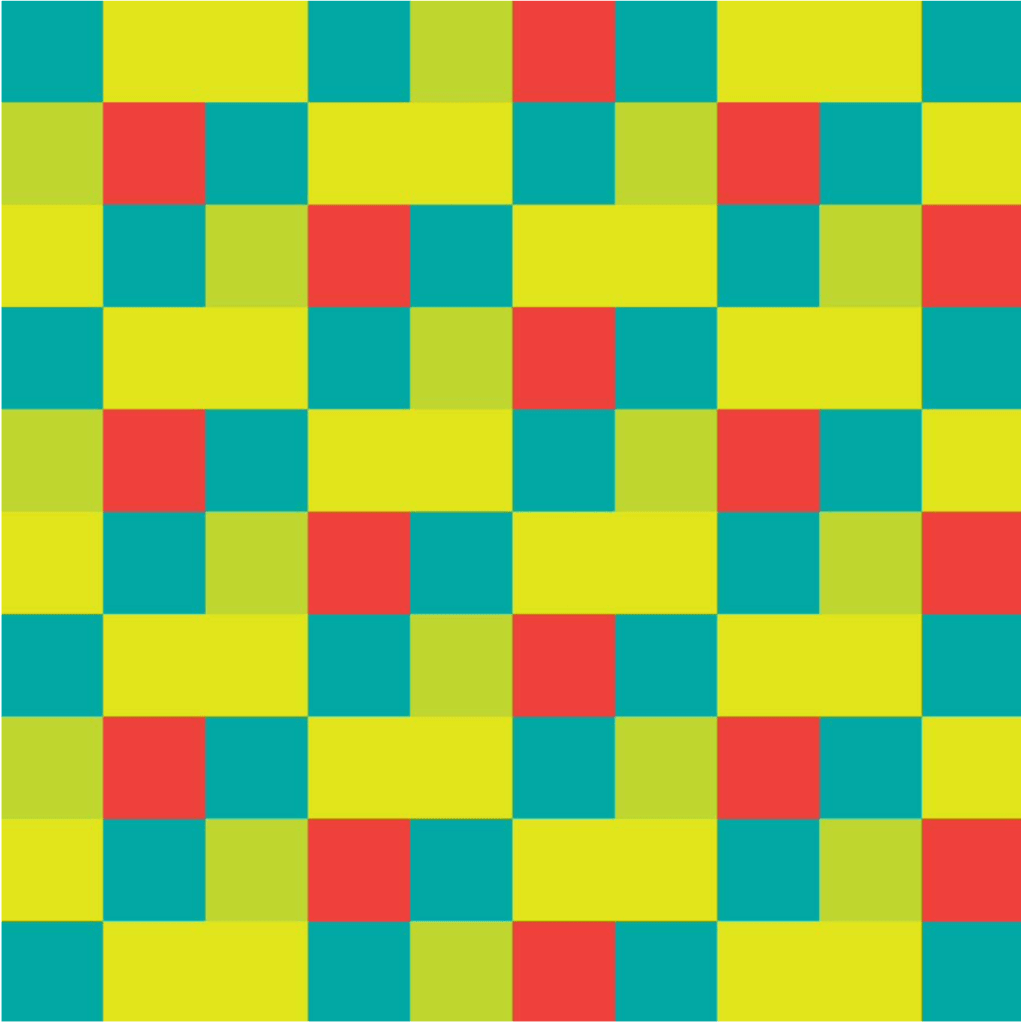
The 100.gallery project invites everyone to create and own a unique artwork. Words, sentences, numbers and characters are transformed into abstract images in a 10 x 10 colour-coded grid. When added to the gallery, two versions of each artwork are produced — a file for web and a vector file for print.

The grid allows for many trillions1 of artwork variations, which means that the 100.gallery has the potential to become one of the largest collection of artworks ever produced.

Our future intention is to showcase a selection of artworks in physical form within galleries around the world.

Visit 100.gallery to create your own.

The first 100 artworks from the project will be available to buy as NFTs on OpenSea.

  1. more variations than there are stars in the solar system – apparently.

The Fleece is an art collective formed in 2022.

We aspire to create and produce ‘abstract ideas’ through the medium of digital, film, music, publications, events, installations and other randomness.

100gallery is a project from The Fleece

For more information please contact: curator@thefleece.art

 Love

 Respect

100.gallery is a project from The Fleece

 For more information please contact: curator@thefleece.art

Arcual Showcases the New Digital Dossier Feature at Art Basel with Commissioned Sculptural Artwork

Arcual is delighted to announce its collaboration with Art Basel and Zurich Art Weekend in 2023, bringing together art and collectors through innovative initiatives and engaging activities. At Art Basel in Basel (12-18 June 2023), Arcual will have a booth in the Collector’s Lounge with unique artwork commissioned by artist Phoebe Cummings. Furthermore, Arcual will otherwise participate in several events and panels with leading voices from the art world, discussing collecting and power dynamics and celebrating art and culture at Zurich Art Weekend.

Phoebe Cummings, Detail from ‘Flora’ (clay), 2020. @ Art Basel, Basel.

Arcual will unveil its latest feature, which opens up new possibilities for artists, galleries, and collectors to connect with an artwork throughout its lifecycle. The Digital Dossier feature will be launched ahead of Arcual’s participation in Zurich Art Weekend and Art Basel in Basel, continuing its commitment to placing artists at the centre of the art ecosystem. This new feature will be brought to life through the commission of a unique sculptural artwork by British artist Phoebe Cummings, for their booth in the Collectors Lounge of Art Basel. 

Arcual’s Digital Dossier can contain the digital Certificate of Authenticity (CoA), Resale Terms, as well as other supporting documentation relating to an artwork, such as sketches, designs, and photographs showing the artist’s creative process, shipping and installation guidelines, condition reports, exhibition certificates, and more. The Digital Dossier furthers understanding of the artist and the artwork, simultaneously enhancing its value and authenticity for collectors, both now and in the future. Collectors will be able to utilise this feature to keep all of the documentation relating to the artwork in one secure space. 

Says Bernadine Bröcker Wieder: “Art is all about storytelling. Arcual’s new Digital Dossier feature strengthens the connection between an artist and their artwork by enabling them to attach documents and images to enhance its story. These may include sketches, designs, even a photograph in the studio showing their creative process. These attachments follow the artwork on its journey from one owner to the next. Further attachable documentation can outline how artists would like for their work to be exhibited, stored, and moved. We have seen a real desire from collectors for deeper engagement with the artworks they purchase, from the very beginning of the process. This new functionality fundamentally enhances the experience of owning and authentifying of an artwork, adding value for the future in a way that’s easy to access and secure.”

Arcual at Art Basel

An official partner for Art Basel in Basel, Arcual will showcase a unique, large-scale sculptural artwork by the artist Phoebe Cummings, commissioned for its booth in the Collectors Lounge, which will be on display throughout the fair. Cummings is known for her ephemeral sculptures that reflect on nature’s beauty and life cycle, created from raw, unfired clay. She will complete the sculpture on site, enabling visitors to experience first-hand the artist’s creative process.  Surrounded by mirrors and brought to life through immersive lighting, the artwork will bring an engaging, interactive element to the space and highlight the connectedness between an artist, collector, and the artwork. 

The work, which was consigned and purchased through Arcual’s blockchain, will have a sustainable life cycle. It will demonstrate the potential of the Digital Dossier, which Cummings will utilise for the first time.

Arcual © Art Basel, Basel, Gloria Soverini

Phoebe Cummings, artist says: “I am increasingly interested in how we collect the ephemeral, and how collections can encompass different forms of artistic practice that may not result in a permanent object.  I have expanded the way I record each work, moving beyond photography and film as the primary method, to include writing as well as other sensory information such as humidity, offering new possibilities in terms of how a work may be re-performed in the future. The Digital Dossier is an interesting feature which enables artists to amplify the storytelling around their artworks, to set out how it has come to be, and to outline how it might best be presented in the world.”

Phoebe Cummings, Detail from ‘Flora’ (clay), 2020. @ Art Basel, Basel.

Arcual will also participate in a variety of talks and events around the fair, with Arcual CEO Bernadine Brocker Wieder joining the Conversations series panel Blockchain, Ownership and Copyright, on Saturday 17th June, 3-4 pm CET. The panel will discuss blockchain as a decentralising and redistributive technology, exploring how works are authenticated, who the copyright belongs to and whether transactions really remain forever on the blockchain, as well as the potential of this rapidly developing field to empower artists, galleries and buyers in equal measure. Alongside Bernadine Bröcker Wieder, the panel will feature Amelie Ebbinghaus (Art Loss Register), Primavera di Filipi (artist and writer) and Sarah Friend (artist), with Brian Droitcour as moderator. The Conversations series is free to attend and open to the public, without a fair ticket and will also be broadcast online.  Arcual will also host Arcual Reflections, a series of intimate talks at their booth which will bring together artists, curators, collectors, and tech experts, which will be livestreamed. The details of these events will be released on the Arcual website, ahead of the fair. Arcual will also be working with several galleries at Art Basel, who will be consigning works for sale.

Maja Hoffmann, Founder of LUMA Foundation, says: “Arcual’s mission from the very start has been to offer pioneering technologies that give artists greater ownership, participation, and transparency in their careers, as well as to provide both institutions and galleries the tools to best nurture them. Arcual’s Digital Dossier feature empowers artists, enables a greater connection with their work and places them in the centre, which aligns with the central mission of the LUMA Foundation.” 

Arcual at Zurich Art Weekend 

Ahead of Art Basel, Arcual is an official partner for Zurich Art Weekend. Arcual hosted a panel discussion with speakers including leading auctioneer, art dealer, and collector, Simon de Pury, alongside art tech expert and advisor, Nina Roehrs, and artist Gretchen Andrew, moderated by Arcual CEO Bernadine Bröcker Wieder on 9th June: How Technology is impacting Power Dynamics in the Art World. The talk explored power structures between artists and galleries, trends and opportunities, how previously marginalised members of the art eco-system who are now being empowered by tech, and more.

For Media Enquiries please contact:

Arcual – Eleanor Taylor, eleanor.taylor@arcual.art

Sutton – Sophiebl@suttoncoms.com

Arcual

Arcual was built with the backing and expertise of the LUMA Foundation, MCH Group (the parent company of Art Basel) and BCG X and launched in 2022. Arcual offers a suite of digital tools and integrations to assist galleries in ensuring verified transactions, digital authenticity, royalty sharing, and secure international payments. Arcual’s first application ‘Salesroom’ offers smart contract terms for physical, primary market artworks, which are registered securely on the blockchain.

Arcual’s customisable, collaborative technology designs a new infrastructure to empower everyone – artists, galleries, collectors, and more – to grow their practices, inspire new opportunities, and solve long-standing challenges in the art eco-system.

Phoebe Cummings

Phoebe Cummings is an artist based in the UK, creating temporary sculptures and environments from raw clay.  The density of labour and skill invested in making sits in direct opposition to the brief existence of the work.  There is an inherent instability that simultaneously untethers clay from the fixed, enduring potential of ceramics.  The works change as they drip, dry, shrink and crack, and the clay is ultimately broken down and recycled, in different locations and periods of time, as an unending material performance. 

Cummings has undertaken numerous residencies in the UK, Greenland and U.S, including six months as Ceramics artist-in residence at the Victoria and Albert Museum, London (2010 and a fellowship at Camden Arts Centre 2012/13).  She continues to show internationally, with recent exhibitions including Lismore Castle Arts, Ireland, Thomas Dane Gallery, Naples and Galerist, Istanbul.  She was the winner of the British Ceramics Biennial 2011, and the BBC Woman’s Hour Craft Prize 2017.  She was awarded an Honorary Doctorate from the University of Brighton in 2019 and continues to work as a Researcher at the Ceramics Research Centre-UK, University of Westminster. 

Art Basel

Founded in 1970 by gallerists from Basel, Art Basel today stages the world’s premier art shows for Modern and Contemporary Art, sited in Basel, Miami Beach, Hong Kong, and Paris. Defined by its host city and region, each show is unique, which is reflected in its participating galleries, artworks presented, and the content of parallel programming produced in collaboration with local institutions for each edition. Art Basel’s engagement has expanded beyond art fairs through new digital platforms and a number of new initiatives such as the Art Basel and UBS Global Art Market Report and Intersections: The Art Basel Podcast. Art Basel’s Global Media Partner is The Financial Times. For further information, please visit artbasel.com.

Zurich Art Weekend

Zurich Art Weekend highlights the quality and diversity of the city’s art scene by offering unique insights into the curated program of highly qualitative and exceptional events organised in collaboration with the participating art venues. Free of charge, the events and initiatives of Zurich Art Weekend continue the pursuit of actively engaging with an audience interested in the arts on a national and international scale. At the core of the international art calendar, Zurich Art Weekend anticipates the preview days of Art Basel as per tradition.

Zurich Art Weekend nourishes and develops links between all entities and players which form its thriving ecosystem, opening it to the public to best serve the knowledge of artistic creation, alongside artists, curators, museum directors and collectors. With the institutions, galleries, offspaces, publishers collections, foundations and universities, the program in June emphasises the latest trends and experiential formats that distinguish the field. Zurich Art Weekend champions more democratic access to the arts, opening the city’s art scene to regional, national and international cultural exchanges.

The Neue Nationalgalerie Berlin won the European Architectural Heritage Intervention Award for its refurbishment

Neue Nationalgalerie
© Staatliche Museen zu Berlin.
Photo by David von Becker.

The Neue Nationalgalerie, designed by the famous Bauhaus architect Mies van der Rohe, symbolizes modernism and has become an icon.

By Christiane Wagner

The Neue Nationalgalerie underwent renovation by David Chipperfield Architects from 2015 to 2021. Their work on the refurbishment earned them the European Architectural Heritage Intervention Award in Barcelona.

Every two years, a group of European architectural players gives the European Architectural Heritage Intervention Award to outstanding projects in architectural heritage. According to the jury’s statement, the Neue Nationalgalerie building was restored to its original state through a meticulous intervention that made it look like nothing had ever happened. The structural changes were carried out with great attention to detail, resulting in an impressive statement showcasing the highest level of architecture, heritage, and intervention.

The project was conducted under strict monument protection guidelines, focusing on refurbishing and reusing the original components and materials. New building materials were only used in exceptional cases. The building also underwent modernization in areas such as air conditioning, electronics, and security to meet the demands of a museum in the 21st century.


The Neue Nationalgalerie showcases Mies van der Rohe’s architecture and is known for its open hall and a flat roof that appears to be floating. The spacious showrooms highlight the importance of urban functionality and technological innovation. Mies van der Rohe believed in creating functional forms using glass, steel, and stones to provide an ordered sequence of geometric space. Modern architectural styles change over time, but the aesthetic experience remains integral to cultural heritage. These architectural forms promote coexistence with technology, preserving culture while embracing innovations in architectural design.


Its minimalistic design and glass enclosure set the perfect tone for the collection. The main hall or glass pavilion serves as the venue for temporary exhibitions, while the lower level houses the permanent exhibition. Alongside historical accounts, the exhibit also features artwork from the museum’s collection that visually connects with the building’s architecture.


The collection at Neue Nationalgalerie features a stunning range of paintings and sculptures, spanning from classical modernism to the 1980s. The collection’s focal point is German Expressionism, with key works by Ernst Ludwig Kirchner, Otto Dix, and Max Beckmann. Some pieces take us into the world of Surrealism by artists such as Dalí, Miró, and Picasso, as well as works by Klee and Kandinsky that showcase the teachings of the world-renowned art and design school, Bauhaus. Additionally, large canvases featuring colorful and abstract works by American painters Barnett Newman, Frank Stella, and Ellsworth Kelly mark the beginning of a new era in art.


The Neue Nationalgalerie is located near Potsdamer Platz on the Reichpietschufer. Potsdamer Straße 50, Berlin-Tiergarten.

For more information, please visit: Staatliche Museen zu Berlin

Fernando Menis wins the AHI European Award for Intervention in Architectural Heritage for El Tanque Garden

Spanish architect won the Exterior Spaces category for El Tanque Garden of Santa Cruz de Tenerife, the Built Heritage category was won by David Chipperfield for the Renovation of the iconic Neue Nationalgalerie in Berlin.

El Tanque Garden of Santa Cruz de Tenerife won the Exterior Spaces category in the AHI European Awards for Intervention in Architectural Heritage. Designed by the Spanish architect Fernando Menis, this is the ecological restoration of a former industrial area, which has endowed the Cabo Llanos neighborhood with its first green public space. Around a former refinery tank, repurposed as a cultural space since 1997, and listed since 2014, this banana trees orchard recalls the agricultural landscape prior to industrialization, staging the city as a place of coexistence of different eras, cultures and sensibilities that have been shaping its identity.

 “El Tanque Garden works with ecology and heritage to offer a creative, cultural and socially inclusive public space. It demonstrates sensitivity on all scales, including the reuse of industrial waste for the design of furniture and lighting”. It is complete in terms of sustainability, social benefits and in relation to local identity and landscape design” – stated the Jury.

The Award in the category of Built Heritage went to the rehabilitation of the Neue Nationalgalerie in Berlin, carried out by the office of David Chipperfield, the last Pritzker winner. In the Urban Planning category, the Jury has awarded the Regeneration of the Gràcia neighborhoods in Barcelona, by the firm Jornet Llop Pastor Arquitectes, together with the Urban Planning Department of the Barcelona City Council. Finally, in the Dissemination category, the Prize has been awarded to the documentary “La vie en kit”, by the Belgian architect and filmmaker Elodie Degavre.

In addition, the non-profit Asociación Amigos del Espacio Cultural El Tanque has been a finalist in the Dissemination category for its incessant activism over 25 years to rescue, defend and protect El Tanque as an element of the industrial and cultural heritage of the Canary Islands.

The Award is a biennial initiative of the Barcelona platform AHI Architectural Heritage Intervention;  the Colegio Oficial de Arquitectos de Cataluña COAC (Architects Association of Catalonia ); Barcelona City Council; and the Barcelona Metropolitan Area. In its sixth edition, a total of 241 projects have been entered by architecture firms from 28 European countries, the highest figure ever achieved.

The Cultural Space El Tanque in Santa Cruz de Tenerife is a former refinery deposit, used as a cultural space since 1997:

The El Tanque Cultural Space of Santa Cruz de Tenerife is the former tank 69, a huge container long used for the refining and storage of crude oil that was part of the CEPSA refinery, the first built in Spain around 1930. It is a 20 m high cylindrical piece with a 50 m diameter that represents one of the last vestiges of an industry that, in the last half century, has been part of the urban geography of the Tenerife island.

The adaptive reuse as a cultural space carried out in 1997 preserved its original appearance thanks to a minimal architectural intervention based on recycling. Thus, an old ferry bridge abandoned in the city’s port was upcycled for the access; the entrance door to the space and the interior ramp were built with large metal sheets retrieved from other dismantled containers; and the skylights were made with empty CEPSA barrels adapted to their new use.

The El Garden Tanque is the ecological restoration of a post-industrial area in Santa Cruz de Tenerife:

Coinciding with the preparation of the 25th anniversary in 2022 of this singular cultural space, the non-profit Asociación Amigos del Tanque and the Government of the Canary Islands promoted planting a garden that would cover its surroundings, to produce the first green public space in the neighborhood of Cabo Llanos.

The perimeter of El Tanque has been covered with banana trees as a way of remembering the agricultural activity that existed in this area before the CEPSA refinery was located here in the 1930s. As time passes by the exuberant subtropical vegetation colonizes the industrial relic, framing its fascinating presence while restoring the memory of the agricultural past to build a sense of cultural continuity and belonging.

The new garden respects the original layout and stone wall of the site, while the base of a dismantled adjoining tank is now the perimeter of a new semi-circular plaza. The exterior of the Tank and its elements have been rehabilitated and integrated into the general redesign concept that combines industrial heritage and nature.

Menis’s landscape design seeks to create a highly biodiverse garden based on native flora with more than 700 trees and shrubs, as well as aromatic plantes areas. There are mostly banana trees as a way to recall the banana plantations that grew on the site before it was converted to industrial use.

“Our research work has confirmed that this area was agricultural. There used to be banana and tomatoes, as well as coast plants such as tabaibas, cardones, verodes, etc., all of them native plants of the Canary Islands, which require little watering, are resilient and durable. By looking back into the agricultural history of Santa Cruz, we decided that the area around El Tanque should be planted again with banana trees. And, the tomatoes have simply sprouted, since there must have been vines over 90 years old, incredible survivors of an entire industrial era, which, after having prepared and watered the land, have grown again because the earth, the soil, can recall, although sometimes we forget it”, explains the architect Fernando Menis.

Following the same line of re-use and recycling that he already applied in the rehabilitation of the El Tanque Cultural Space, the architect designs the outdoor lighting and furniture of the Garden with waste. Thus, divers’ oxygen bottles were recovered from the garbage and adapted to be used as lamps. And, since one of the main users of the garden are children, the lamps resemble the Minions, the cartoon characters who are heavy banana consumers. Care for the environmental impact is also perceived in the orientation of the lamp so that it avoids light pollution, as well as in the watering of the greenery, which is supplied with recycled water.

What used to be contaminated and underused land, although part of a protected heritage compound, is now a lush garden that will only improve as biodiversity recovers, offering a public space for social cohesion, reconnection with nature and the cultural heritage of Tenerife.

“In short, it is an action with multiple implications since we have got now an accessible plaza, which is also a new green public space, a first one in the Cabo Llanos neighborhood, the agricultural history of Santa Cruz de Tenerife is evoked and, at the same time, biodiversity is recovered. It is an action that can be an example to ecologically recover other spaces in the city and on the island”, emphasizes Dulce Xerach, a lawyer and president of the Association Los Amigos del Tanque.

El Tanque Garden Facts:

Address: C/Adán Martín Menis s/n 38003 Santa Cruz de Tenerife, Canary Islands, Spain

Completion: 2022

M2 site: 5.714,55 m2 (2.210 m2 garden)

M2 : 2.563,75m2 (environment 1.989,63 m2+ tank 574,12m2)

Cost: 480.086,74 €

Architect: Fernando Menis

Client: Consejería de Educación, Universidades, Cultura y Deportes del Gobierno de las Islas Canarias, Dirección General de Patrimonio Cultural (The Government of the Canary Islands)

Initiative: Association Amigos del Espacio Cultural El Tanque

Design project team: Jesús Montejano, Javier Espílez, Joanna Makowska-Czerska, Yanira León

Consultants: Ruperto S. Hernández González (Technical Architect and Director of building works); Prisma Ingenieros SLP (Building services engineer); Interjardín SL (Gardening); Cristina Saavedra (Logo Graphic Design)

Companies: Señalizaciones VillarPlantas (asphalt); Interjardín S.L (soil and plants); Zumtobel (lighting); Refinería Cepsa (elements for recycled furniture); Eco Steel (locksmith); Hernández de la Guardia (paint); Fachadas Dimurol S.L (painter)

Construction companies: UTE Señalizaciones Villar S.A and Interjardín S.L.

Fernando Menis (1951, Tenerife). Witha professional career spanning more than 40 years, Menis’s architectural production includes works of various scales and typologies, as well as long-term research projects. An expert in designing concert halls and auditoriums, he is internationally recognized and awarded for conceiving an innovative variable acoustics system for the CKK Jordanki Concert Hall (2015, Poland). Among the projects completed, alone and in co-authorship: the Church of the Holy Redeemer of Las Chumberas (2022), El Tanque Cultural Space Public Garden (2022), CKK “Jordanki” Concert and Conventions Hall, in Poland (2015) , Plaza Bürchen in Switzerland (2015), Insular Athletics Stadium (2007), Magma Arte & Congresos (2007), Floating pool in the Spree River of Berlin (2004) and the Presidency of the Canary Islands Government in Tenerife (2000). Among the ongoing projects, the following stand out: the Rehabilitation of the Viera y Clavijo Cultural Park, the Masterplan in Boa Vista, the Pájara Conventions and Concert Hall in Fuerteventura, the Rehabilitation of the Cultural Center in La Guanche, the Rehabilitation of the Teobaldo Power Performative Arts Hall in La Orotava. Distinguished on 10 occasions with the Canary Islands Architecture Prize, Menis also won: the Prize for the Best Cultural Building in Poland 2015 from the National Council of Architects of Poland; the CEMEX Award for Universal Accessibility 2016; the 2016 Taipei Design Award to the Best Public Building Award; the Stone Award at the VIII International Stone Architecture Award 2005; and the Prize of the V Spanish Biennial of Architecture 1998, among others. Architect Doctor from the Polytechnic of Valencia, his works have been shown in several editions of the Venice Biennale, at the Museum of Modern Art in New York, at the Aedes Berlin gallery and the GA gallery in Tokyo. His project Iglesia del Santísimo Redentor is part of the permanent collection of the MoMA Museum of Modern Art in New York.

Gerlinde, a solo exhibition of new work by Royal Academician Ian McKeever

IAN MCKEEVER – Gerlinde

2 June – 5 August 2023

No 5, 1995-2023

HackelBury is pleased to present Gerlinde, a solo exhibition of new work by Royal Academician Ian McKeever. This new body of work, his most personal to date, is the portrait of a woman, a love letter to his wife. Drawing on abandoned drawings and his archive of photographs which capture everyday objects in a domestic setting, his black and white photographs are filled with light and shadow, providing evocative glimpses of the human presence which merge with silhouetted objects and structures from their home.

McKeever’s emphasis on an abstract language fosters ambiguity. His interest is in pushing the conventional notion of photography as a literal, figurative representative of reality away and establishing a visual language providing only transitory glimpses of reality. This invites the viewer to focus on the compositional elements such as the quality of light and balance of shadow, the drawn line and assembled object, the ‘aura’ of the edge between gouache and photograph, the silhouetted form and the gestural mark.

McKeever is intrigued as to ‘where the image begins and finishes’ and the glimpse of a fleeting moment in which nothing is fixed. His work explores meeting point between the ‘truth’ of photography and the language of painting. The gap between the photograph’s instant reality and the slow incremental process of mark-making in painting.

In some of the work, McKeever has photographed objects against strong sunlight to evoke an almost gestural painting imbued with a calligraphic quality reminiscent of Japanese Shoji screens which were traditionally used to provide visual privacy.

The artist’s exploration of the domestic setting could also be said to be as a meditation on such artists as American photographer Charles Sheeler, whose work in the 1930s, after documenting local buildings for architects, took a new direction when he began photographing the interior of his home, drawing out compositions of solids and spaces. Also, in his use of torn or cut papers, McKeever draws on the poetic language of Matisse’s ‘cut-outs’, to explore the balance and boundaries between abstraction and representation, photography and painting, edge and space, and shadow and light. This new body of work has a cinematic quality in which the artist captures the essence of someone’s presence through objects in the space around them. As Marcel Proust wrote,

‘….I am myself again. Pleasure in this respect is like photography. What we take, in the presence of the beloved object, is merely a negative, which we develop later, when we are back at home, and have once again found at our disposal that inner darkroom the entrance to which is barred to us so long as we are with other people’.

In Search for Lost Time, Volume II

No 7, 1995-2023
No 3, 1995-2023

About Ian McKeever

Ian McKeever (born 1946) is primarily known as one of the leading British painters of his generation. However, photography has always played an important part in his practise. His early work grew out of a conceptual interest in landscape leading in the mid-1980s to his engaging more fully with the practise of painting. Concurrently over the last twenty years, he has pursued his commitment to photography in such groups of works as Eagduru and Against Architecture. The new Gerlinde series takes further this exploration between photography and its affinity to painting.

In 1989, McKeever received a DAAD scholarship to live and work in Berlin. In 1990 he had a major retrospective at the Whitechapel Art Gallery, London. Since 1971 he has exhibited extensively including major exhibitions at the Kunstverein Braunschweig in 1987, the Porin Taidemuseo in 1997, the Kunsthallen Brandts Klaederfabrik, Odense in 2001 and 2007, the Morat Institute, Freiburg in 2005 and 2007, the New Carlsberg Glyptotek, Copenhagen in 2006, the Royal Academy of Arts, London in 2010, the Sønderjyllands Kunstmuseet in 2011 and the Josef Albers Museum, Quadrat Bottrop in 2012. McKeever has taught extensively in Great Britain, Germany, and the USA. He has held several teaching positions including Guest Professor at the Städel Akademie der Kunst in Frankfurt, Senior Lecturer, Slade, University of London and Visiting Professor at the University of Brighton. In 2003 he was elected a Royal Academician. He has also published many texts and essays primarily concerning the nature of painting. Ian McKeever’s work is represented in leading international public Collections, including Tate, British Museum, Royal Academy of Arts, London; Museum Moderner Kunst, Vienna; Museum of Fine Art, Budapest; Louisiana Museum of Modern Art, Humlebæk; Glyptotek, Copenhagen; Museum of Contemporary Art, Helsinki; Brooklyn Museum of Art, New York; Metropolitan Museum of Art, New York; Boston Museum of Fine Art and Yale Center for British Art, Connecticut.

About HackelBury Fine Art

Established in 1998, the London gallery in Launceston Place is committed to nurturing long-term relationships with both artists and clients. It continues to evolve and progress through an expanding program of gallery exhibitions, museum projects and publishing ventures.

The small group of artists with whom HackelBury work, represent a diversity of practice, pushing the boundaries of various media. The work and practice of these artists encompasses the worlds of photography, painting, drawing, sculpture, architecture and performance. Each artist, whether emerging or established, creates work defined by a depth of thought and breadth and consistency of approach.

FOR ALL PRESS ENQUIRIES PLEASE CONTACT

Camilla Cañellas – Arts Counsultancy & PR
E: camilla@culturebeam.com M:+34 660375123

Phil Crook – HackeklBury Fine Art
E: phil@hackelbury.co.uk T: +44 20 7937 8688

Instagram @hackelburyfineart

The Berlin Synthesis Gallery presents ‘Unstable Objects’

Mures Nicoleta, An Employee-Owned Company, 2020

The Berlin Synthesis Gallery presents UNSTABLE OBJECTS

UNSTABLE OBJECTS | The screenings, a video screening program opening June 1, 2023, at Molt (Berlin) and running through June 20, 2023.

UNSTABLE OBJECTS | Online, an online exhibition on New Art City running through July 6, 2023.

The contemporary visual universe has become an uncanny, quirky, mixed up place: gifs, photoshopping, GAN, remixes, deep fakes and memes have made their way from the depths of the digital world into our everyday lives. Images have become unstable objects, as art historian Valentina Tanni refer to them: “They are made, sent, resent, distorted, manipulated by human and non-human life forms, and the growing and accelerating dissemination of their contents and contexts affects systems of power and changes the way we perceive reality.”

UNSTABLE OBJECTS | The screenings is presented physically at MOLT, a Berlin-based project space, through June and presents video works by Sara Bezovšek, Casey Kauffmann, Valerie Leya and Lorna Mills. Lorna Mills’ “Ways of Something” is a collaborative four-episode remake of John Berger’s influential 1972 documentary Ways of Seeing, which explored the hidden forces of power, wealth and desire at work in traditional notions of art. For “Ways of Something”, Mills crowdsourced over 115 digital and new media artists to produce minute-long videos inspired by every minute of the original documentary, creating a stunning homage that takes the viewer on a tour of art in a post-internet age. Valerie Leya’s “Powers of Cringe: An Essay on Aesthetics of Degradation” explains the cringe aesthetic in internet culture. It attempts an aerial view of cringe, using art historical and post-Marxist frameworks to explain how cringe emerged in today’s technological paradigm. Casey Kauffmann’s “Knowing Others and Wanting to be Known” is a video collage piece created using found videos, after effects and a variety of phone-based applications, addressing the archival nature of the online performance of the self. Sara Bezovšek’s “False Utopia” embraces new remix culture to speculate on the possibility of utopia in our society, extrapolating snippets from the internet with a strong visual awareness.

Bringing together works by Casey Kauffmann, Katherine Mills Rymer, Nicoleta Mures and Romain Thibault, UNSTABLE OBJECTS | Online highlights this new era of images and their power to reflect our fragmented, hybrid, hyper-stimulated selves. Either taken from popular culture or created from scratch, distorted upon themselves or remixed in the primordial swirl of the internet, the works on display stand as a form of critique and celebration. Romain Thibault’s project “Cognitive Distortions” is about automatic thought patterns that cause individuals to perceive reality inaccurately and negatively. This phenomenon is explored through the lens of our current image culture. Katherine Mills Rymer’s sister works “Face Like A Cave” and “Hairy Melty” explore ideas of the socialized self, the private self and the paradisiacal online self. Each work seeks to understand internal shame, infinite circularity and digital entanglement. Casey Kauffmann’s “Cursed AF” series of GIFs explore the concept of cursed content, a type of online content and popular subculture that is considered disturbing, unsettling or even frightening. Nicoleta Mures’ collages explore the overwhelming nature of our always-connected society, highlighting the alienation that comes with living in a world where we are always online but never truly present. The artworks are placed in dialogue with a virtual environment architecturally designed by Mohsen Hazrati, to recall the overflowing and breached out stream of the web.

UNSTABLE OBJECTS is curated by Rebecca Manzoni and co-curated by Giorgio Vitale.

UNSTABLE OBJECTS | The screenings

Venue: Molt – Tempelhofer Ufer 1A, 10961 Berlin

June 1, 6pm CET: Valerie Leya, Lorna Mills
June 8, 6pm CET: Sara Bezovsek, Lorna Mills
June 13, 6pm CET: Casey Kaufmann, Lorna Mills
June 20, 6pm CET: Lorna Mills

UNSTABLE OBJECTS | Online


Online exhibition: May 25, 2023 – July 6, 2023
Venue: New Art City – https://newart.city/show/unstable-objects-synthesis
Private tour: email to register

On the occasion of the exhibition I Know presented with Feral File and featuring works by aaajiao, AES+F, Cibelle Cavalli Bastos, Claudia Hart and Yehwan Song, curator Giorgio Vitale speaks with Lívia Nolasco-Rozsas, scientific associate of Hertz-Lab at ZKM Karlsruhe, and Boris Magrini, head of program and curator at HEK (House of Electronic Arts Basel), about the entanglements of politics and aesthetics, the role of new technologies in regards to social issues, and which problems NFTs have the potential to solve. Read the editorial here

We are pleased the exhibition was reviewed by Lyndsey Walsh for CLOT Magazine. Walsh describes the exhibition: “I KNOW takes a bold step forward with this call and endeavors to navigate how creativity and aesthetic truths can be used to stop us from following the governance of algorithms and find our own voices to guide us forward.” Read the review here

Synthesis is a genre-defining cultural institution working with new media. Since its inception in 2017, the gallery has produced over twenty exhibitions of new media art in Berlin and abroad, online and on chain and is dedicated to exhibiting internationally renowned, well-established artists alongside emerging ones.

For press inquiries, please contact

 giorgio@synthesis.gallery  or call +49 174 2747 842

Weisestrasse 8, Berlin 12049, Germany 
Botanical Legacies, a solo exhibition by South African artist Stephen Inggs

Orchid, 2023

STEPHEN INGGS – Botanical Legacies

19 April – 27 May 2023

HackelBury is pleased to present Botanical Legacies, a solo exhibition by South African artist Stephen Inggs. Inggs’ work focuses on material objects which become symbols of transience and history. His images of flowers are beautiful but belie more sombre themes around colonialism and migration. Inggs is interested in the ‘archaeology of identity’ and how ‘the emblems of cultural history and the circulation of objects’ are given new meanings.

Inggs creates his large-scale black-and-white artwork by hand, using silver gelatin emulsion on cotton rag paper to create a painterly effect giving the work a timeless quality. The soft tactile nature of the watercolour paper acts as a trompe l’oeil, blurring the boundaries between photography, drawing and printmaking. This reflects his concern with the ‘dematerialisation of the digital age’ and his need to be involved in the physical making of an image, not simply reproduce one.

His contemporary still lifes are intended to ‘slow-down time’ and allude to the historical vanitas still-life paintings which were woven with allegories around the transience of life, the passing of time and human fragility. This ‘disguised symbolism’ creates a pictorial language in which an ordinary object can convey a deeper meaning, often touching on culture, politics and society.

Inggs grew up in South Africa in the Western Cape surrounded by vineyards and farms. His interest in the environment is a recurring theme. With Botanical Legacies, he explores the relationship that flowers have with our everyday life. The flora he chose to photograph are deliberate and considered. They range from the protea, an indigenous flower which is the symbol of South Africa, to the hydrangea, an invasive species from Asia, and the rose – brought to South Africa by the first Dutch settlers and planted as an early warning system to alert the farmer to aphids before they reach the vines.

Inggs is strongly influenced by the notion of rhopography – ‘the depiction of those things that lack importance’ – and the writings of Norman Bryson in which he says ‘painting is an art made not only of pigments on a surface, but of signs in semantic space’. For Inggs, the photographic still life takes on the exploration of what ‘importance tramples underfoot.’

Inggs uses ubiquitous flowers and plants to explore these complex issues around colonialism, migration, land ownership and ecology. For him, the ‘garden becomes the site of cultural critique’.

Protea in Bottle, 2023
Ranunculus, 2023

About Stephen Inggs

Stephen Inggs (South Africa, b.1955) is a printmaker and photographer who focuses on the visual representation of overlooked material objects and places as emblems of transience and history. Through collecting and photographing everyday objects, his work interrogates both signifier and signified, surfacing the potency that lies in their associations and traces of history, society, nature and culture. He speaks of his still life works as a way of exploring the history of objects, their ‘cultural residue and meaning’.

“My interest lies in transforming an intrinsically humble genre from merely representing reality to presenting the image so that it seems more wonderful, more intriguing and better than the found objects themselves.”

About HackelBury Fine Art

Established in 1998, the London gallery in Launceston Place is committed to nurturing long-term relationships with both artists and clients. It continues to evolve and progress through an expanding program of gallery exhibitions, museum projects and publishing ventures.

The small group of artists with whom HackelBury work, represent a diversity of practice, pushing the boundaries of various media. The work and practice of these artists encompasses the worlds of photography, painting, drawing, sculpture, architecture and performance. Each artist, whether emerging or established, creates work defined by a depth of thought and breadth and consistency of approach.

FOR ALL PRESS ENQUIRIES PLEASE CONTACT

Camilla Cañellas – Arts Counsultancy & PR
E: camilla@culturebeam.com M:+34 660375123

Phil Crook – HackeklBury Fine Art
E: phil@hackelbury.co.uk T: +44 20 7937 8688

Instagram @hackelburyfineart

HACKELBURY FINE ART

 4 LAUNCESTON PLACE, LONDON W8 5RL T: 020 7937 8688

 www.hackelbury.co.uk