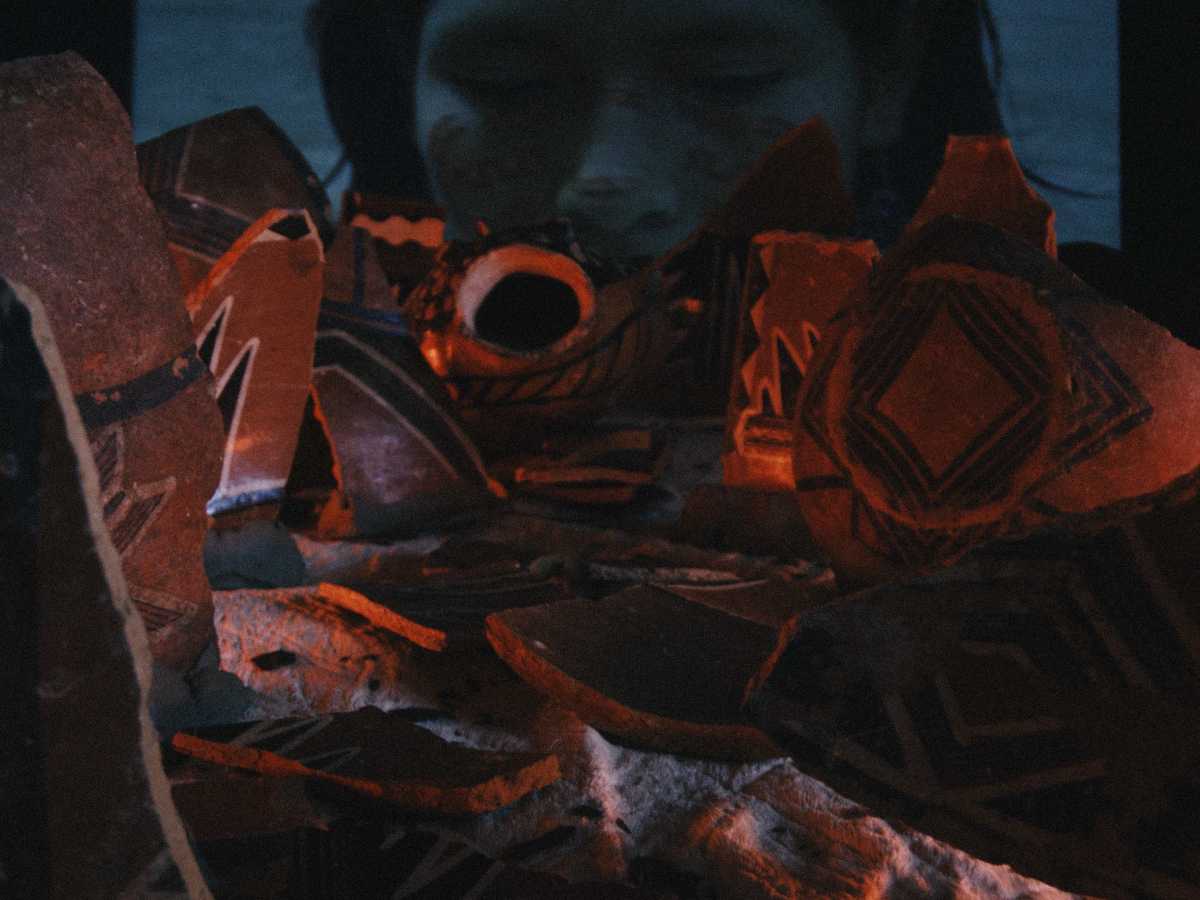
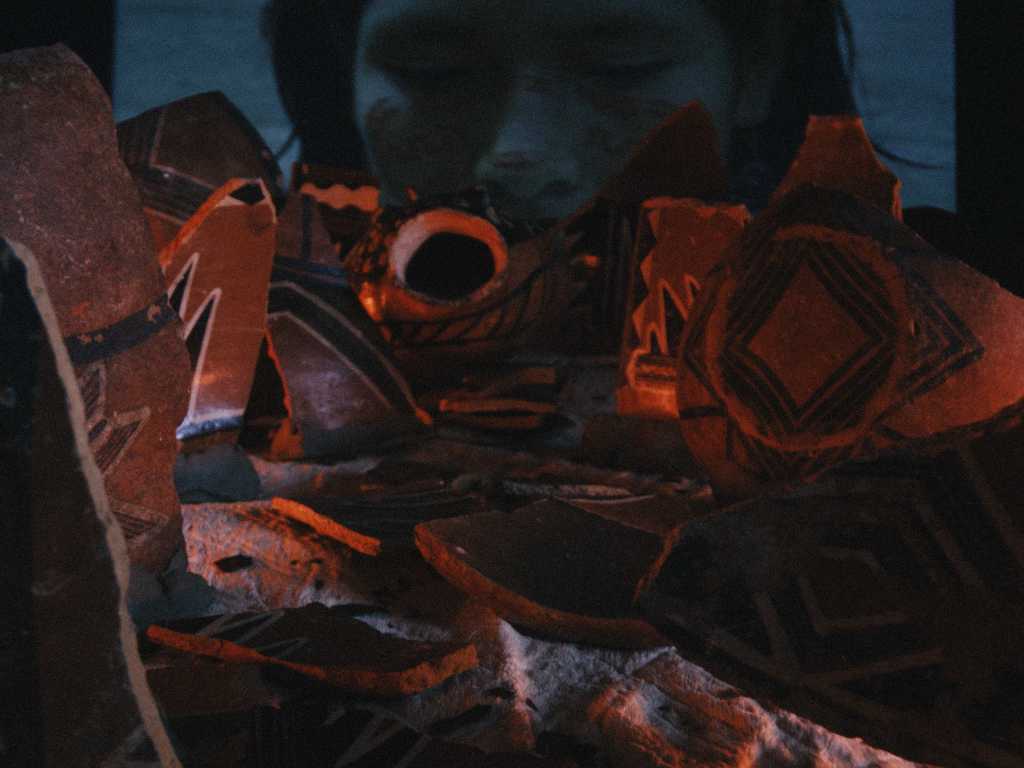
The Pavilion of Ecuador at Biennale Arte 2026 presents Tawna & Oscar, an exhibition that challengesdominant ways of organizing life, knowledge, and territory. Featuring the Tawna collective and OscarSantillán, and curated by Manuela Moscoso with the support of its commissioner, the Museum ofAnthropology and Contemporary Art of Ecuador (MAAC), the project approaches art as a practice ofattention.
Tawna & Oscar brings together the practices of Oscar Santillán and the Tawna collective to present two contemporary ways of thinking and making the world through relation. The project proposes an approach to art that moves away from fixed categories and closed hierarchies, focusing instead on processes of exchange that unfold across bodies, languages, territories, and times.
Curated by Manuela Moscoso, the Pavilion of Ecuador is conceived as a space of attention and listening. Rather than offering a single narrative, it invites visitors to slow down and engage with forms of knowledge that are often overlooked within dominant cultural frameworks. Emerging from Andean Amazonian territories marked by linguistic, cultural, and ecological plurality, the project advances a situated position that understands knowledge as something produced through shared experience and ongoing relation.
The practice of the Tawna collective is rooted in Pan-Amazonian ways of thinking that conceive existence as an active continuity among bodies, territories, and forces. Working from community-based and embodied experiences, Tawna understands sexuality and dreaming as sensitive technologies through which life is oriented, knowledge is transmitted, and care is organized. In their practice, language functions not as distant representation but as a living force that participates in the making of the world, activating connections between the personal, the collective, and the spiritual.
Oscar Santillán’s practice explores what exists beyond established notions of reality: those conditions that escape dominant systems of order and open other ways of perceiving the world. Moving across science, emerging technologies, and ancestral knowledge, his work insists on indeterminacy as a fundamental condition of life. From this perspective, the terrestrial, the technological, and the cosmic are understood as interconnected and continuously shaping one another.
The encounter between Tawna and Santillán does not aim for synthesis or resolution. Instead, it sustains an open space in which different ways of inhabiting and understanding the world can coexist without being reduced to a single framework. Art operates here as a practice that holds this openness, creating the conditions for new forms of perception, relation, and coexistence.
Rather than representing a fixed national identity, Tawna & Oscar proposes a contemporary position grounded in situated knowledge, relation, and material responsibility, offering tools to think with the present and imagine multiple possible worlds.
The Museum of Anthropology and Contemporary Art (MAAC) is a key cultural institution in Ecuador, dedicated to preserving archaeological and modern heritage, promoting contemporary art, and serving as a bridge between the country’s historical memory and its present cultural landscape. As custodian of 60,000 pre-Hispanic archaeological objects and 3,500 works of modern and contemporary art, the MAAC fosters spaces for encounter, critical reflection, and research. With approximately 120,000 annual visitors and a strong public program, it has established itself as a dynamic institution with an international outlook.
CURATOR
MANUELA MOSCOSOis the inaugural Executive and Artistic Director of the Center for Art, Research and Alliances (CARA) and, in 2025, curated the 2a Bienal das Amazônias. Formerly curator of the Liverpool Biennial (2021) and a senior curator at Museo Tamayo, Moscoso focuses her work on relational, political, and embodied approaches to contemporary art and institutions.
EXHIBITORS
OSCAR SANTILLÁNis an Ecuadorian artist working between Ecuador and the Netherlands. His practice explores science, ancestral technologies, and the concept of the “Anti-world,” dissolving boundaries between the natural and artificial. His work has been shown internationally and he is active in art education.
TAWNAis an anti-colonial collective of Sápara, Kichwa, and mestizo artists founded in 2017. Working with video, photography, and living archives, they create narratives from Amazonian territories through ritual, dreaming, and community-based processes. Their work has been shown internationally.
INSTITUTIONAL LEADERSHIP Romina Muñoz Procel (Vice Minister of Culture of the Ministry of Education, Sports and Culture, Ecuador), Stephanie García Albán (Executive Director MAAC)
SUPPORTERS Vice Ministry of Foreign Affairs, Ministry of Education, Sports and Culture, Vice Ministry of Tourism, Embassy of the Republic of Ecuador in Italy, Foundation Identidad Nacional, NIRSA, James Fuentes Gallery, Foundation EACHEVE, Livia Benavides Gallery, Global Transport, TAtchers’ Art Management, Colecciona.Art, Pily Estrada Lecaro, Dos Islas Studios, Giada Lusardi
PAVILION OF ECUADOR – ADDRESS: Castello 1636/A, Venice, Italy
OPENING: Wednesday 6 May, 4 PM, RSVP by 4 May to tatchersartmanagement@gmail.com
OPEN TO THE PUBLIC May 9 – November 22, 2026, daily except Monday, free entry. May: 11 – 6 PM, June:
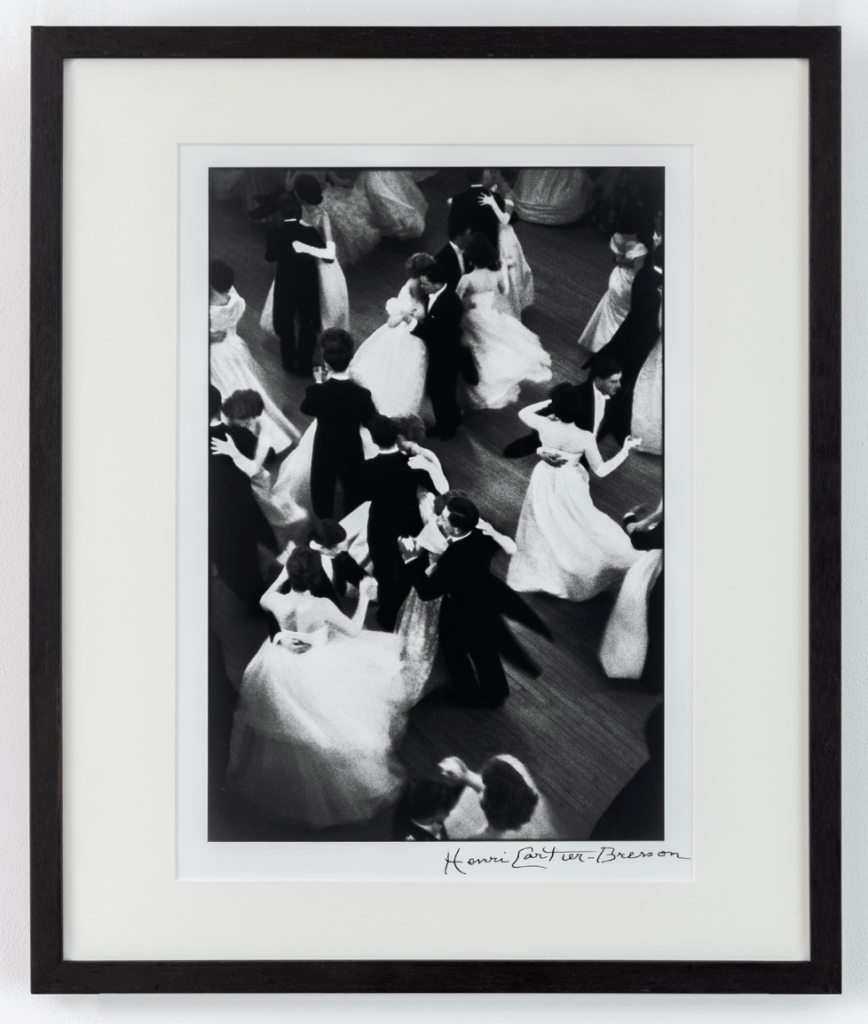
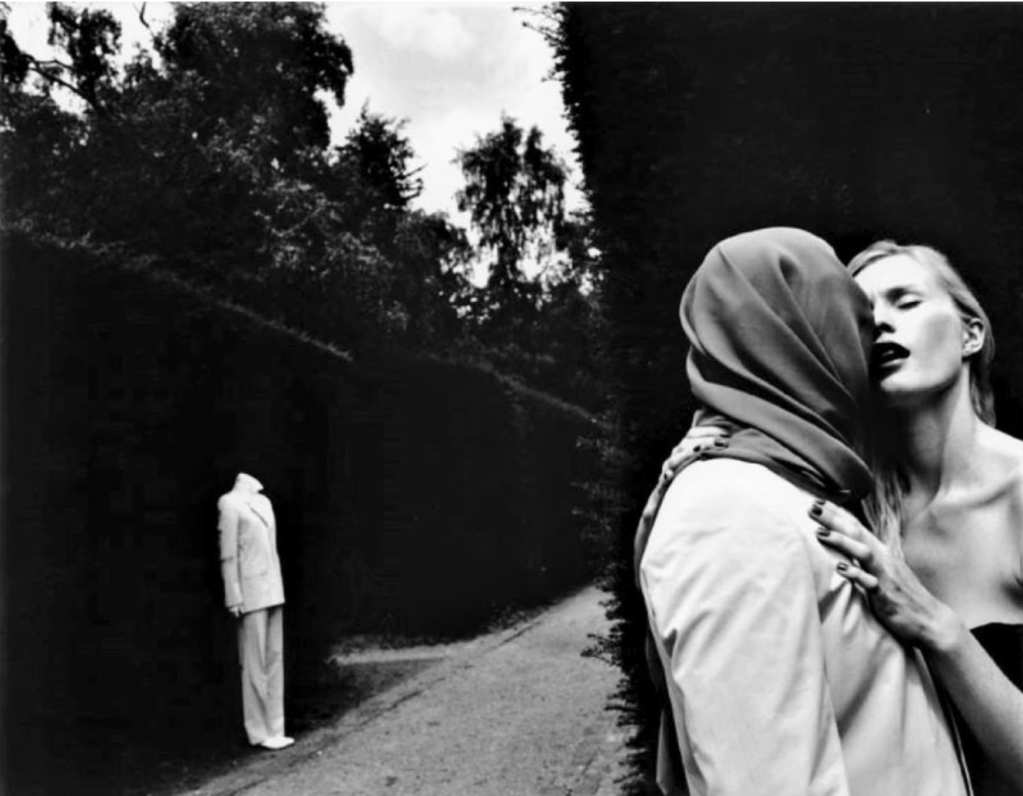
Henri Cartier-Bresson, Queen Charlotte’s Ball, London, 1959.
The Story
12th March – 23rd May 2026
Founded twenty-eight years ago, HackelBury traces its origins to the lifelong passion for art shared by Marcus Bury and Sascha Hackel, collectors for more than thirty-six years. This exhibition brings together the works which first ignited their interest in photography and helped shape their collecting philosophy long before the gallery opened. It also celebrates the artists whose practices have defined HackelBury’s identity across the decades.
From modernist masters such as Edward Weston, Margaret Bourke-White and Consuelo Kanaga, to artists who have exhibited at the gallery including Ellen Auerbach, Berenice Abbott and Arnold Newman and to influential contemporary voices such as Seydou Keïta, Malick Sidibé, Joanne Leonard, Doug & Mike Starn, Bill Armstrong and others, the exhibition honours the individuals who have shaped HackelBury’s past and continue to inspire its future.
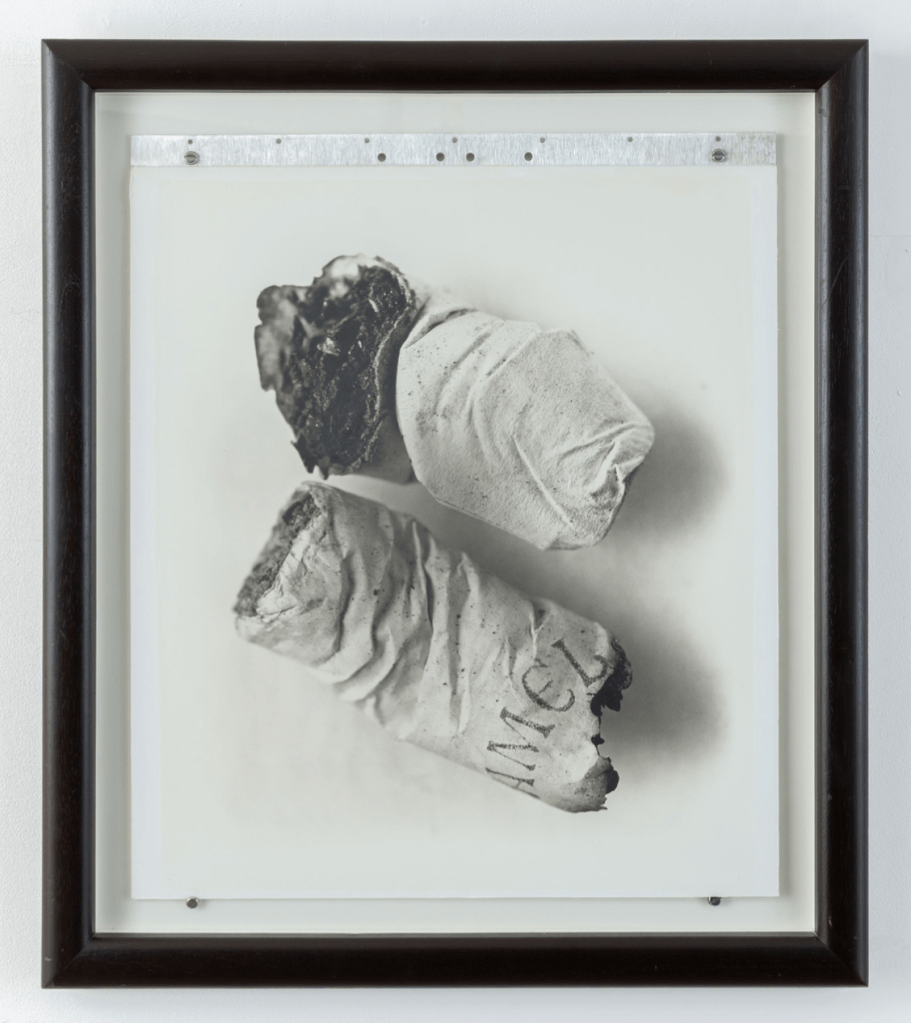
The works on view — ranging from Irving Penn’s Cigarette No. 111, William Klein’s exuberant painted contacts, Joanne Leonard’s domestic interiors to Margaret Bourke-White historic image of the United Statses Airship ‘Akron’, celebrate the personal and artistic relationships at the heart of the gallery’s story. They also illuminate Sascha and Marcus’s enduring commitment to championing artists who push the boundaries of their medium to create meaningful and contemplative work.
Curated as a “memoir” with selections made by founders Sascha Hackel and Marcus Bury alongside contributions from the HackelBury team, the exhibition offers a shared reflection on the images and artists which resonate at HackelBury. It is a celebration of works, a tribute to the relationships which have shaped HackelBury, and an homage to the artists who continue to define the gallery’s vision.
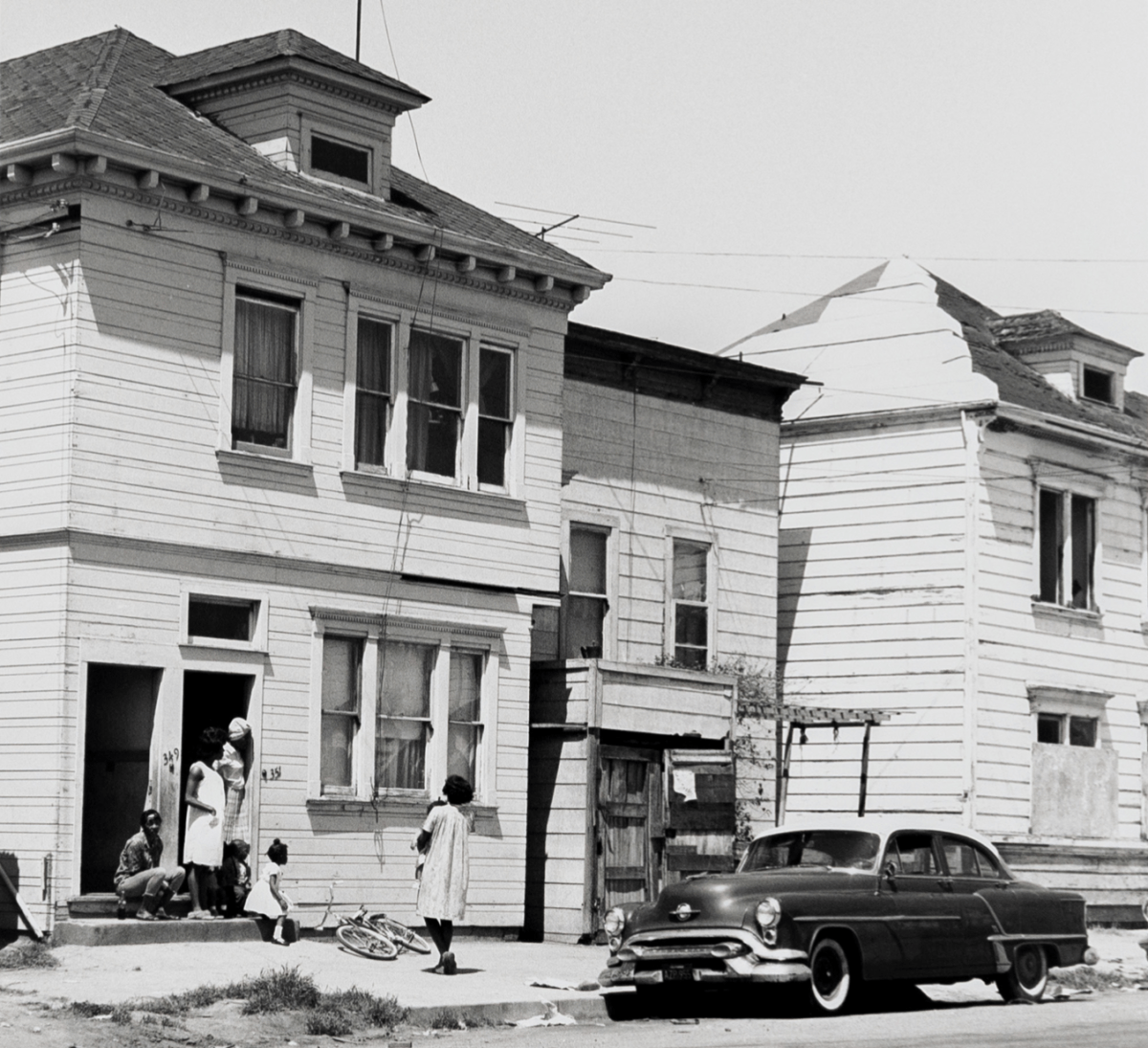
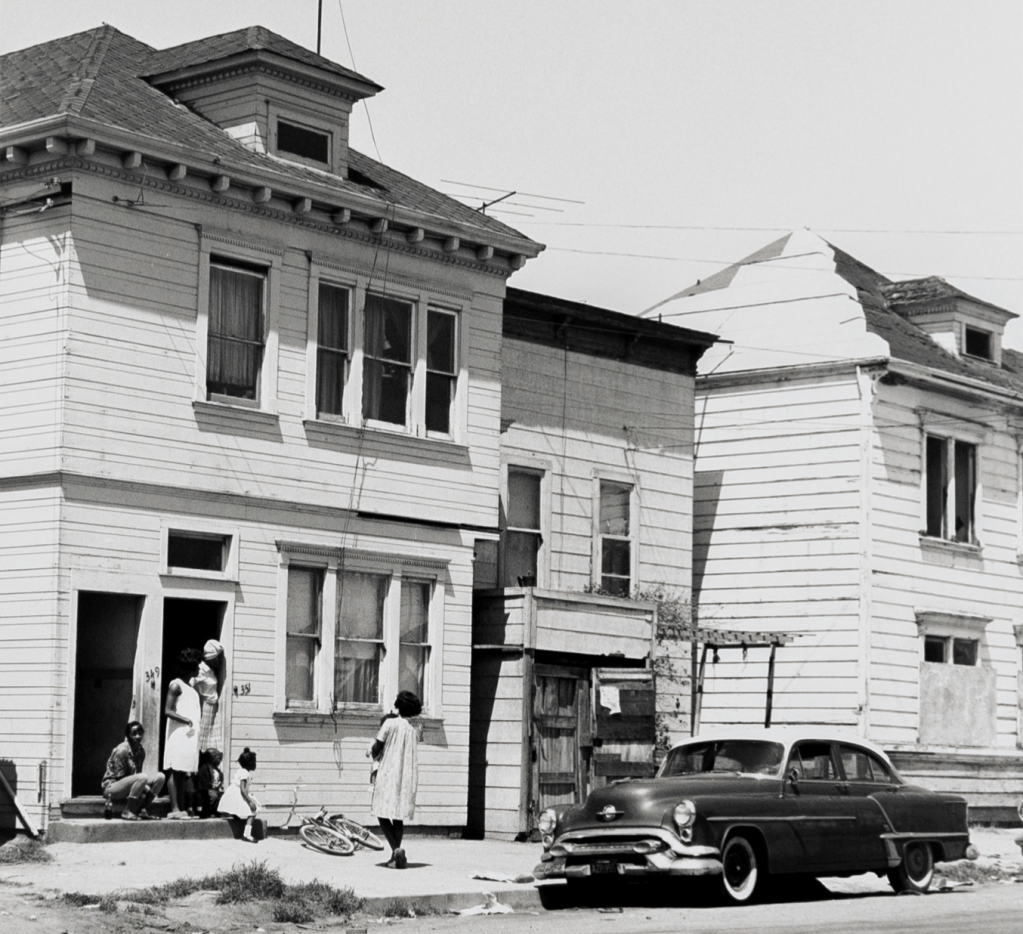
Joanne Leonard, Street Scene, West Oakland, CA, 1960’s
About HackelBury Fine Art
HackelBury was founded twenty-eight years ago by Marcus Bury and Sascha Hackel. The gallery is committed to championing artists working with the visual arts who push the boundaries of their medium to create meaningful and contemplative work.
The London based gallery initially showcased classic photography from the 20th century including Henri Cartier- Bresson, Berenice Abbott, Malick Sidibe, and Sebastião Salgado. The transition from traditional photography to more conceptual work was as intuitive as it was organic, beginning with artists such as William Klein, Pascal Kern, Doug and Mike Starn, Garry Fabian Miller, Katja Liebmann, Ian McKeever, Stephen Inggs and Bill Armstrong.
In recent years the gallery has taken on emerging artists such as Oli Kellett, Nadezda Nikolova, Alys Tomlinson, Coral Woodbury and Sharon Walters.
Each artist, whether emerging or established, creates work defined by a depth of thought and breadth and consistency of approach. The small group of artists with whom HackelBury work, represent a diversity of practice yet share an artistic integrity which the gallery is fully committed to supporting in the long term.
Irving Penn, Cigarette No. 111, 1974
____
The HackelBury Story
Sascha Hackel, co-founder of HackelBury Fine Art, entered the art world not through formal training but through an early love of black-and-white cinema. After moving to London in her twenties, a chance encounter at Hamiltons Gallery gave her an unexpected start in the photography world — a trial week which turned into seven years working with major photographers and learning the market from the inside at a time when photography was scarcely recognised as fine art in the UK.
She and her husband, Marcus Bury, became passionate collectors in the 1990s — the days when an Irving Penn print could still be bought for £1,500 and when viewing 600-lot auctions at Sotheby’s or Christie’s was an education in itself. Their shared instinct for discovering photographers under-recognised in London became the seed of a future gallery.
In 1998, with a one-year-old at home, the couple transformed a dilapidated local frame shop, on Launceston Place, into HackelBury Fine Art. They opened not with glamorous fashion photography but with Roman Vishniac — a statement of seriousness, integrity and historical depth. From the start, they built their programme around artists who had not been properly exhibited in London, developing long-standing relationships defined by trust, loyalty and a deep belief in each artist’s work.
Although rooted in photography, HackelBury has always followed its artists as their practices evolve, supporting shifts across disciplines as naturally as they unfold. Over the years, the gallery has championed photographers moving into new mediums — from drawing to filmmaking — and has worked closely with multidisciplinary voices such as Doug and Mike Starn and Ian McKeever, whose practice bridges photography and painting, and Coral Woodbury, whose work spans image, object and text. This commitment to accompanying artists on their creative journeys has become as central to the gallery’s identity as its dedication to photographic practice itself.
Over 25+ years, HackelBury became known for championing humanist, street and conceptual photography, introducing London to figures such as Pascal Kern, Martine Franck, Malick Sidibe, and later forging decades-long collaborations with artists including Doug and Mike Starn, William Klein and Marc Riboud. Unlike many galleries, they still operate without contracts —relationships sustained by trust, shared values and a commitment to supporting artists through everything from health crises to book publishing.
Through constant shifts in the art world, from the 2008 crash to COVID to a transformed media landscape, the gallery has persisted by staying true to a core ethos: only show artists whose work they would collect themselves; invest deeply and emotionally in every relationship; price work ethically; and prioritise long-term development.
In recent years, a new generation of women artists has entered the programme, reflecting a conscious shift toward nurturing female voices and emerging talents who resonate emotionally and conceptually with the gallery’s history.
The Story exhibition brings all of this together — not a retrospective of artists, but a meditation on 29 years of relationships, instincts, risks and quiet revolutions within the photography world.
FOR ALL PRESS ENQUIRIES PLEASE CONTACT
Camilla Cañellas – Culturebeam | Cultural Communications
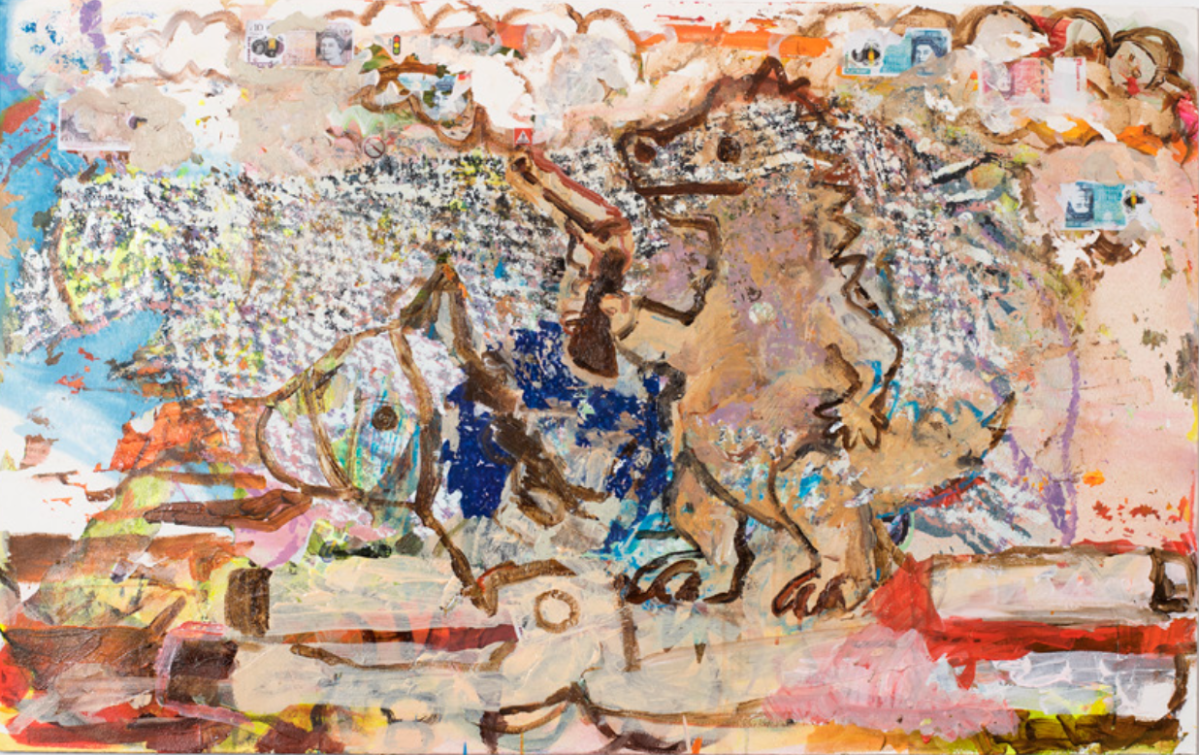
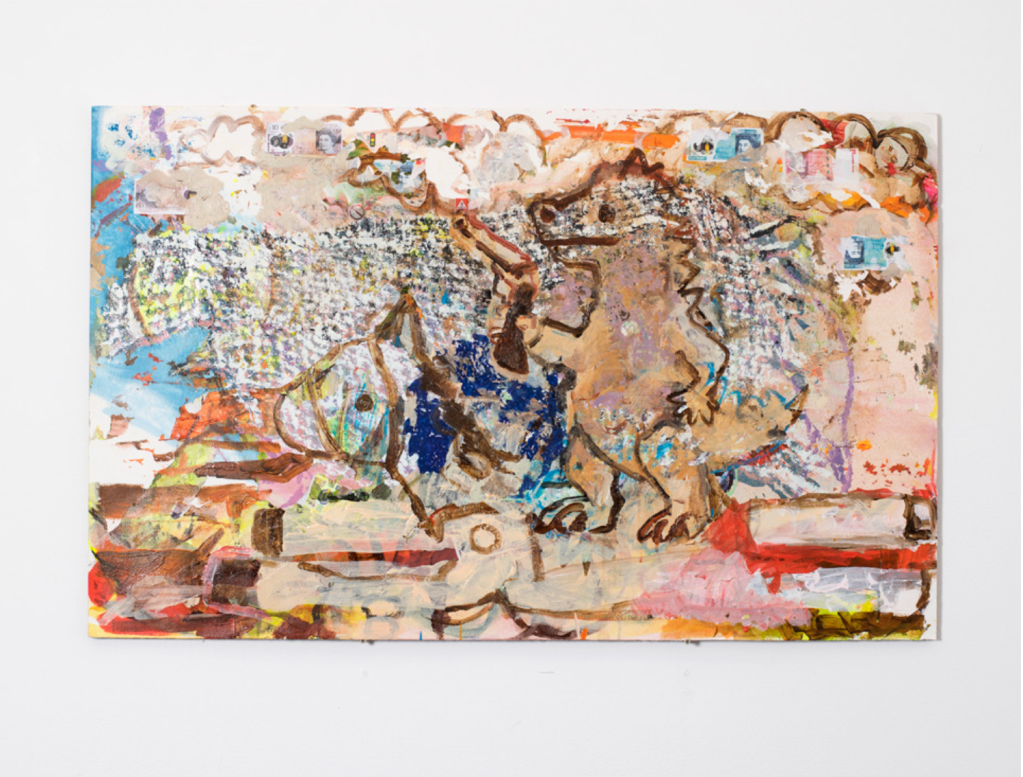
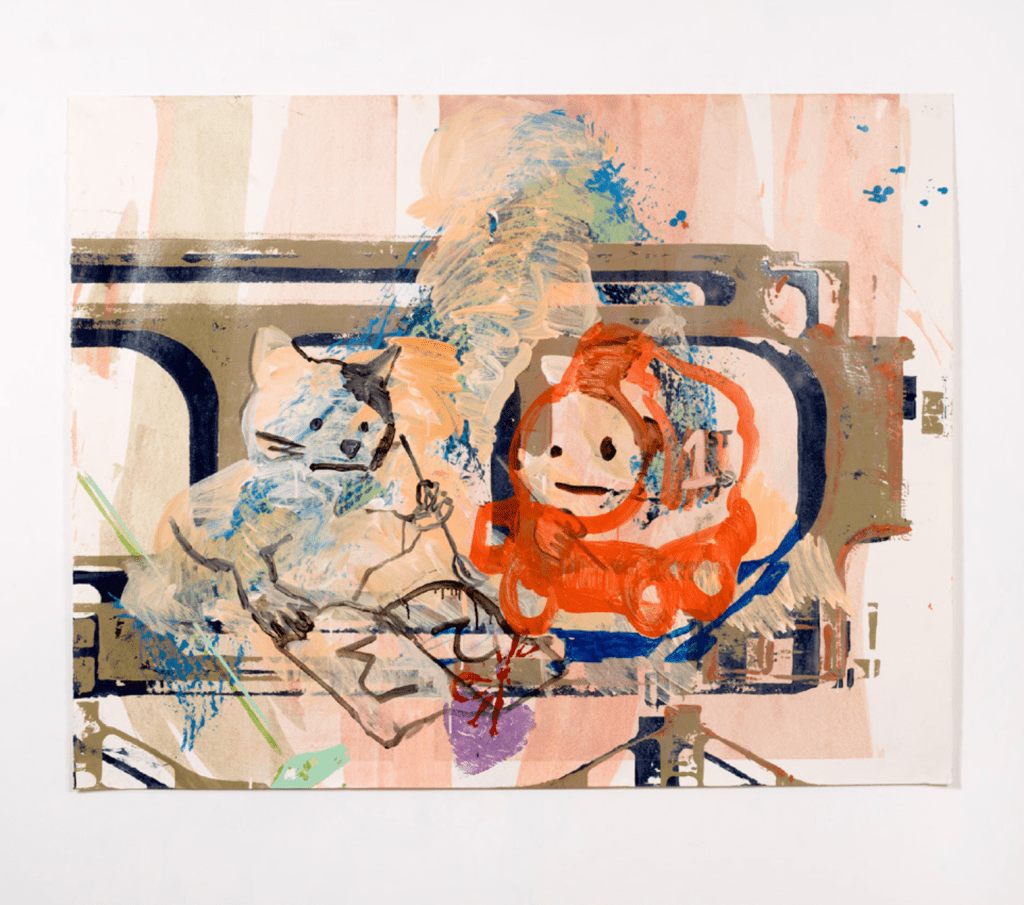
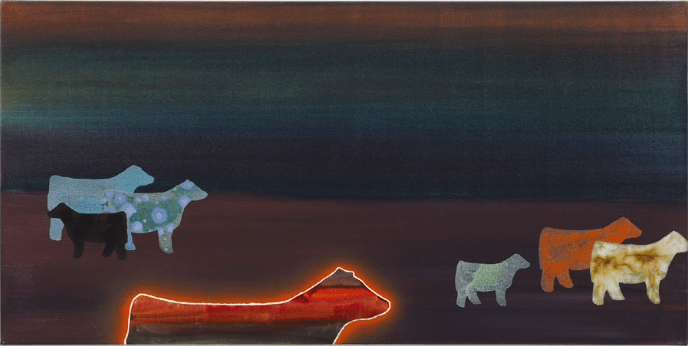
Sabrina Shah, Toys, 77.5 x 122cm, Acrylic and oil on paper, 2026.
Paintings by Sabrina Shah on surfaces by Shane Bradford
Trespass
Sabrina Shah
Shane Bradford
Trespass is an unusual collaboration between Union curator Shane Bradford and painter Sabrina Shah. The project is intended to test the jurisdiction of creative authorship in a traditional gallery setting. While these works are firmly Shah’s painting, the fact that they have been painted on top of abandoned former works by Bradford defines the series. Doubts arise. Questions are posed: what does it mean to trespass? Where is the consent?
To all these queries there is only one reliable response: the exhibition itself. A complex curatorial conundrum has been initiated, the outcome of which is visible in the actual event of the exhibition experience. If there are answers, they reside within the dynamism of Shah’s brushstrokes and the inherent surprise of the unpremeditated symbiosis between the protagonists.
Sabrina Shah, First Place, 152 x 122cm, Acrylic and oil on paper mounted on canvas, 2026.
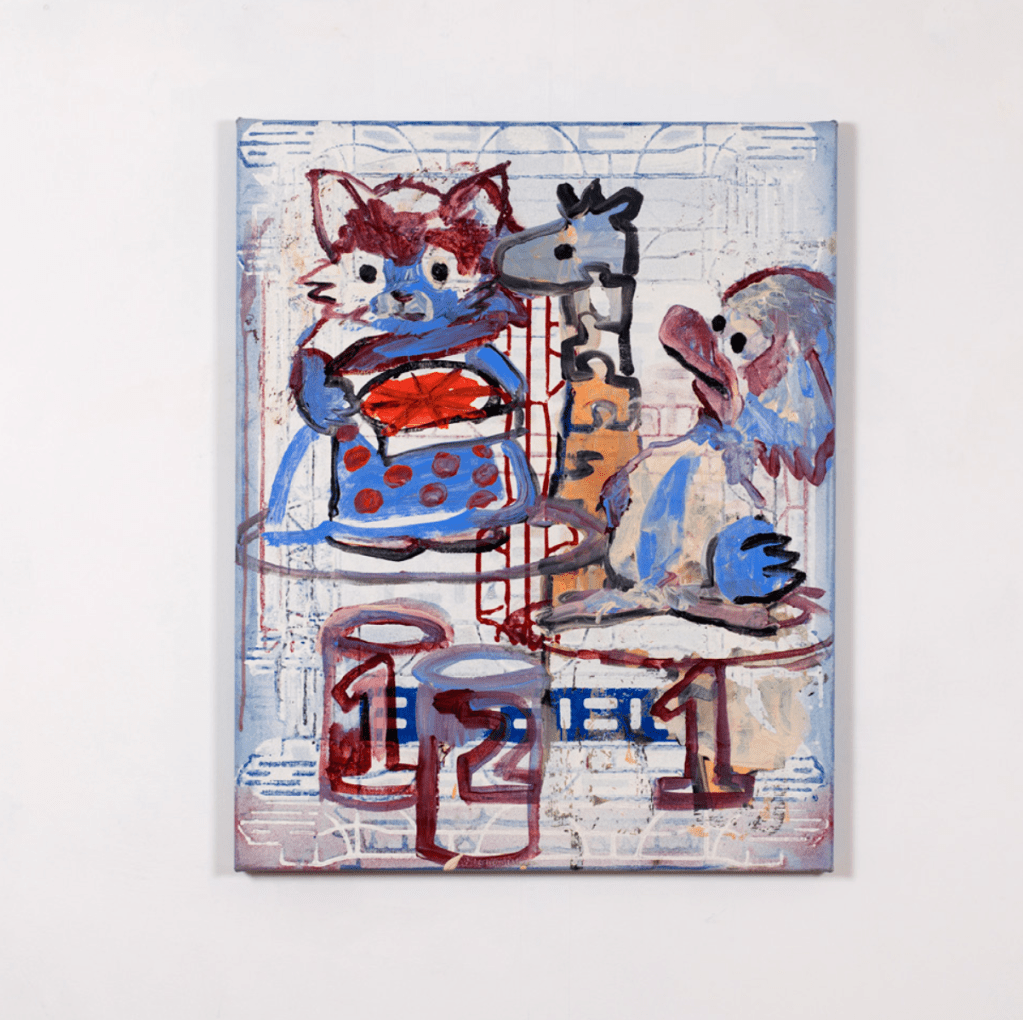
Sabrina Shah, 121, 75 x 60cm, Acrylic and oil on canvas, 2026.
Shah’s spontaneous, unfiltered, and immediate paint-handling is supported by the show’s context, allowing for the event to remain in progress. The imagery often depicts participatory social happenings to which the viewer is invited. The result is a gloriously jarring and unexpected extension of Shah’s painterly psycho-dramatic fiction.
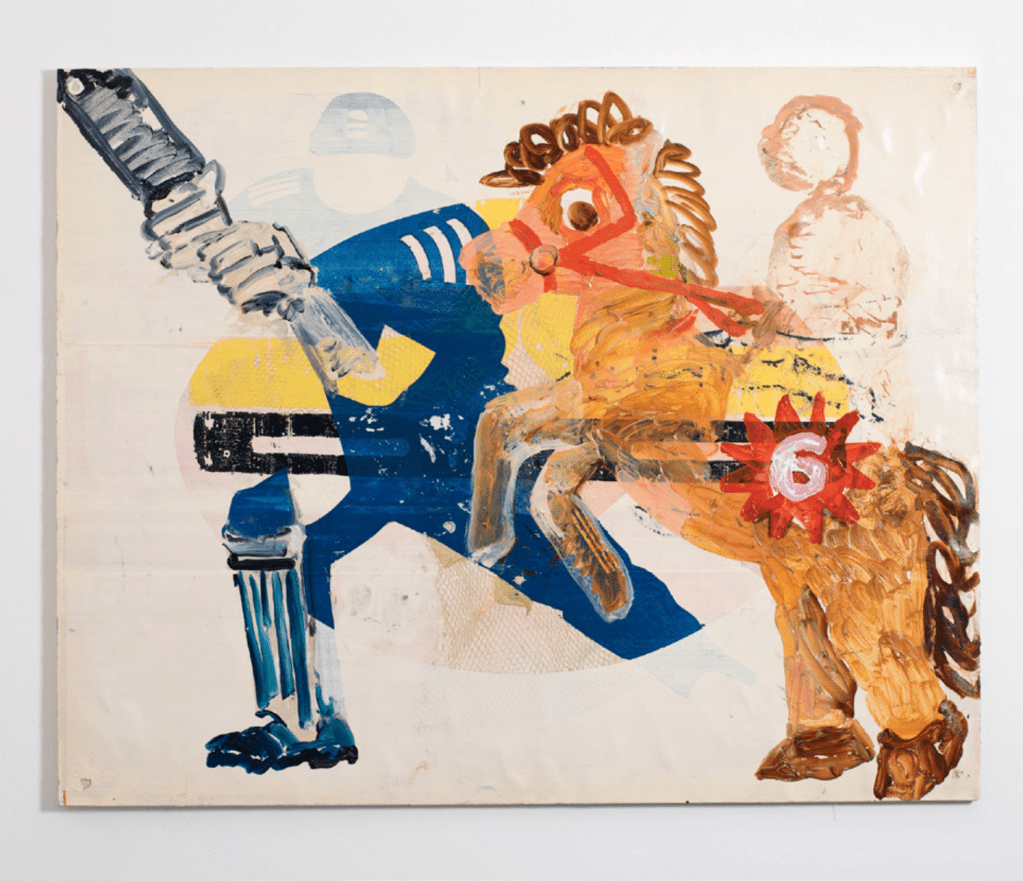
Shah has a history of reworking her older paintings. The previous layers and scars are important. This time, however, her imagery responds to the incomplete narrative threads of Bradford’s beginnings’. Suggestive traces of basketball courts, road traffic barriers, and abandoned train tracks are picked-up on and answered with animals, characters, toys, and games. 1,2,3. First, second, and third. Is anybody winning?
Sabrina Shah, Six, 152 x 122cm, Acrylic and oil on paper mounted on canvas, 2026.
While Bradford’s backgrounds perform the dual role of story and substrate to provide an authentic foundation for Shah’s primary interventions, an intimate yet delightfully unstable bond is formed. Despite the literal cover-up there is no hiding; the uncertain friction between object and ground makes for an atmosphere of palpable vitality. There’s a raw honesty in the dynamic fusion of the paintings that perfectly platforms Shah’s naturally expressive and distinctive idiosyncrasies.
Exhibition: Sabrina Shah – Trespass Dates: 5 March – 11 April, 2026 Opening preview: Saturday 28 February 2026, 5– 8 pm
Opening times: Thursday – Saturday 12.00 – 18.00 or by appointment
Publishing in Art Style Magazine is free of charge for anyone. There are no article processing charges or other publication fees. Art Style Magazine is independent and supports the Open Access Movement. The editors of Art Style Magazine cannot be held responsible for errors or any consequences arising from the use of information contained in essays and articles published on the Art Style Magazine’s website and editions. Authors agree to the terms and conditions and assure that their submissions are free of third parties’ rights. The views and opinions expressed in the essays and articles are those of the author and do not reflect the views of Art Style Magazine. The authors of Art Style Magazine’s essays and articles are responsible for its content. The Art Style Magazine‘s website provides links to third-party websites. However, the magazine is not responsible for the contents of those linked sites, nor for any link contained in the linked site content of external Internet sites (see Terms & Conditions).
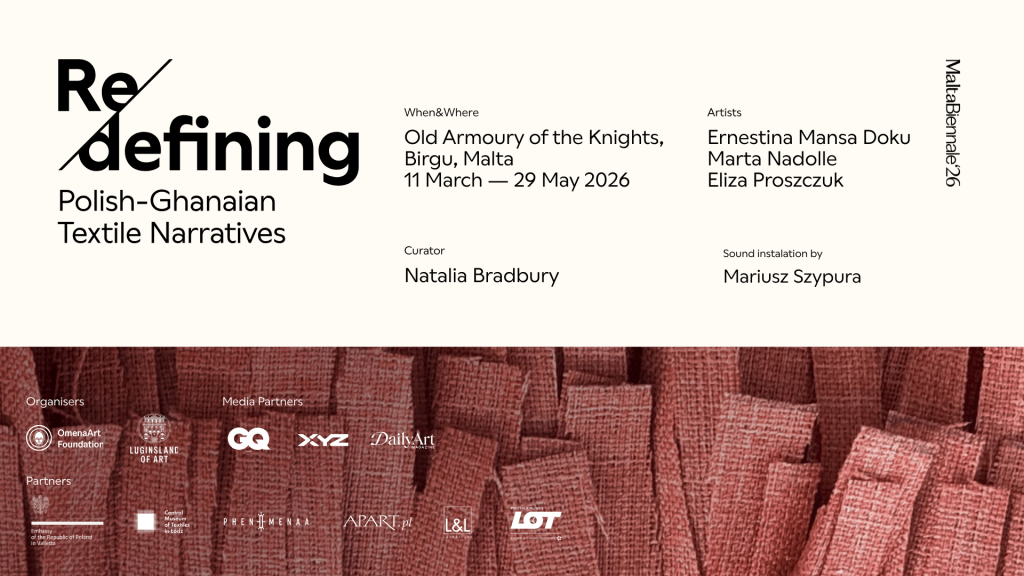
Art as a Bridge Between Cultures. OmenaArt Foundation and LuginsLand of Art’s Thematic Pavilion at the Malta Biennale 2026
The OmenaArt Foundation and LuginsLand of Art will once again be situated at the intersection of cultures and contemporary artistic practices. In 2026, the Foundation returns to the Malta Biennale, with a thematic pavilion titled Redefining. Polish-Ghanaian Textile Narratives.
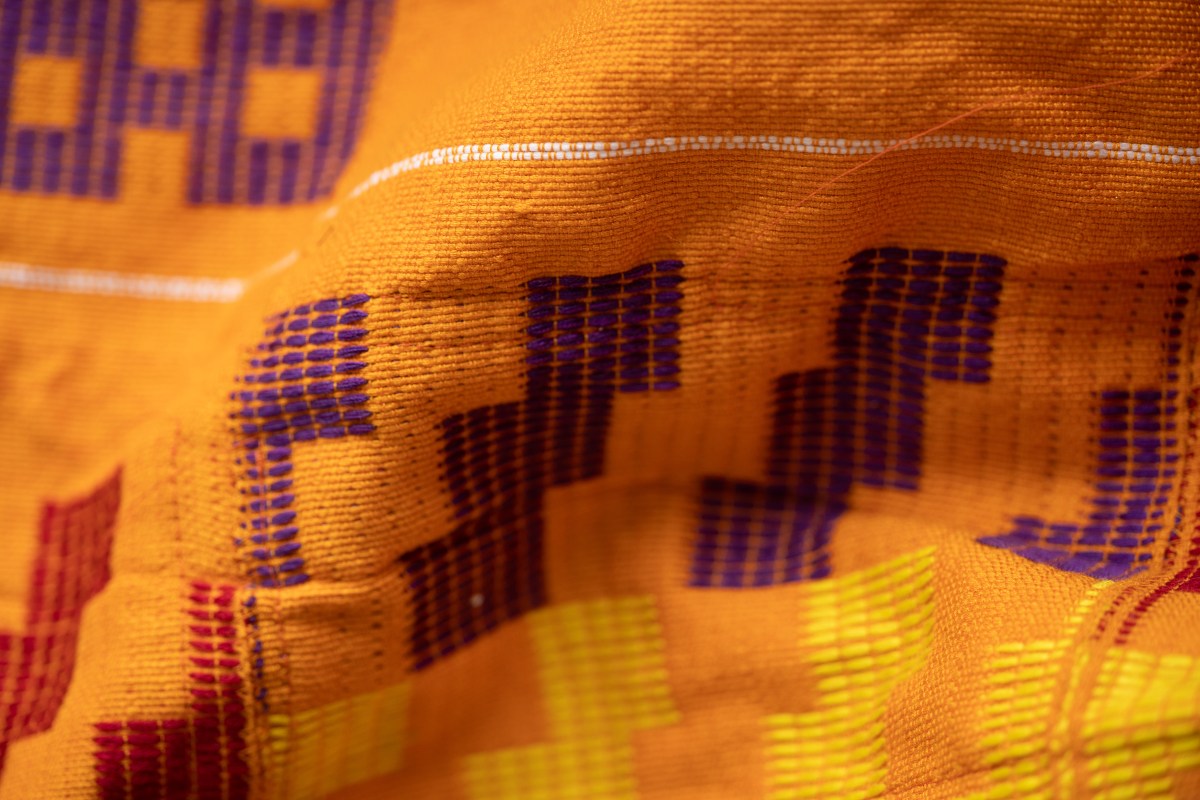
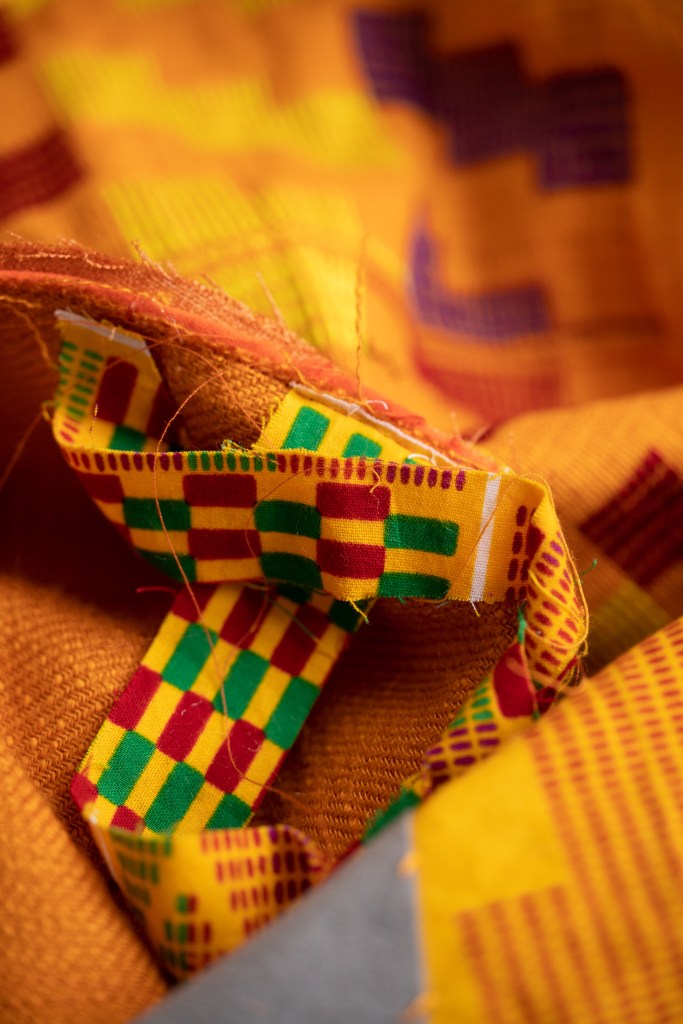
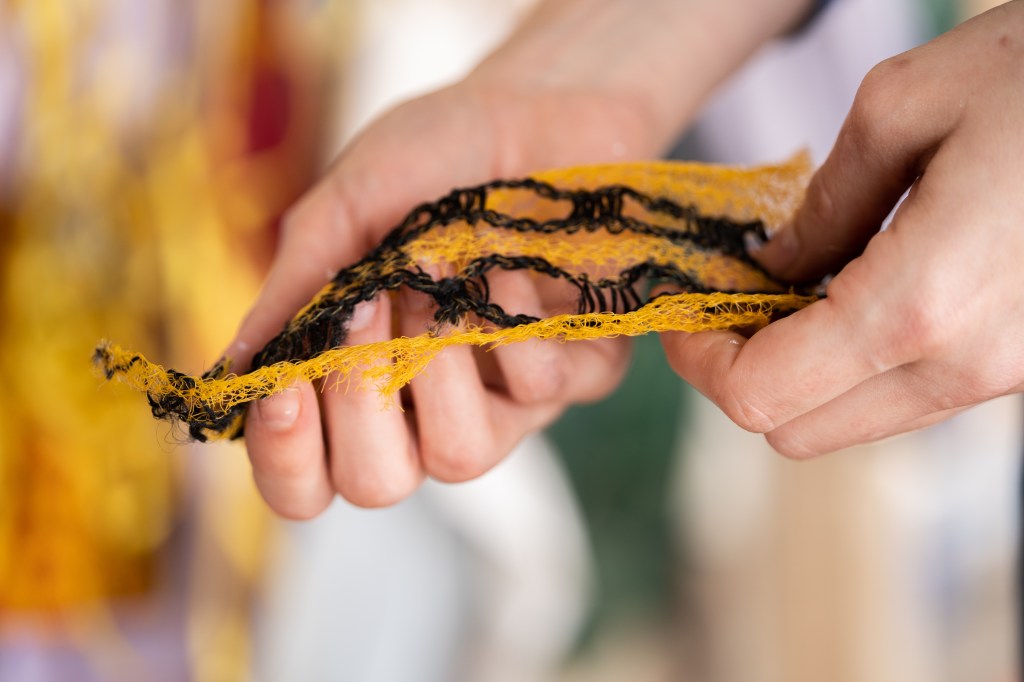
Curated by Natalia Bradbury, the exhibition will feature large-scale textile installations by Marta Nadolle, Eliza Proszczuk, and Ernestina Mansa Doku, created during their artistic residency in Malta. The artists, coming to Malta from Poland and Ghana, will intertwine the historical narratives of both countries, drawing on weaving traditions and the island’s local heritage. Their collaboration began during Accra Cultural Week 2025 in Ghana, where, together with local artists Moses Adjei, Cornelius Annor, and Raphael Adjetey Adjei Mayne, they conducted art workshops for children exploring the textile art heritage of Poland and Ghana. The workshops took place at Kids Haven School, built by the Omenaa Foundation.
Photo by Wojtek Ciszkiewicz, 2026.
“Our exhibition explores the theme of historical bonds and solidarity between Poland and Ghana. Through the artists’ works, we want to show that despite distance and differing experiences, we are united by shared emotions and values,” says Natalia Bradbury, curator of Redefining. Polish-Ghanaian Textile Narratives. “Ernestina Mansa Doku brings to the project an organic approach to material and nature; Eliza Proszczuk contributes a reflection on memory, emancipation, and the body; while Marta Nadolle offers a perspective focused on interpersonal relationships and observations of tensions between the public and the private. The juxtaposition of these three practices makes it possible to create works that operate both through personal narrative and through the universal language of contemporary art, legible within the international art circuit,” Bradbury emphasizes.
Running from 11 March to 29 May 2026, the OmenaArt Foundation’s thematic pavilion will reference the philosophy of Ubuntu – “I am because we are” – emphasizing interdependence, community, and mutual respect. This idea links the artists’ collaboration with historical Polish-Ghanaian relations that have developed since the 1960s. The artworks will be accompanied by a premiere sound installation by the composer Mariusz Szypura. The pavilion will also feature a public program including debates, panel discussions, and meetings with international experts.
Photo by Wojtek Ciszkiewicz, 2026.
The thematic pavilion is organized by the OmenaArt Foundation, which is dedicated to fostering relationships and promoting artists from Central Europe and West Africa. In 2025, the Foundation presented its African art collection for the first time at the TOP CHARITY Art exhibition at the Orangery of the Wilanów Palace. Also, OAF supported the creation of a monumental work by Ibrahim Mahama, which was exhibited at Zachęta – National Gallery of Art. The OmenaArt Foundation works closely with Phenomenaa Gallery in Warsaw, consistently strengthening the presence of African and non-European artists on the Polish art market.
Photo by Wojtek Ciszkiewicz, 2026.
“In recent years, African art has secured a significant position on the global art scene. Works by artists such as Amoako Boafo and Julie Mehretu achieve record-breaking prices at auctions and are presented in leading cultural institutions. In 2025, ArtReview magazine named the Ghanaian artist Ibrahim Mahama the most influential figure in contemporary art. That is why I am proud that through the activities of my Foundations, we support artists from this continent – investing in art and education, including through the construction of the innovative Kids Haven Sport & Art Complex in Ghana, and promoting their work on international platforms,” says Omenaa Mensah, CEO of the OmenaArt Foundation.
“I am especially delighted that our exhibition, presented during the Malta Biennale 2026, will highlight how powerful and inspiring intercultural dialogue can be – between Poland and Ghana, Europe and Africa – in the extraordinary setting of a Mediterranean island,” Mensah adds.
The exhibition will explore intercultural relationships across past, present, and future perspectives, while simultaneously interpreting the central theme of Malta Biennale 2026 – CLEAN | CLEAR | CUT – which refers to ideas of repair, connection, and purification.
The OmenaArt Foundation and Luginsland of Art project highlights the significance of the Polish and Ghanaian contemporary art scene. Through its presence at the Malta Biennale – an important global artistic platform – it strengthens intercultural dialogue and promotes the rich textile traditions of Poland and Ghana.
Photo by Wojtek Ciszkiewicz, 2026.
Artists
Ernestina Mansa Doku
Ernestina Mansa Doku (b. 2001) is a Ghanaian visual artist of the younger generation who lives and works in Accra. She works primarily with acrylic paint, as well as artistic textiles, animation, and sculpture. She completed her BA in Painting and Sculpture at Kwame Nkrumah University of Science and Technology (KNUST) in Kumasi, where she is currently continuing her MA studies in the same department. She is a member of the blaxTARLINES collective. In 2024, she received a scholarship from the OmenaArt Foundation as part of the Artis Arundo programme, which supports emerging talents.
The artist draws inspiration from nature and how it adapts to changing conditions and environments: pushing through cracks, clinging to surfaces, and intertwining with other objects. In her practice, she seeks to challenge anthropocentric perceptions of lived experience, opening space for a posthumanist perspective. She describes her creative processes as a form of surgical intervention; through deformation, reorganisation, transformation, multiplication, or division of forms, she strives to create something new. In the act of creating, Doku consciously embraces spontaneity and the role of chance. Her painting reflects horror vacui (Latin: fear of emptiness) – the artist deliberately saturates space with details and elements that often go unnoticed in everyday life.
Marta Nadolle
Marta Nadolle (b. 1989) is a Polish visual artist specializing in painting. She graduated from the Academy of Fine Arts in Gdańsk and the Academy of Fine Arts in Warsaw, receiving her diploma with distinction in 2014. In her artistic practice, she addresses themes of love, alienation, coming of age, intimacy, and interpersonal relationships. She reworks the tradition of the veduta, intertwining it with inspirations drawn from folk culture. By setting together these seemingly disparate elements and customs, she crosses the line between what is central and what is peripheral, between the public and private. Her works combine metropolitan narratives with intimate handcraft and folklore, exploring the emotional landscapes of the metropolis. From Nadolle’s paintings emerge the desires of contemporary city dwellers – for genuine closeness and some emotional calm.
Winner of Paszporty Polityki Prize 2023 in the field of Visual Arts. Her work has been exhibited both in Poland and internationally, including in Warsaw, Łódź, Sopot, Wrocław, Poznań, Prague, Bratislava, Stockholm, and at NADA Art Fair in Miami (2021). She has held several solo exhibitions, including Don’t Worry (LETO, Warsaw, 2022), I’ll Send Him Nudes (Galeria Dobro, Olsztyn, 2021), and 35 (Galeria Art Hub, Łódź, 2024). Nadolle’s works are held in the collections of the National Museum in Gdańsk, the Museum of Warsaw, and the mBank collection.
Eliza Proszcuk
Eliza Proszczuk (b. 1980) is a Polish visual artist, PhD in Fine Arts, academic lecturer, and researcher. She graduated from the Academy of Fine Arts in Warsaw (Faculty of Painting, 2006) and from the AKV St. Joost in Breda and Den Bosch (Netherlands), where she earned an international Master of Fine Arts degree (2009). She creates textiles, spatial objects, and collages, treating art as a tool for social change and a space of emancipation. In her practice, she explores themes of memory, inheritance, and women’s herstory, combining artistic activity with research and social engagement.
She has carried out projects with marginalized groups, including incarcerated women, patients of addiction treatment centers, and refugees. She is the author of, among others, the project Girls from the Castle, created in collaboration with female inmates of the Warsaw-Grochów Detention Centre (Ujazdowski Castle Centre for Contemporary Art, 2014; CSW Kronika, 2022), which examined childhood as a cell and culture as a prison.
She draws inspiration from the traditions of northeastern Poland, where she comes from, reconstructing and reinterpreting women’s crafts and narratives erased from official history. She collaborates with international academic and artistic institutions, including the University of St Andrews in Scotland and Humboldt University in Berlin. In 2022, she received a four-year COST grant (European Cooperation in Science and Technology) for a research-artistic project on sisterhood and social justice. Proszczuk is a co- editor of the publication Traces of Sisterhood (Academy of Fine Arts in Warsaw Press) and a co-organizer of events combining art and science, such as Care and Repair: Ungendering Memory and Museum Practices (Ethnographic Museum, Ljubljana, 2023) and Connecting Lines: Tracing Care at the Intersection of Feminism and Ecology (City of Women, Museum of Modern Art, Ljubljana, 2024). Since 2017, she has been working at the Academy of Fine Arts in Warsaw, where she leads the Textile in Architecture Studio. She is a two-time recipient of scholarships from the Polish Ministry of Culture and National Heritage and ZAiKS. She finds inspiration in the words of Pier Paolo Pasolini: “Culture as prison, art as liberation” – and consistently creates spaces where art becomes a tool for experimentation, therapy, and social transformation.
Mariusz Szypura – Sound Installation
Mariusz Szypura (b. 1972) is a composer, music producer, and audiovisual artist working at the intersection of music, design, and contemporary art. After years of activity on the Polish alternative scene (Happy Pills, Blimp, Silver Rocket), he focused on interdisciplinary artistic projects in which sound becomes a sculptural material and a tool for shaping experience.
In recent years, he has concentrated on large-scale audiovisual installations. In 2024, at the Centre for Contemporary Art Ujazdowski Castle in Warsaw, he presented the project in:human – an immersive environment exploring relationships between humans and technology through multichannel sound and image. During the Unsound Festival at Lincoln Center in New York, he presented êkhos, combining electroacoustic composition with stereoscopic projections.
His most extensive artistic undertaking is Chopin Residue – an international audiovisual project deconstructing the work of Frédéric Chopin through experimental compositional techniques combined with large-scale imagery, video installation, and spatial sound. In its musical layer, co-created with artists such as Adrian Utley, Lee Ranaldo, John Stanier, and Fennesz, it has been presented in venues including New York and Osaka. As a composer of music for exhibitions, Szypura creates autonomous sonic environments that engage in dialogue with both the artwork and the architecture. His compositions do not illustrate – they shape the rhythm of perception, the intensity of experience, and the viewer’s relationship with space.
Curator – Natalia Bradbury
Natalia Bradbury is an art historian, curator, and art advisor, living and working between Poland and the United Kingdom. She is the Executive Director of OmenaArt Foundation and Phenomenaa Gallery in Warsaw, which specializes in contemporary African and non-European art.
Her main area of research focuses on the growing significance and market value of a new generation of artists from West Africa and its diaspora, as well as from Central and Eastern Europe, particularly Poland. In her work, she analyzes the factors influencing the development of this segment, including relationships between global institutions, galleries, collectors, and auction houses. She initiates projects that situate contemporary artistic practices of Polish and African artists within a broader economic, social, and geopolitical context.
She is the author of exhibitions such as TOP CHARITY Art (2024, 2025), Other Geographies, Other Stories (Malta Biennale 2024, with Hanna Wróblewska), and Redefining. Polish-Ghanaian Textile Narratives (Malta Biennale 2026), co-curator of the Kids Haven Sport & Art Complex in Ghana. Mentor at Rafał Brzoska Foundation, she also serves as a juror for artistic competitions, including the 16th edition of Best Artistic Diplomas, organized by the Academy of Fine Arts in Gdańsk, and Loostro – Competition for Young Artists.
Organisers – OmenaArt Foundation & Luginsland of Art
About OmenaArt Foundation
OmenaArt Foundation implements unconventional artistic projects in Poland and internationally. The Foundation’s mission is to build intercultural dialogue, support artists, and promote contemporary art from Eastern Europe and Africa, with a particular focus on art in public spaces. OAF is also actively involved in the revitalization of historic buildings and in conservation and educational projects.
The Foundation coordinates the TOP CHARITY Auction – one of the most significant philanthropic events in Europe. Over the course of four years, the auction’s organizers have raised more than PLN 145 million. The funds have been allocated to the charitable work of the Omenaa Foundation, the Rafał Brzoska Foundation, and the Philanthropic Consortium, as well as to OmenaArt Foundation projects supporting artists and cultural institutions.
About Luginsland of Art
LuginsLand of Art organizes artist residencies, exhibitions, and public programmes in Malta. The project aims to breathe new life into one of the island’s most important architectural gems – Villa Luginsland in Rabat. The historic property, currently undergoing restoration, will be transformed into a center for exhibitions, discussions, and artistic events, fostering international artistic exchange and open dialogue about the past, present, and future.
Malta Biennale
Malta Biennale is an international contemporary art initiative inaugurated in 2024 under the patronage of UNESCO and the President of the Republic of Malta. The biennale’s concept centers on dialogue between contemporary art and cultural heritage – exhibitions are presented in historic sites, including Valletta, the Three Cities (Birgu, Cospicua, Senglea), and the Cittadella in Gozo.
The inaugural edition featured over 100 artists from 35 countries, as well as 14 national and thematic pavilions across 21 historic venues. The first participating countries included Poland, France, Germany, China, Austria, Serbia, Ukraine, Italy, Spain, and Malta.
This year’s Malta Biennale will take place from 11 March to 29 May under the theme CLEAN | CLEAR | CUT. The event’s Artistic Director is Rosa Martínez, a renowned curator and Artistic Director of the 51st Venice Biennale. She has also directed or curated biennials in Barcelona (1988–1992), Rotterdam (1996), Istanbul (1997), Santa Fe, New Mexico (1999), Busan (2000), São Paulo (2006), and Moscow (2005–2007).
Redefining. Polish-Ghanaian Textile Narratives
Thematic Pavilion of the OmenaArt Foundation, Malta Biennale 2026 (11 March – 29 May 2026)
Venue: Old Armoury of the Knights of Malta, Birgu, Malta Artists: Ernestina Mansa Doku, Marta Nadolle, Eliza Proszczuk Curator: Natalia Bradbury
Organisers: OmenaArt Foundation, LuginsLand of Art
Partners: Embassy of the Republic of Poland in Valletta, Central Museum of Textiles in Łódź, Phenomenaa Gallery, Apart, Luce&Light, LOT Polish Airlines
To Pulse, One Must Love: On Kim Dotty Hachmann’s Pulsar
Essay by Natasha Marzliak, Curator, Art Critic, Professor of Art History and Aesthetics, and Associate Editor of Art Style International Magazine
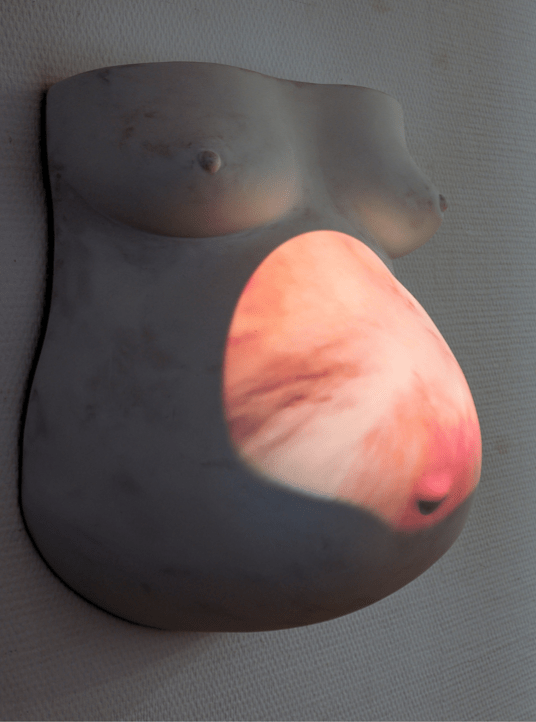
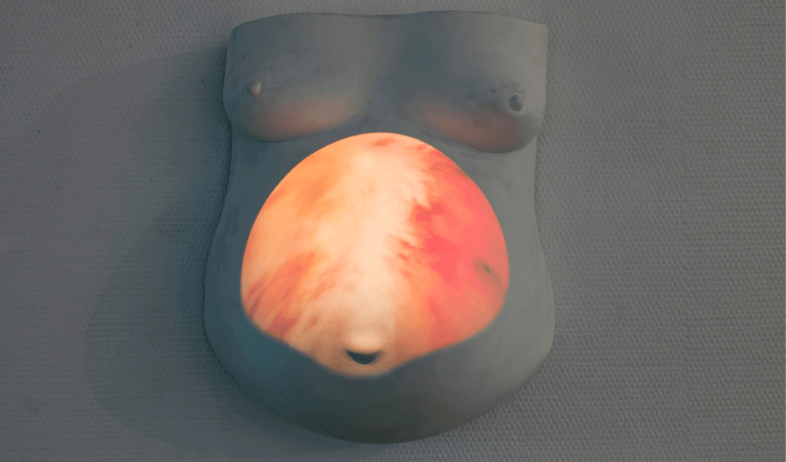
About the artwork »Pulsar« (2008–2024) by Kim Dotty Hachmann, video installation, 120 x 120 cm, white plaster cast from silicone mold, AI-generated video projection, sound; on view at Ausstellung „Aus heiterem Himmel“, November 1–23, 2025, Verein Berliner Künstler in cooperation with the A und A Kulturstiftung, part of the selection of artists nominated for the Kunstpreis für Bildende Kunst 2025.
»Pulsar« (2008–2024) by Kim Dotty Hachmann is a liminal artwork, situated in a threshold space: it invites the viewer to the impossible experience of seeing birth through the eyes of the one being born. This perceptual shift, created through the sculptural womb receiving a video projection generated by artificial intelligence, does more than represent birth; it invites the viewer to inhabit this state of coming into being in a way that is both intimate and disorienting. What is normally assumed as a self-evident beginning – the arrival into the world – is rendered strange, making the body, time, and relational conditions visible as active, contested dimensions.
The choice of the title, Pulsar, emerges naturally from this experience of threshold and passage. Coming from Latin-based languages – Portuguese and Spanish – the word carries the sense of pulsing, a rhythmic insistence that is felt physically and intuitively. Its pronunciation and cadence resonate with the ongoing, insistent force of life, preparing the viewer for the embodied experience of the installation that follows.
The white plaster womb, cast from a silicone model, functions simultaneously as membrane and surface. In this three-dimensional object, the video projection is not merely an overlay of image but a spatial inscription that transforms the volume into a body in flux, where presence, observation, and corporeality intersect. This practice, highly relevant in contemporary art, sits at the frontier of video-mapping and object-based installation: by projecting onto the womb, Hachmann creates a hybrid materiality in which digital imagery interacts with physical form, making the act of seeing inseparable from the act of being present. The body pulses alongside the viewer who experiences it in that moment, not as record or memory, but as a shared, in-the-moment event. In dialogue with the exhibition’s title, Aus heiterem Himmel, birth appears as something that comes unexpectedly – from nothing, yet also carrying the weight of a larger cosmology.
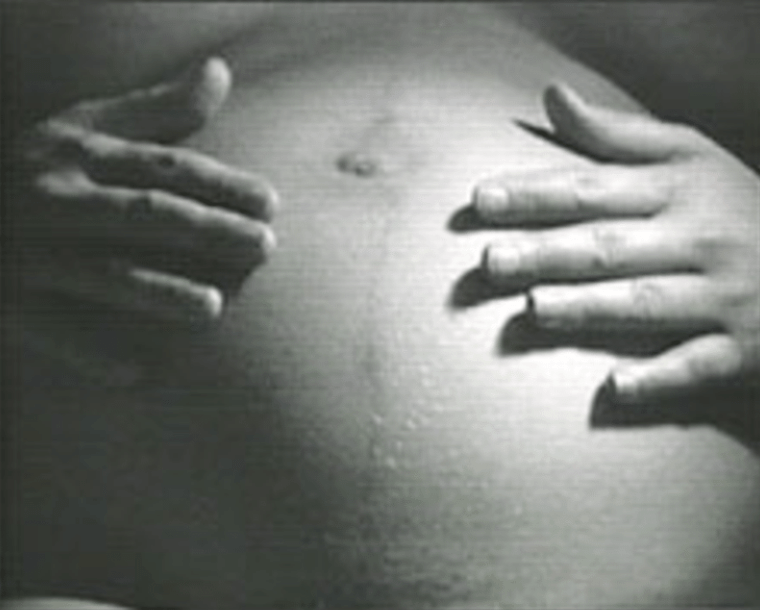
The sound layer is structuring for the work. Ancestral female chants are delivered through headphones, creating a focused listening space. This sound recalls practices that Western history medicalized, silenced, or disciplined, restoring birth to a ritual, communal, and cosmological dimension. Hachmann describes this experience as a “trance of self-empowerment,” repositioning maternity beyond idealization or stigmatization and making visible the agency of the female body. The artist’s declaration that “my female body is a gift” situates the work within a lineage of feminist practices that reclaim the maternal body from historical regimes of control and appropriation. In this sense, Hachmann’s gesture resonates with Mary Kelly’s pioneering works of the 1970s: in Anteparto (1973), Kelly transformed intimate traces of pregnancy into analytical records, and in Post-Partum Document(1973–79), she displaced the mother’s body from an object of representation to a site of enunciation, exposing how authority, authorship, and visibility are structured within patriarchal culture.
Mary Kelly Antepartum 1973, 8mm film transferred to DVD 1999.
The artificial intelligence[1] does not function as a neutral technical device; it acts as a proposer of ethical and existential questions. The imagery it generates occupies an in-between space: it is neither memory, nor representation, nor pure fiction. It attempts to imagine what cannot be remembered – the intrauterine space, the act of coming into the world – and in doing so, raises questions about how technology engages with the body, life, and the limits between human and nonhuman.
The title of this essay, »It Takes Love to Be Able to Pulse«, summarizes the ethical dimension the work evokes. The pulse is not only a heartbeat, but a cosmic vibration; a condition of shared existence, dependent on care, connection, and presence. Love here is not sentimentality, but a political, relational, and cosmogonic force. It is what sustains life and the very possibility of entering the world.
»Pulsar« (2008–2024) by Kim Dotty Hachmann
»Pulsar« returns us to the moment before consciousness, before language, before the world as we see it. At its core is the understanding that birth is not simply past, but a continual condition: we are always being launched into the world, always crossing membranes, always pulsating. The work opens a space onto this impossible moment, the impossibility of now, and in doing so, allows the viewer to recognize themselves as a body that vibrates, that is traversed, that inhabits this state of coming into being. Hachmann offers this passage as a form of reunion: with beginnings, with the body, with ancestry, and with the cosmos. In the end t reminds us that the pulse of life does not exist alone. To Pulse, One Must Love.
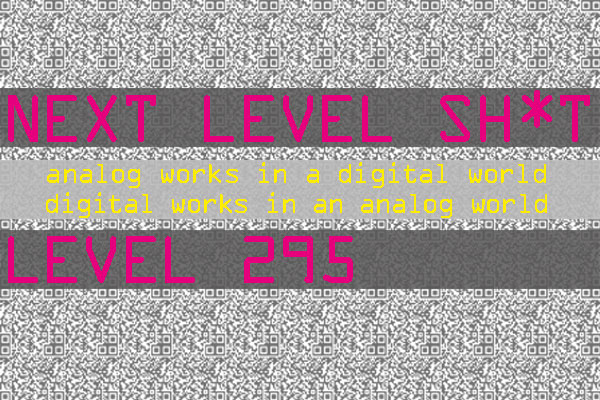
[1] The work was first presented in Next Level Sht* (2024) at INSELGALERIE Berlin, curated by the artist and Miriam Smidt, an annual exhibition dedicated to artistic practices engaging with artificial intelligence.
Publishing in Art Style Magazine is free of charge for anyone. There are no article processing charges or other publication fees. Art Style Magazine is independent and supports the Open Access Movement. The editors of Art Style Magazine cannot be held responsible for errors or any consequences arising from the use of information contained in essays and articles published on the Art Style Magazine’s website and editions. Authors agree to the terms and conditions and assure that their submissions are free of third parties’ rights. The views and opinions expressed in the essays and articles are those of the author and do not reflect the views of Art Style Magazine. The authors of Art Style Magazine’s essays and articles are responsible for its content. The Art Style Magazine‘s website provides links to third-party websites. However, the magazine is not responsible for the contents of those linked sites, nor for any link contained in the linked site content of external Internet sites (see Terms & Conditions).
Next Level Sh*t: Digital Works in a (Still) Analog World, curated by Kim Kim Dotty Hachmann and Miriam Smidt, INSELGALERIE in Berlin
Exhibition: Next Level Sh*t| INSELGALERIE, Berlin | until 24 January 2026
Essay by Natasha Marzliak, Curator, Art Critic, Professor of Art History and Aesthetics, and Associate Editor of Art Style International Magazine
In Next Level Sh*t – digital works in an analog world, curated by Kim Dotty Hachmann and Miriam Smidt, INSELGALERIE in Berlin unfolds as a continuous site of tension between the physical and the virtual, the artisanal and the algorithmic, the human gesture and technological mediation. The addition of (still) to the subtitle, (a still analog world), does not belong to the exhibition’s official title, but serves, in this essay, as a critical inflection that I propose, a deliberate gesture to name a liminal moment, in which we live, a suspended, unstable temporality where the analog persists not as nostalgic residue but as an active field of contestation.
Us series, by Miriam Smidt, 2025. Photo by Natasha Marzliak
Me, myself, AI, by Miriam Smidt,Video in the bar of the Insel Galerie. Photo by Natasha Marzliak
Update Us series, by Miriam Smidt, 2025. Photo by Natasha Marzliak
We inhabit a world increasingly saturated with synthetic images, AI-generated visualities, and regimes of hyperproduction that progressively hollow out the gaze. In this context, the question quietly underpinning the exhibition is not how to reject the digital, but how to continue producing meaning, experience, and relationality in an ever more fictive world, without losing sight of the fact that our relationships, affects, and corporealities remain profoundly “analog”. It is precisely within this interstice that the exhibition operates.
The curatorial structure resists a linear narrative of progression from analog to digital, favouring an experience composed of infiltrations, returns, echoes, and mirrorings, an expanded present in which matter and code no longer separate cleanly, and where the vision is constantly mediated by interfaces, platforms, and automated systems.
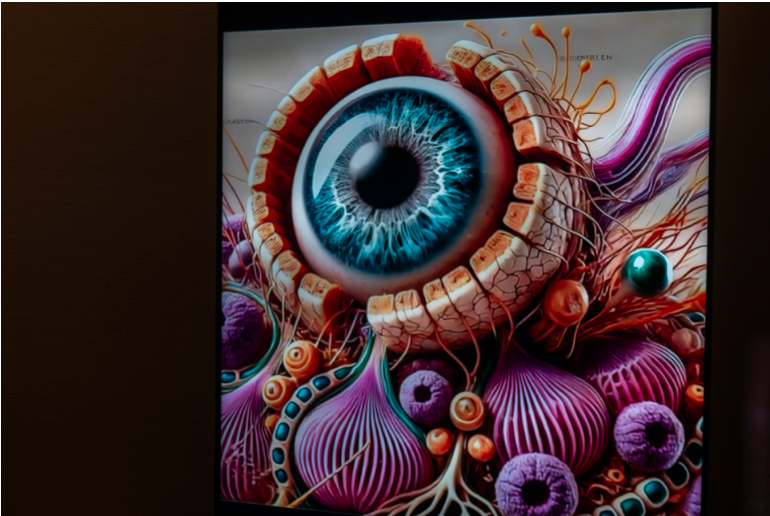
This logic manifests immediately upon entry, a print of an eye generated by artificial intelligence by Miriam Smidt greets the visitor, a static eye observing from the outset, functioning not as scenography but as a conceptual device, a non-human perception that precedes and frames the visitor’s experience. At the far right of the gallery, in the bar, a space of conviviality, distraction, and inebriation of Bacchus, the same eye returns in motion as an AI-generated video. Between print and video, between still and moving image, a silent circuit emerges that structures the entire exhibition, a continuous oscillation between presence and simulation, between what remains materially anchored and what flows, permeated by artificial intelligence.
The decision to begin the exhibition route on the right-hand side of the gallery, a deliberate choice of mine, reinforces this ambiguity. While this section hosts predominantly physical works, collages, paintings, prints, and objects, it does not constitute a sanctuary from the digital. The view has already been shaped at entry. The digital does not appear as a destination, but as a latent layer permeating the space, even where paper, paint, and matter remain tangible.
Within this liminal zone, Miriam Smidt’s works operate as a recurring conceptual axis. In Me, Myself, AI (2024), her images function as indices of subjectivity in constant modulation. Life, death, healing, and transformation do not emerge as opposites, but as transitional, fluid conditions.
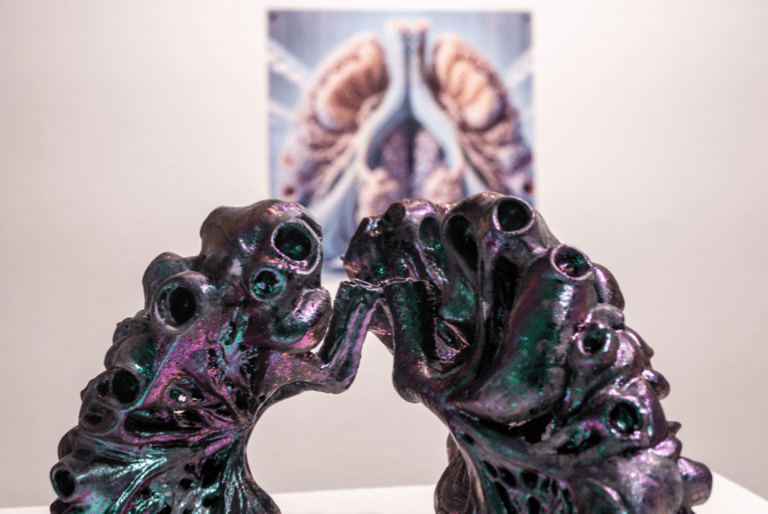
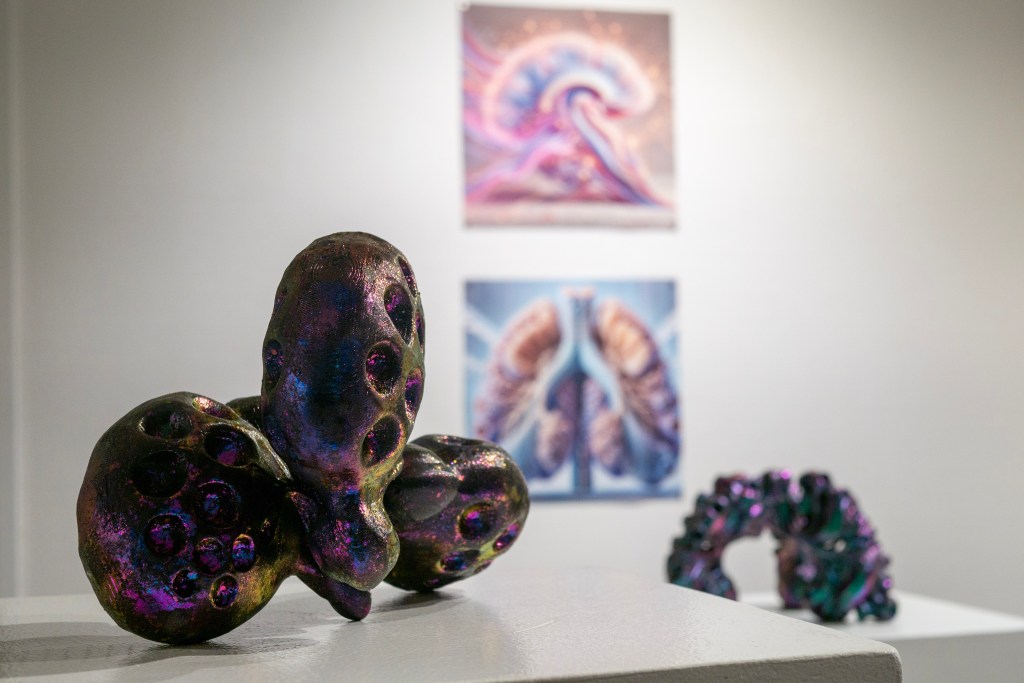
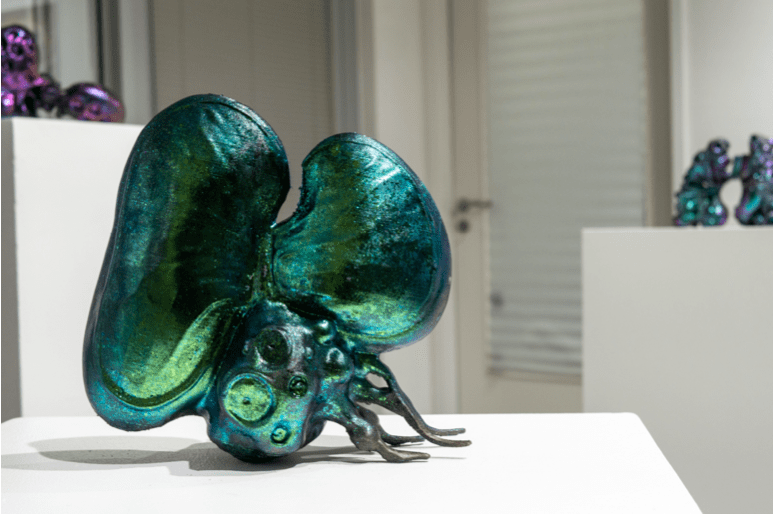
This exploration materialises three-dimensionally in the series Update Us (2025), realised in 3D printing. Glandula Empathiae, Memoria Triplex, and Glandula Dissolutrix designate fictional organs, as if the human body needed to be redesigned to survive a world saturated with informational flows. The AI eye accompanying the visitor from entry to exit functions as an amplified metaphor, an organ without a fixed body, observing, learning, and returning images.
Update Us series, by Miriam Smidt, 2025. Photo by Natasha Marzliak
Arctic Illusion (2025), by Swaantje Güntzel. Photo by Natasha Marzliak
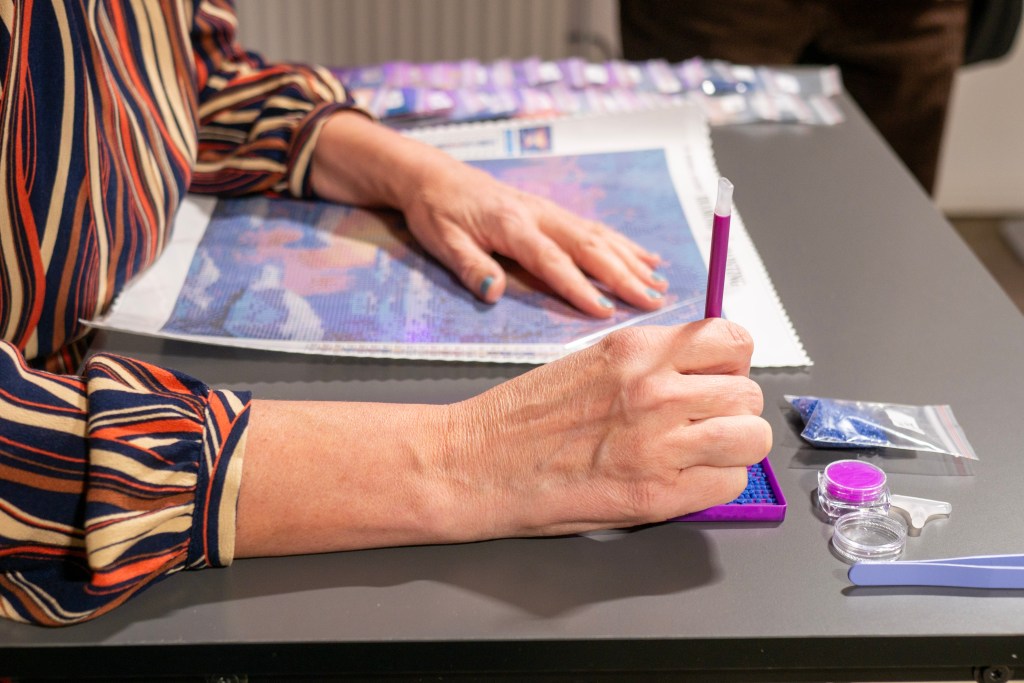
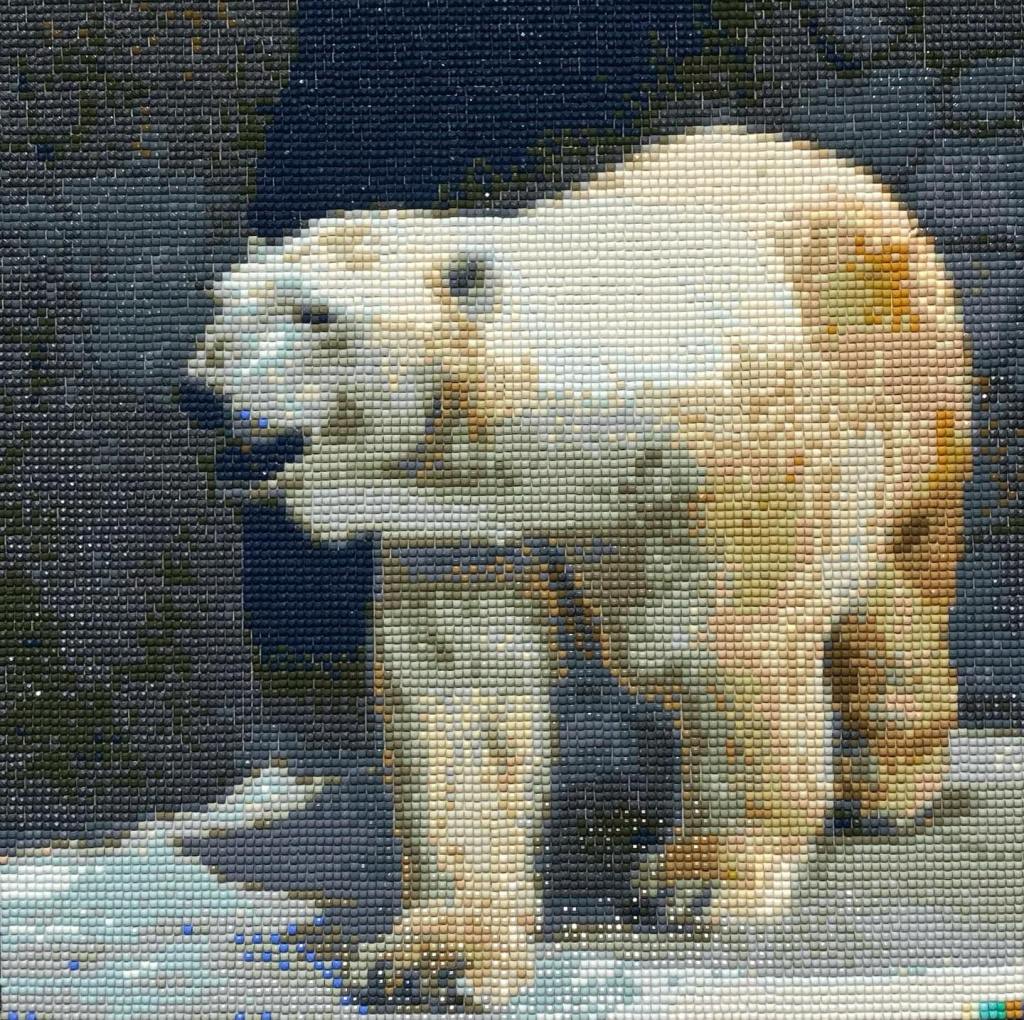
Also on the right-hand side, Swaantje Güntzel’s works offer a rigorous critique of contemporary landscape imagery. In Eisbär / Diamond Painting II and the installation Arctic Illusion (2025), popular artisanal techniques interrogate the aestheticisation of environmental catastrophe and the reproduction of stereotypical visions of the Arctic, now amplified through databases and AI-generated imagery. Dialogue with a chatbot in Arctic Illusion exposes the gulf between material urgency and discursive simulation, often more readily consumed than translated into transformative action.
Arctic Illusion (2025), by Swaantje Güntzel. Photo by INSELGALERIE Berlin
Arctic Illusion (2025), by Swaantje Güntzel
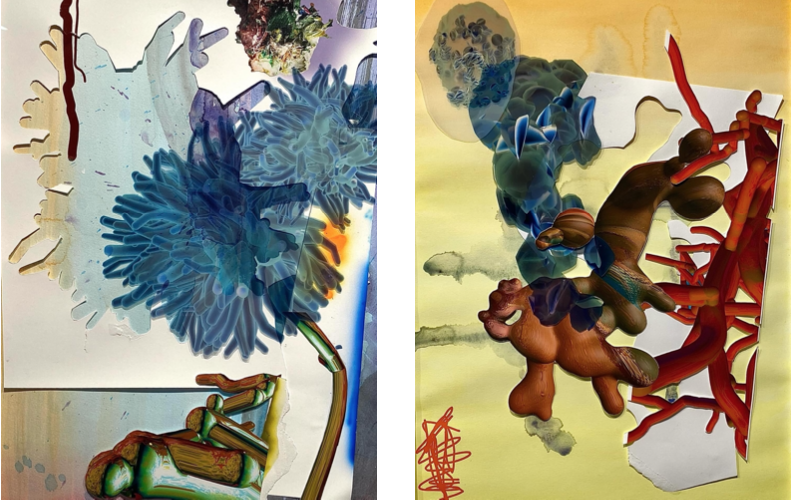
Maja Rohwetter’s collages and paintings establish a poetics of fragmentation. In Paradise #1 and Paradise #2 (2024), as well as in Gemischte Gefühle #19 (2025), paradise appears as a precarious construction, composed of cut-outs, overlays, and ambiguous affective registers. The logic of collage dialogues directly with the aesthetics of digital interfaces, feeds, windows, and layers, while manual execution asserts the corporeal presence of the artist. In In the Vicinity of Life Parts (2011), painting extends beyond the canvas, entering processes of virtualisation that destabilise the analog rather than negating it, transforming the medium itself into a field of ontological inquiry.
Paradise #1 and Paradise #2, by Maya Rohwetter, 2024. Photos by Insel Galerie
Moving toward the left-hand side, the exhibition brings into view what until then had operated as a subterranean layer, the digital emerging as a space in its own right, experienced through the curators’ careful scrutiny. Here, NFTs from Kika Nicolela’s collection assume a central role. Navigation through this territory remains cautious, and rightly so. The infrastructures underpinning the crypto universe are neither neutral nor free from environmental, economic, or political contradictions. Yet within this context, NFTs do not present themselves as redemptive nor as absolute villains. They emerge as symptoms of our times, spectral spaces in which images, affects, and experiences exist without stable physical anchoring.
In A Working Day (2025), Estelle Flores offers a quiet observation of labour time within the digital economy. An ordinary day is transformed into an aesthetic unit, a datum, a record. The work neither accuses nor celebrates, but observes. As an NFT, the piece amplifies this ambiguity: lived time is captured, edited, and circulated. What precisely is being archived here, a day of work, or the experience of existing under continuous regimes of productivity?
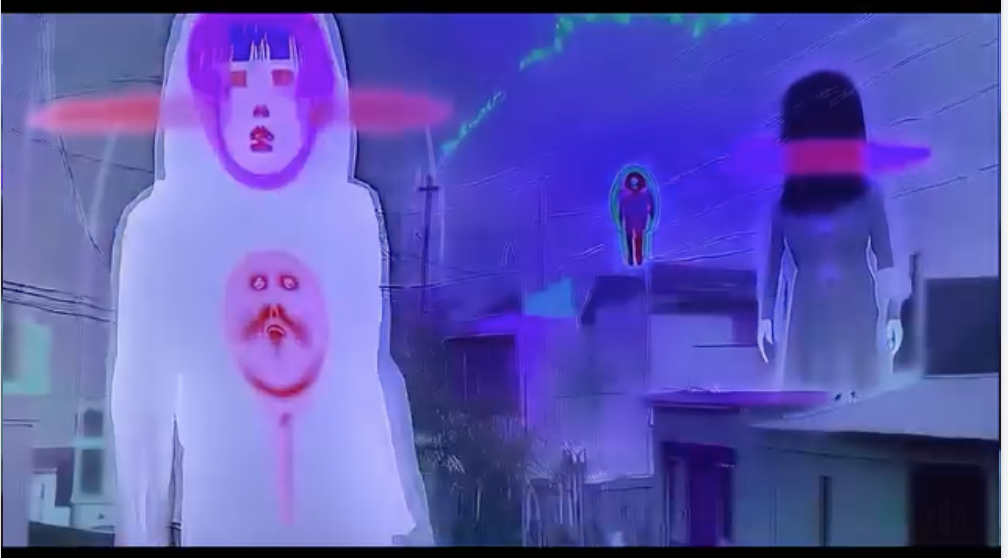
In the feels – seventeen aka. stepping through the warp that I can only see (2025), the artist littlecakes constructs a brief yet intensely sensory video. The work operates as a fragmented affective experience, marked by unstable rhythms and discontinuous perceptions. The “warp” of the title is not merely visual or temporal, but psychic, an internal displacement, difficult to articulate, referring to emotional states mediated through the digital. The piece inhabits a space between presence and disappearance, like a ghost that manifests only as flow.
the feels – seventeen aka. stepping through the warp that i can only see, by littlecakes, 2025 , NFT video Full HD, 0:43 min, and A Working Day“, by Estelle Flores, 2025, NFT video Full HD, 3:15 min. Photo by Natasha Marzliak
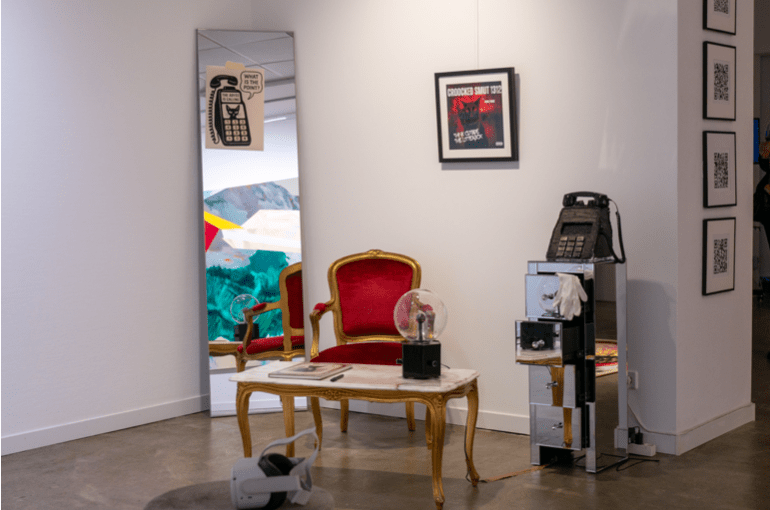
At the conceptual core of the exhibition, Ann Schomburg makes explicit what quietly permeates the entire path, infrastructures of intimacy. In CATThexis (2025), a complex and striking installation, visitors encounter a series of hybrid devices, physical works, a telephone through which they can “speak” to a cat, mirrors, digital interfaces, and a website narrating a futuristic story about human-animal relations. The narrative recalls elements from the film Minority Report (2002), in which technology monitors every gesture and glance. Visitors care for the animal, yet by failing to follow certain rules or protocols imposed by the digital control structure, they lose it. This tension between care, responsibility, and technological surveillance generates an immersive experience blending affection, frustration, and surprise, revealing how algorithms, digital systems, and attention economies shape relationships, desires, and visibility. Life, performance, and social practice intertwine, highlighting the active role of the visitor within the sensitive ecosystem the work constructs.
CATThexis, 2025, by Ann Schomburg, Multimedia-Rauminstallation, diverses Mobiliar, 3D- Telefon mit Handy, 300 x 400 cm. Photo by Natasha Marzliak
It is within this entanglement of works, languages, and media that (still), as a critical gesture, manifests its force. It does not signal nostalgia nor a refusal of the digital. It designates a heterogeneous transitional state. We are increasingly immersed in synthetic images and systems shaping perception, memory, and desire, while simultaneously relying on bodies, materials, and physical relations. The (still) marks this unstable interval, a time in which passage remains incomplete, with consequences still unresolved.
The question underpinning Level Sh*t is not new. It has arisen with the advent of photography, cinema, and video, and resurfaces now with symbolic artificial intelligence, NFTs, and digital environments: where is art headed? Perhaps the answer lies precisely in its capacity to endure. Art does not die. It appropriates, displaces, distorts, and reconfigures available media to render visible that which remains as yet unnamed.
The AI eye greeting visitors at the entrance, returning in motion at the end of the route, offers no answers. It returns the question to the visitor. Perhaps the exhibition’s subtitle, digital works in an analog world, speaks precisely to this, not a delay but a critical interval, a time necessary to think, feel, and conceptualise the observing before the analog becomes mere archive or fetish. This will not occur, as everything intertwines in the loose threads of contemporary art. Level Sh*t reminds us that we are midway along the path, and in the meantime, the responsibility to look and to think the gaze persists. It is incumbent upon us, artists, curators, critics, and audiences, to sustain this reflection.
The curators Miriam Smidt and Kim Dotty Hachmann. Photo by Natasha Marzliak
Opening hours: Tue–Fri 2-7pm, Sat 1-5pm Finissage of the show with artist talk: Sat 24th January 2-4pm
Publishing in Art Style Magazine is free of charge for anyone. There are no article processing charges or other publication fees. Art Style Magazine is independent and supports the Open Access Movement. The editors of Art Style Magazine cannot be held responsible for errors or any consequences arising from the use of information contained in essays and articles published on the Art Style Magazine’s website and editions. Authors agree to the terms and conditions and assure that their submissions are free of third parties’ rights. The views and opinions expressed in the essays and articles are those of the author and do not reflect the views of Art Style Magazine. The authors of Art Style Magazine’s essays and articles are responsible for its content. The Art Style Magazine‘s website provides links to third-party websites. However, the magazine is not responsible for the contents of those linked sites, nor for any link contained in the linked site content of external Internet sites (see Terms & Conditions).
An immersive crossover design defying limits for Dutch Design Foundation
Event: DUTCH DESIGN WEEK 2025
Location: Ketelhuisplein – Eindhoven NL
– Architect: mesure studio (Raphaël Boursier Desvignes) – Paris
Designer: ultimo intimo (Charlotte Kammerer) – Berlin
Sound designer: Vincent Drux – Paris
Introduction
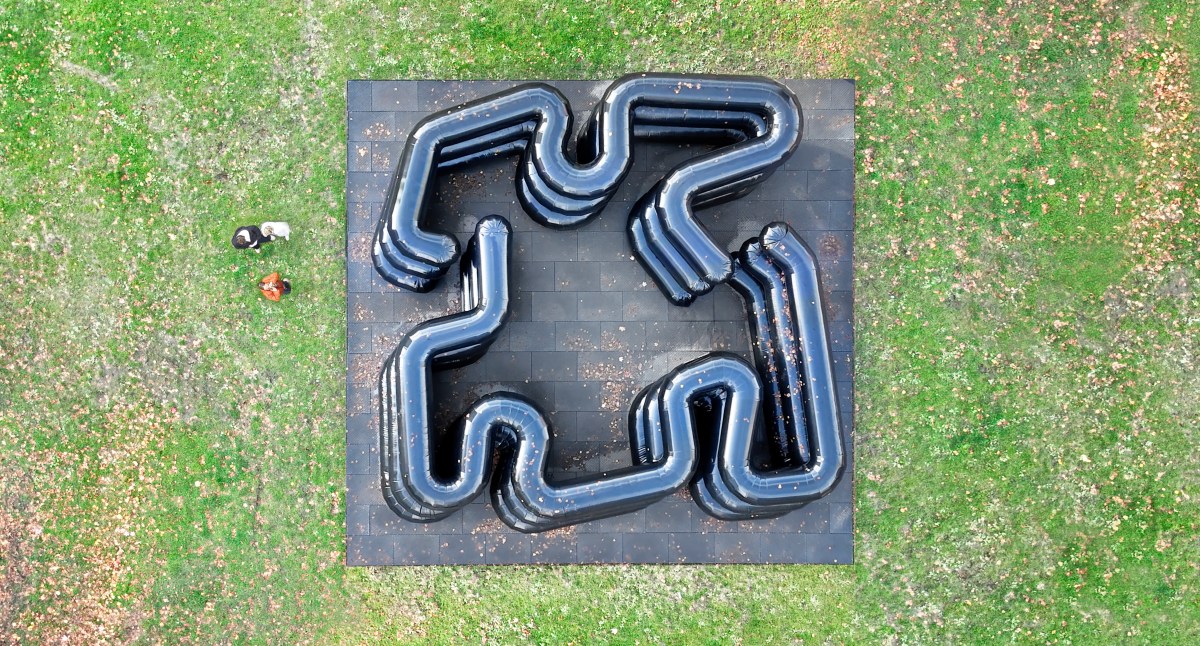
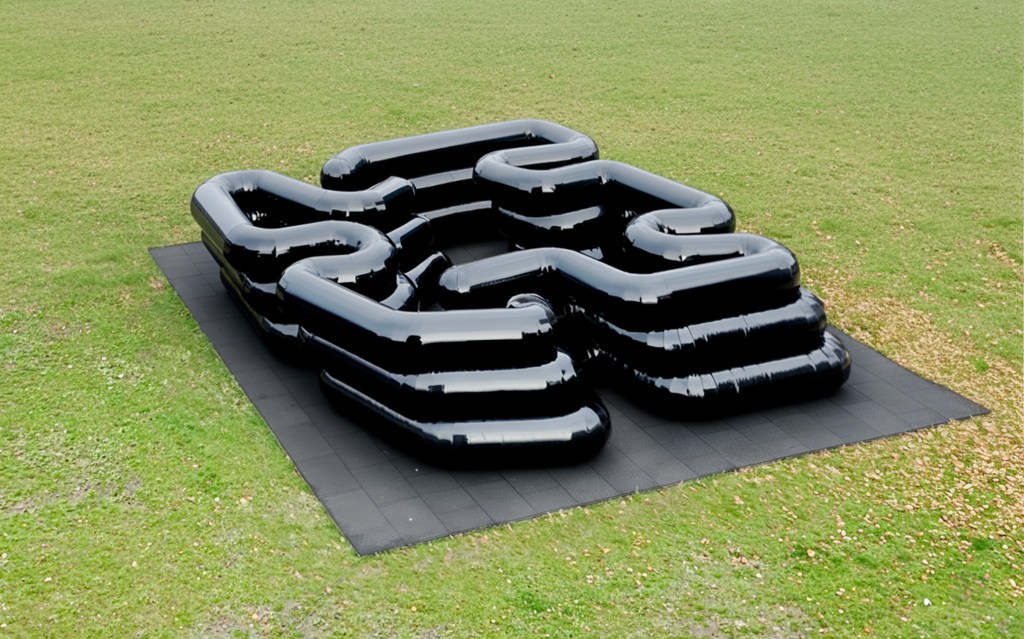
In a Europe navigating fragmentation, digital isolation, fear, and conflict, SONIC MAZE emerged from the collaboration between French architect mesure studio and German designer ultimo intimo. Their 12 × 12-meter structure is an original, custom design composed of two independent inflated bodies. At Dutch Design Week 2025, it rose to its full shape within minutes on the festival’s central plaza. Selected as Grand Project by the Dutch Design Foundation, the installation was conceived as an introductory threshold welcoming the 350,000 visitors expected over the nine days of the fair. A radical presence that resists categorization, SONIC MAZE challenges the boundaries between design, art, music, and architecture – inviting visitors to collectively imagine the future and to reconsider the limits we place upon ourselves.
Experience
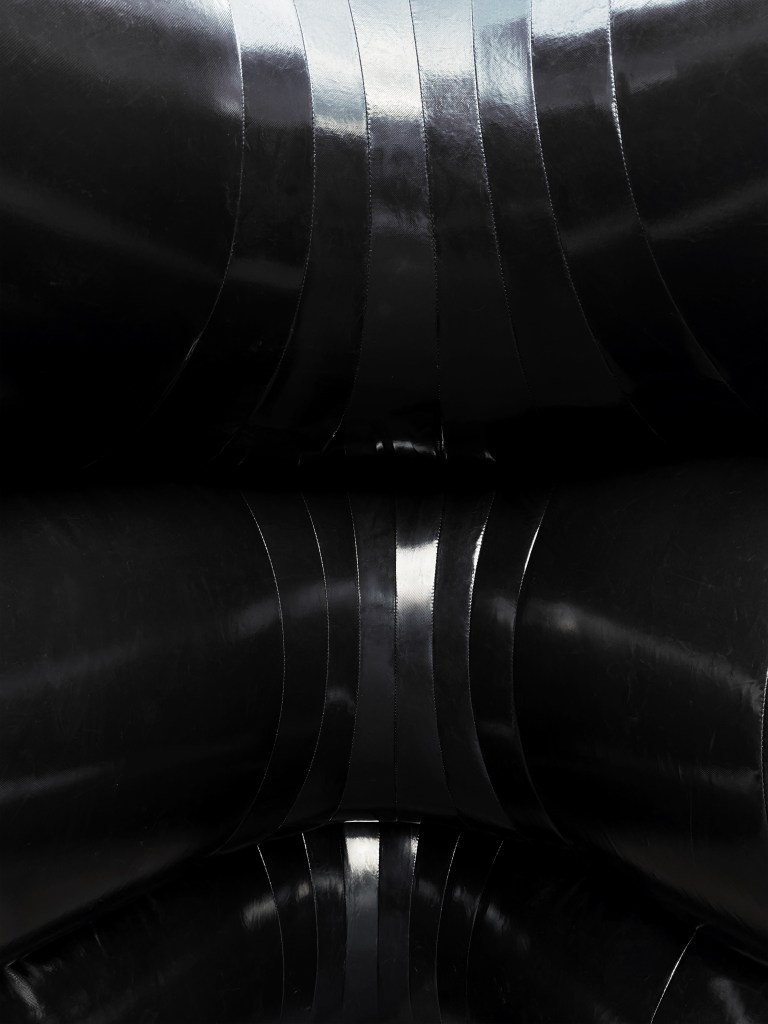
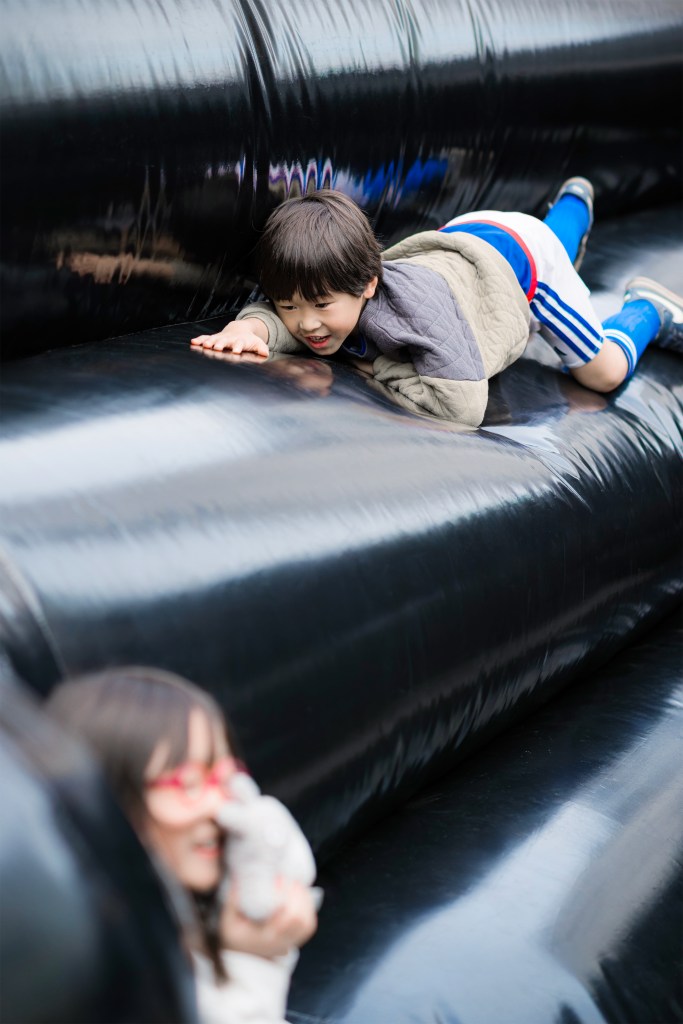
Confronted with a monumental black presence, visitors were drawn into an unexpected start to their Design Week experience. Entering required physically pushing through soft, inclined walls – a bodily threshold. Inside, dense fog periodically shifted the senses away from sight, while immersive sounds animated the interior, giving the structure the presence of a living organism. At its core, the project explores and challenges the notion of limits. Depending on one’s position, the same surface might appear impossibly steep and impassable, or conversely, as a terrain to inhabit – to sit on, climb, play with, or explore. Visitors were encouraged to drop assumptions and renegotiate the boundaries between themselves and the space. Vibrations travelled through the membrane-like walls wherever bodies touched, leaned, or lay against them. To create a world apart that invited movement and perceptual drift, French electronic music producer Drux composed a series of spatial soundscapes, each unfolding in infinite variations. Inspired by white noises, drones, and shifting air pressures, the symphonic composition evolved continuously in response to time, position, and chance, ensuring each visit felt unique and ephemeral.
Outlook
The SONIC MAZE revealed the power of open-ended design: a structure that can become a concert venue, festival stage, playground, public sculpture, meditative space, or gallery installation – depending on who enters and how they choose to engage. Its versatility demonstrated how audiences intuitively take ownership of spaces that invite rather than instruct. Looking ahead, mesure studio and ultimo intimo seek collaborators who share an appetite for experimentation, public engagement, and immersive storytelling – across culture, technology, architecture, music, fashion, and the public realm. Ultimately, the SONIC MAZE leaves a question at the heart of contemporary design: What possibilities emerge when creativity is freed from categories, and when we allow spaces – and the people who inhabit them – to redefine what design can be?
Sonic Maze, DDW25, Eindhoven NL, mesure studio x ultimo intimo, photo credit Charlotte Kammerer, 2025.
Sonic Maze, DDW25, Eindhoven NL, mesure studio x ultimo intimo, photo credit Charlotte Kammerer, 2025.
Sonic Maze, DDW25, Eindhoven NL, mesure studio x ultimo intimo, photo credit Max Kneefel, 2025.
Sonic Maze, DDW25, Eindhoven NL, mesure studio x ultimo intimo, photo credit Charlotte MSD, 2025.
Written by Natasha Marzliak, art critic, curator, and studio manager
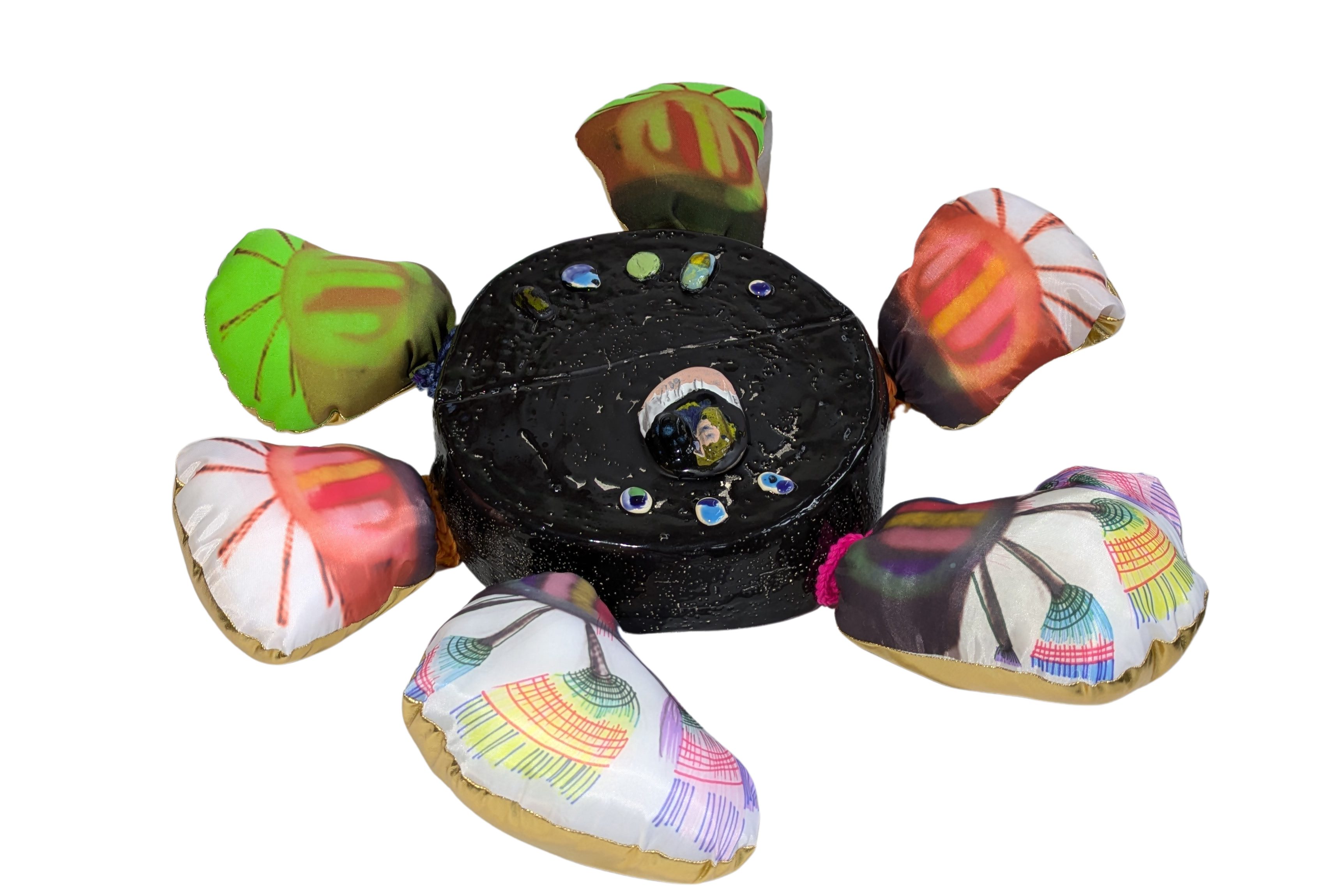
When I first encountered Laura Kärki, a Finnish artist based in Berlin, in 2024 at VBK (Verein Berliner Künstler), one work captured my attention: Sweetheart (2024). A robot vacuum transformed into a hybridobject -composed of ceramics, glazes, textile prints, mixed crochet, and filling material – radiated joy through its saturated colors while destabilizing formal expectations. The piece carried a sense of humor, yet it is not naive; its wit is measured and ambivalent. What first appeared light was anchored, quite literally, by the weight of its ceramic components painted in black, a grounded counterpoint to the cheerful palette. Ceramics curtail the mobility embedded in the robot vacuum’s original function; rather than circulate freely through space, Kärki’s hybrid creature is immobilized and fixed in place.
Sweetheart (Robot vacuum), 2024, Ceramics, textile prints on polyester, crocheted yarns and filling material, 60x60x12cm, photo by Laura Kärki.
The work enacts the embedded architectures of expectation – those that guide conduct, dictate domestic routines, and render certain bodies legible only within normative matrices. For women, childhood memories of play – often structured around chores and implicit social codes -surface not as nostalgia but as structural logic: care, responsibility, and ritual are inscribed in the object’s form, its weight, and its configuration. Sweetheart becomes a material diagram of constraint, a tactile map of gendered circulation and the invisible burden of domestic expectation. The domestic device – typically associated with a sanitized, frictionless functionality – is transformed into something dense, resistant, and oddly vulnerable. Kärki sidesteps predictable tropes of feminist commentary by refusing melodrama. Instead, she stages the problem materially: constraint presents itself as a physical condition, revealing how women’s bodies are shaped, slowed, and contained by expectations that appear innocuous.
Central to her practice is the notion of “the game”: her works operate as propositions in which play is not a theme but a method and a strategy. In Sweetheart, elements of childhood play are present -soft textures, crafted surfaces -yet the game is structurally rigged. The pleasure of touch coexists with the impossibility of movement; the impulse toward interaction meets a quiet divergence from the object itself. Kärki stages a game whose rules we, women, recognize intuitively, because they are inherited through social conditioning, yet she alters the parameters just enough to expose their arbitrariness. This modulation becomes a tactical demonstration: the object enacts constraint, proposes by withholding, and reveals through absence.
This strategy is potent precisely because it does not critique from the outside. Kärki works within the symbolic vocabulary of domestic life – toys, appliances, decorative techniques -introducing disruptions that operate from within. Crochet, printing, and ceramics, historically tied to gendered labor, are recomposed into structures that neither obey utility nor fully abandon it. They function as traps disguised as invitations: objects that generate friction while confronting the viewer with inertia and hesitation.
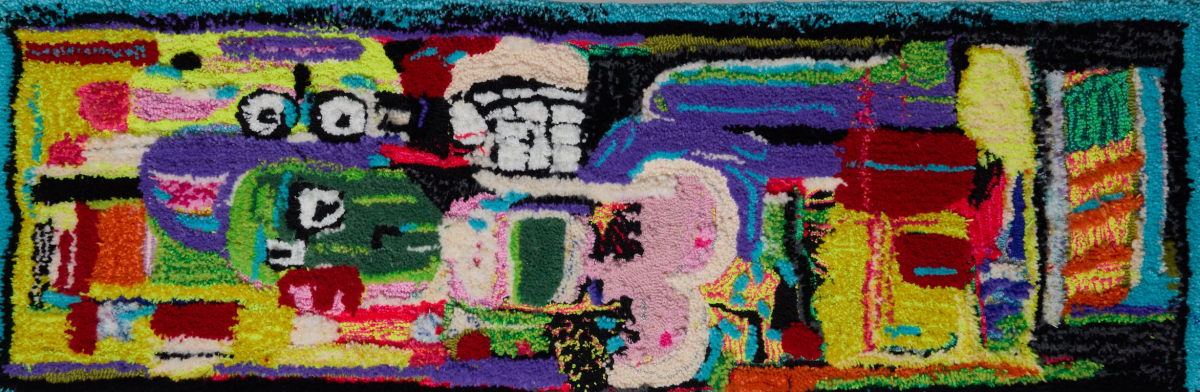
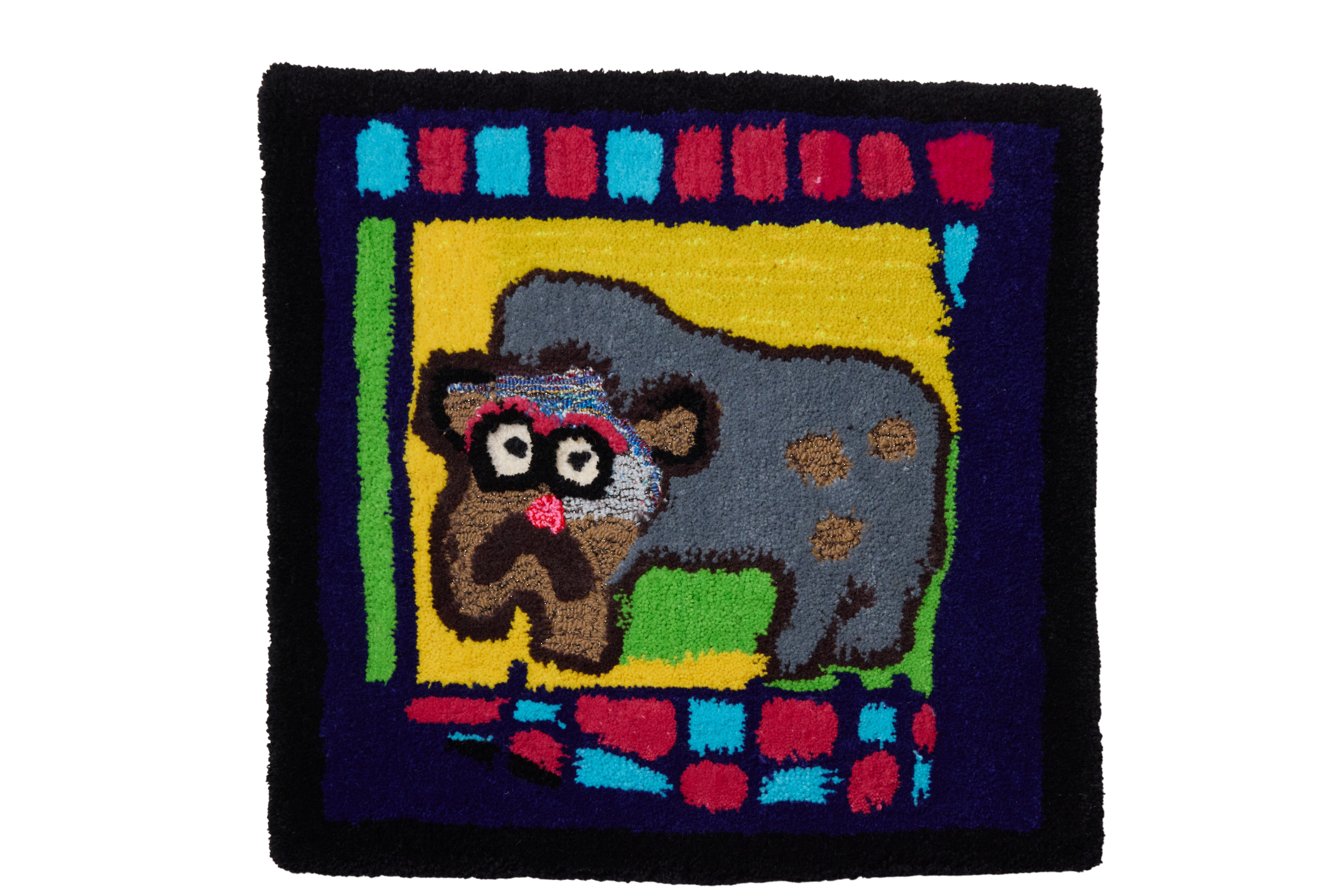
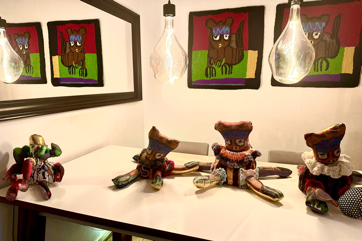
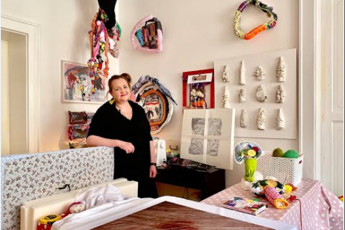
The concept of the game becomes even clearer when considered alongside other works in her practice. On November 2nd, during Schöneberger Art 2025, I visited her studio and encountered pieces such as A Wild Boar in Grunewald Forest(2022), Tattered Children Room Teddy Bear (2024), An Embarrassed Guinea Pig (2024), and Bastard (2024), among others of equal significance. The studio’s arrangement allowed each work to stand as a distinct entity while entering into a network of relations between gesture, memory, and materiality. Here, too, the game manifests not as entertainment but as structural strategy: inherited rules, choreographies of behavior coded as natural, and the quiet forms of sabotage that Kärki introduces to make their mechanics visible.
A Wild Boar in Grunewald Forest, 2022, Tufted different yarns, 29x29x3cm, photo by Laura Kärki.
Bastard, 2024 111 x 38 x 3 cm, mixed tufted yarns, photo by Laura Kärki.
There is a surface softness in Kärki’s pieces, made palpable through threads, fabrics, tufts, and crochet. Yet this tactile immediacy only partially conceals a deeper undercurrent: a murmur of containment, invisibility, and stories truncated before they fully emerge. Her figures move within a delicate oscillation between levity and gravity, presence and erasure, mnemonic trace and invented memory. What appears playful becomes charged with critical ambivalence, exposing the instability of recollection itself. The resulting tension evokes the fractured temporality of childhood imprint, where perception is dispersed, recursive, and always on the verge of slipping into multiplicity – a multiplicity that reflects remembrance and also the multiple vectors of social, cultural, and affective forces that shape subjectivity.
Many works exist in two, three, or more versions, nearly identical yet never the same. Each iteration sharpens difference and discernment. Every deviation in tufts, stitches, and crochet produces a shifting field of possibility, suggesting memory is never stable but always reconstituted. The saturated colors, bold outlines, and ambiguous expressions combine critical subtlety with an almost baroque exuberance: layered compositions, dense textures, and chromatic intensity turn each object into a miniature theater. The outlines and ambiguous expressions generate a mode of looking oscillating between immediacy and reflection, combining subtle critique with a vibrancy refusing closure. Each object becomes a site where micro-narratives emerge and recede, foregrounding the fragmentary, the minor, and the overlooked. Kärki’s poetics embraces this instability, inviting a perception attuned to Zeit as conceptualized by Benjamin and Husserl: both layered, fragmentary, and charged with potential (Benjamin), and simultaneously experienced, retentive, and anticipatory, shaped by consciousness itself (Husserl). Kärki’s sculptures instantiate this dual temporality, producing a field where affect, reminiscence, and relationality emerge in their full complexity, resisting the flattening velocity of contemporary visual culture. They demand a tempo of attention that is relational, recursive, and never fully captured, an apprehension calibrated to notice the subtle oscillations, deviations, and resonances that define lived experience.
An embarrassed guinea pig, 2024, 1_2, mixed tufted yarns, 67 x 63 x 2 cm, photo by Laura Kärki.
Tattered Children´s room teddy bear, 2024, 3D Ceramics, glazes, textile prints on polyester, mixed crochet yarns and filling material, 52x54x28cm, photo by Laura Kärki.
An embarrassed guinea pig, 2024, 2_2, mixed tufted yarns, 66 x 66 x 2 cm, photo by Laura Kärki.
An embarrassed guinea pig free 1,2, 2024, photo by Laura Kärki.
Kärki constructs a poetics of touch and variation, where materiality and thought intersect. Her sculptures, often toy-like, are not exercises in nostalgia; they decelerate cognition within the logic of accelerated visual culture. Her work retrieves subjectivity diminished by hyperreality, AI-driven systems, and speeded visual consumption, creating spaces for attentive engagement and discovery. Each piece subtly resists the dominance of efficiency and uniformity, reaffirming the value of human gesture, imperfection, and nuance. Her practice is simultaneously intimate and expansive, playful and analytical, generating conditions for reflection, recognition, and imaginative inhabitation.
Laura Kärki´s Studio in Berlin, photo by Natasha Marzliak
The artist’s approach embodies a capacity that nurtures the critical potential of art: to pause, to dwell in affect. In an era dominated by homogenized rhythms and algorithmic leveling, her practice affirms the value of slowness, tactility, and the singularity of experience. In Berlin and beyond, I hope to encounter more works of this kind -those that compel us to decelerate, offering an invitation to pause, a gentle interruption to the relentless, runaway pace of post-modern life. At the close of our studio visit, she presented a small rug, suggesting it might be placed beside one’s bed to initiate the day differently: embodied and attuned to possibility – a practical, poetic recalibration of perception. This gesture crystallizes the “game” Kärki stages: its rules are discovered through touch, attention, and the oscillation between expectation and deviation. The game is neither mere play nor entertainment; it operates as a mechanism of critical engagement, rendering the familiar strange and the overlooked legible.
Morning at 5 o´clock, 2025, mixed tufted yarns, 54x65x2cm, photo by Laura Kärki.
Laura Kärki in her studio in Schöneberg, Berlin, photo by Finnland Institut
Benjamin, Walter. 2010. Über den Begriff der Geschichte. In Werke und Nachlass. Kritische Gesamtausgabe, Band 19. Frankfurt am Main: Suhrkamp.
Benjamin, Walter. 2019. Ursprung des deutschen Trauerspiels. Faksimilenachdruck der Erstausgabe von 1928. Herausgegeben und mit einem Kommentar von Roland Reuß. Göttingen: Wallstein.
Benjamin, Walter. 1982. Das Passagen-Werk. Hrsg. Rolf Tiedemann. Frankfurt am Main: Suhrkamp. (English translation: The Arcades Project, trans. Howard Eiland & Kevin McLaughlin, Cambridge, MA: Harvard University Press, 1999.)
Husserl, Edmund. 2000 (orig. 1928). Vorlesungen zur Phänomenologie des inneren Zeitbewusstseins. Halle a. d. S.: Max Niemeyer. (3. A., unveränderter Nachdruck der Erstausgabe von 1928.)
Opening: 20 November 2025 | Exhibition runs until 15 January 2025
In Reveries, Sanges invites viewers to cross the delicate line between reality and imagination, presenting a selection of photographs that float between the possible, the dreamlike, and the uncanny. The exhibition creates a visual landscape of gentle confusion and wonder, where the everyday becomes absurd and new visions softly appear.
Through sharp portraits, surreal compositions, busy group scenes, and moments where viewers become voyeurs, Sanges constructs worlds that feel both familiar yet subtly altered. Each im- age becomes a fragment of a “woken dream,” a suspended moment where reality dissolves. With rigorous attention to light, colour, and form, his works are calibrated to both enchant and destabilise.
Each photograph unfolds as a staged cinematic tableau, where every figure is orchestrated with the deliberate precision of a film director. Sanges’ characters are poised, inhabiting settings that contrast opulence with decay, creating tense, theatrical spaces. Echoes of Helmut Newton’s elegance meet the surreal wit of Man Ray. Each figure engages in intricate movements, and their poses add ambiguity and drama.
While Sanges has long explored the technical possibilities of digital photography, his practice remains deeply and unshakably rooted in the analogue. All the works presented in Reveries are shot entirely on film. In resisting the instantaneous perfection of the digital, Sanges embraces the slow alchemy of analog photography, where light and time are interwoven with artistic intent.
Building on this foundation, Reveries continues Sanges’ exploration of dreamlike states and psychological landscapes, expanding themes developed in his earlier series Wunderkamera, Circumstances, Polaroids, Big Scenes, and, indeed, Reveries itself.
Mattia Martinelli, director of Robertaebasta, and Giorgia Zen, gallery manager, have expressed great excitement for this upcoming display. Zen, who was first struck by Sanges’ talent, reflects on his imagery:”It is the sensation that lingers upon waking from a dream, an instant when reality feels suspended. Was it real? Did I dream it? Or am I still within the dream? In that fragile, fleeting moment, the real and the imagined coexist, and all possibilities seem alive. It is a rare and singular experience.”
Exhibition Details
Robertaebasta London, 85 Pimlico Road, SW1W 8PH, London Opening: 20th November 2025 | Closes: 15th January 2025 Opening Reception: 20th November 2025, 6–9 PM
For press inquiries, image requests, or to arrange an interview, please contact: Giorgia Zen – Gallery Manager – giorgia@robertaebastalondon.co.uk
About the Artist
Marco Sanges is an Italian award-winning photographer known for his distinctive surrealist vision and narrative-rich imagery. His work navigates the boundaries between dream and real- ity, frequently constructing cinematic tableaux that probe psychological depth and the uncanny. Sanges has created acclaimed series such as Wunderkamera, Circumstances, Polaroids, and Big Scenes, which have been exhibited globally and featured in multiple photobooks. He currently resides and works in London.
About the Gallery
Established in Milan in 1967, Robertaebasta is a globally recognised gallery celebrated for its expertise in twentieth-century art and design. The gallery remains dedicated to illuminating the connections between historical achievement and innovation, showcasing works that foster re- flection and dialogue across generations. Robertaebasta London, at 85 Pimlico Road, continues this legacy, providing a meticulously curated space where the richness of Italian mid-century art and design converses meaningfully with present-day creativity.
The exhibition is now open and will run until November 22, 2025.
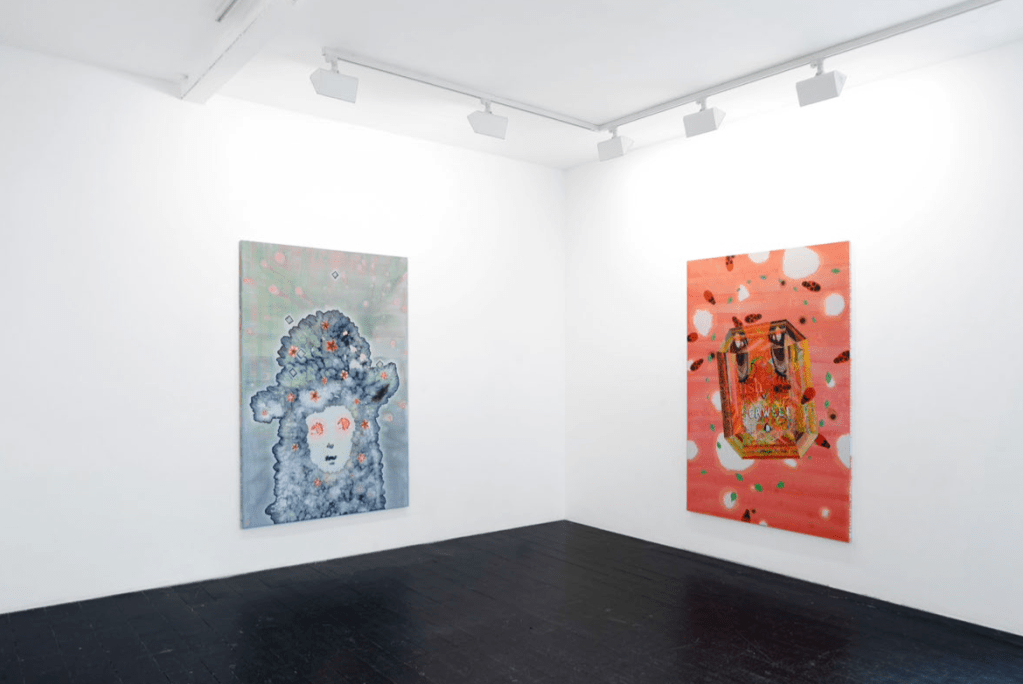
Union Gallery is delighted to present The Meadow, Billy Crosby’s first major solo show in London to date. The exhibition presents a brand-new series of paintings from the artist’s studio in south-east London.
Concentration Without Effort, 2024. Acrylic and collage on polyester 50.8 x 101.6 cm
The singular work of Billy Crosby intuitively connects the complex relation of painting to current global discourse around the subject of machine learning and its impact on socio-political and personal futures. Crosby guides us into this novel landscape by adopting ‘new tech’ as a natural partner in paint, quieting the hysteria surrounding AI and its potential consequences. Instead, Crosby offers a deeper painterly means to probe these concepts at the dawn of their realisation.
The Meadow signifies a gentle, liminal place of emergence; of rest and threshold, wildness and openness. It implies a context of entangled life, diverse intelligences and larger patterns.
(Billy Crosby)
The eponymous meadow can be understood then, as a literal setting as well as an inner or psychic terrain. Both ancient and modern, The Meadow operates on a suspended plane of speculative contemplation. Here we encounter the fruits of Crosby’s lived experience filtered through a recursive dialogue with generative AIs and LoRA diffusion models, trained on the artist’s previous work.
Motifs of biological mimicry and artificial emergence run throughout the work. Forms suggestive of mycelium, neural net structures and symbolic architectures flicker in and out of legibility…
(Billy Crosby)
The formal configuration of his painting often involves the recurring figurehead of a guide-like chaperone, part mystic, part automaton. Though not a central subject, the recurring presence of this talismanic animation leads us through Crosby’s labyrinthine imagery, and hints at sentience within the complex lexicon of his visual language.
Collectively, this body of work represents a pertinent commemoration of the current moment as digital advances reshape the eternal record once again. We meet Crosby in this rarefied prairie of interconnected existence, this neutral and neural pasture, to experience afresh the senescence of living and snatch a glimpse of contemporaneity as it stands at the cultural crossroads of today.
The Meadow
By Shane Bradford and Siân Newlove-Drew
A head signifies cognisance, consciousness and first vitality; it’s the first part of the body to enter the world. Within the head is vital parts- the eyes, ears, nose, mouth, and the brain. This organ of nervous tissue is suspended in fluid, floating, ensheathed by multiple membranes. The external protective membrane is the dura matter, then in the middle is the transparent arachnoid membrane, named as such for its delicate spider web-like projections of protective tissue, cells and connections. The most interior layer of membrane around the brain is the pia matter, also termed the ‘tender mother’ membrane.
The ‘mother’ is an often-used metaphor for the world. Billy and I live next to a meadow, together, we often cross it. The meadow pushes us out- the opposite orient of home and returns us to it, moving through in different emotional states, imagining, and noticing, walking in glimpsed feeling.
During the summer’s heatwave, it caught fire. The meadows centre turned torrid, jet black and planetary, rolling into unharmed grass, distinctive, and changed against the green. It didn’t take long until plants asserted growth, in a stirring of rejuvenation. The blackened grass, rapidly flecked with new colour and shape. Standing inside it, I felt an exchange between Billy, myself, and the meadows atmosphere. We were spirited witnesses to the fire-the once buoyant embers and smoke, and the diligent roots, invisible underground-the manifest and the unseen felt. The meadow a resilient mother, a constellation, a nervous system of organised receivers, pollinators, processors, and responders.
‘Floaters’ are visual symptoms which appear in one’s vision. Emerging like snowflakes, thread-like objects, dots, rings, petals, insects, and amorphous clouds, or flashes. Floaters occur when strands and specks drift in the eyes vitreous humour and cause shadows. These shadows are perceived as suspended, appearing active and elusive, shifting across the visual field. In ancient Greek and Roman times, they were termed muscae volitantes, translating to “flying flies” and compared to lentils and swooping birds. Throughout history, humans have tried to understand these phantom specks, and have even interpreted them as supernatural and spiritual, and as optical messages from divine realms.
The idea that the eye could emit light was an enduring theory in early history. Empedocles compared the eye to a lantern; and therefore, vision the result of the eyes ‘light’ touching objects and grasping them with its beams. Ancient philosophers understood everything as made of the four elements, fire, air, earth, and water; and that the eye, an incredible flaming beacon, was ignited by Aphrodite. To ancient people, this theory made sense. It was a reasonable explanation for the intense illuminated solar form that persists and reverberates when eyelids are closed, after looking into the sun, or the flashes and flares under skin, when eyelids are pressed with fingertips.
It also explained the occurrence of reflective optical orbs in the heads of wolves and lambs in the dark. We now understand this as ‘tapetum’, a mirror like layer beneath the retina, creating the eye-shine and night vision in animals. I can understand the thinking- and as a child, I liked the red discharging eyes that developed in the flash photos of me at birthday parties, and at Halloween. This red eye effect occurring in humans is caused by light
reflecting the blood in the back of the eye. This effect transformed me into a cat, hero, or mystic. The heads in Billy’s paintings, are perhaps fuzzy lambs with ablaze retinas… or cats or hero’s or mystics, or witnesses; us, interacting with the corporal world. Foregrounded, flashed, and focussed.
The reflective surface of the eyeball has stimulated gem-like descriptions. Comparable to the eye, it was thought that within a gemstone; compounded, absorbed, and intensified, was a light. Eye agate describes the distinctive formations of concentric rings, akin to iris and pupil, found within agate stone. Cats Eye Chrysoberyl, Bulls Eye, Hawks Eye and Tigers Eye are gemstones named after the eyes of animals.
Gemstones are used as talisman, for balance and for healing. They are connected to qualities, archetypes, and spirits. They are selected through connection to particular associations and externalise an innate and personal resonance. On holiday, Billy bought a purple piriform Amethyst. The stone containing stratums of white ocellus markings, and on the side less smooth, a love heart. I bought a carnelian, attracted to its redness and perfect sensual roundedness.
Today, passing through the meadow, I was stopped by a fallen leaf. It was glowing and crimson, and so glossy it was nearly viscous. Out from its midrib flared gold and orange. I photographed it to share with Billy. I typed, ‘fire leaf’ and pressed send.
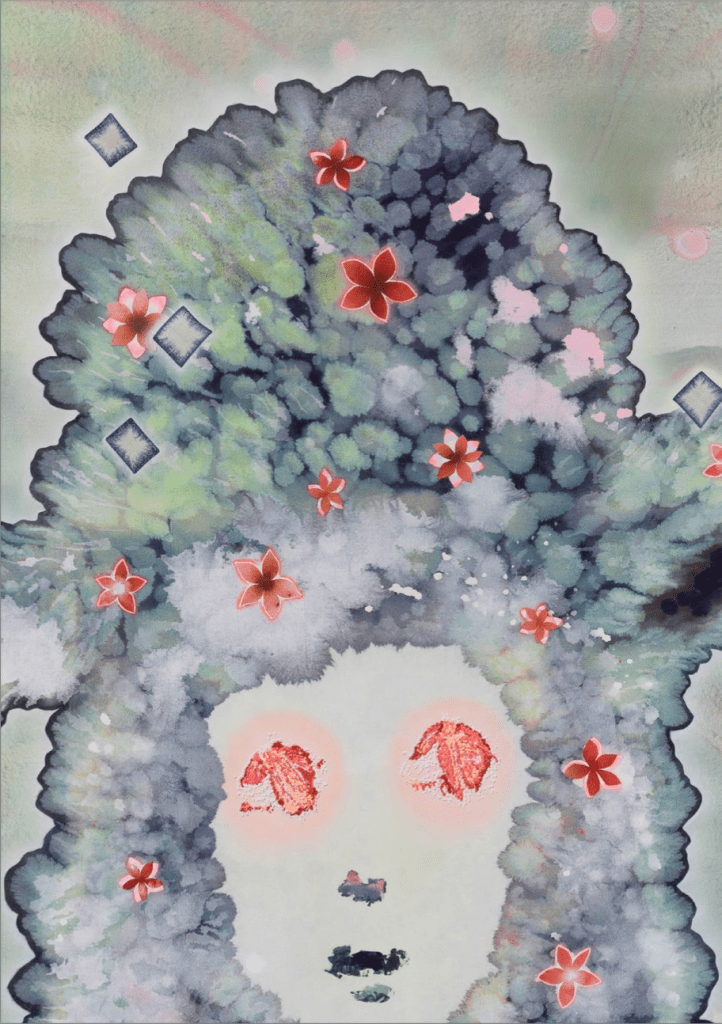
Waterboy Cusp, 2024. Acrylic and puff paint on canvas 200 x 130 cm
Stable Diffusion, 2024. Acrylic and puff paint on canvas
English Seaweed, 2025. Acrylic and canvas collage on gessoed polyester 180 x 120 cm
Pluto Complex, 2025. Acrylic, puff paint and canvas collage on gessoed polyester 180 x 120 cm
BILLY CROSBY, b. 1992 Lives and works in London, UK
EDUCATION
2024 MA Painting, Royal College of Art, London 2016 BA (Hons) Painting, Camberwell College of Arts, London
SELECTED SOLO AND DUO EXHIBITIONS
2025 Every Day I Bear Witness to the Birth of a Thousand Suns, Lucas Gallery, London, UK 2024 Dreamers, Well Projects, NADA Miami (with Siân Newlove-Drew), US 2023 This Package Contains the Universe, Calcio, London (with Siân Newlove-Drew), UK 2022 TG Paintings, Ron Providence, Rhode Island, US
In Search of Our Most Precious Resource…, Well Projects, Margate (with Siân Newlove-Drew), UK 2020 Phlegm Festival, Honeymoon 226, London, UK
2019 Superorganism, Thames-Side Studios Gallery, London, UK
SELECTED GROUP EXHIBITIONS
2025 Mechanical Animal, Blackbird Rook, Artsy Online (curated by Shane Bradford) 2024 Greta Thunder, Special Animal, London, UK (co-curated with Siân Newlove-Drew
The Fruit is Not There to be Eaten, Art Busan, KR (curated by Sunjoo Jung) Caper, 10 Greatorex Street, London, UK (curated by Toby Rainbird) Linked Out: Logged In, Gossamer Fog / Enclave Projects, London, UK (curated by Nina Wong) Palimpsestic Impressions, Arusha Gallery, London, UK (curated by Danny Leyland)
2023 Contingency Part 1 / Cozzie Livs Part II, Des Bains, London, UK (co-curated by Tom Bull) Baggage Claim, Staffordshire St, London, UK (curated by Georgia Stephenson and Rosalind Wilson)
2022 High Windows, Recent Activity, Birmingham, UK (curated by Ted Targett) 2019 All or Nothing, Lungley Gallery, London, UK 2018 Fatal Attraction, Thames-Side Studios Gallery, London , UK (curated by Chris Thompson)
Paper Cuts, Saatchi Gallery, London, UK (curated by Kristian Day)
Salt Castles, Lewisham Arthouse, London, UK 2017 Changelings, The Flying Dutchman, London, UK (curated by Chris Thompson) 2016 Sticking the Moon with Double Sided Tape, Fotopub, SI(curated by Marta Barina)
PRIZES & RESIDENCIES
2018 The John Moores Painting Prize, Liverpool, UK 2017 The Vanguard Court Award, Artist Residency, London, UK 2016 The Marmite Prize, Block 336, London and Highlanes Gallery, IRL
PUBLICATIONS
2023 Seeking Channels Anthology, Well Projects, Margate















 Art Style | Art & Culture International Magazine