Anish Kapoor. WATER LIGHT FESTIVAL Neustift 2024. Photo Zumtobel.
The Water Light Festival 2024 promises to be a celebration for the senses and the soul as it transports visitors to a world full of colour, fantasy and reflection. From 24 April to 12 May, the episcopal town of Brixen/Bressanone in South Tyrol and the Neustift monastery will shine in unique splendour thanks to the creative works of some outstanding artists from all over the world.
In the evening in Brixen
There are 15 light art installations in public spaces in Brixen, which can be admired in the evening from 9 pm to midnight. Public art has the power to transform the environment, bring it to life and offer people new ways of experiencing and understanding their surroundings. “Through art in public space, we can also address important social and environmental issues, bring communities together and make public space a place where creativity, dialogue and exchange can flourish,” says Werner Zanotti, Managing Director of the Brixen Tourismus Association and head of the event’s curatorial team.
One of the highlights of the festival is undoubtedly the presentation by the Spanish multidisciplinary art and design studio Onionlab. On the imposing facade of the Brixen Cathedral, it presents the captivating work “Climate”. This nine-minute audiovisual piece confronts the viewer with a dilemma: which world do we want to inhabit? A gloomy, dry and grey world, marked by the consequences of the climate catastrophe, or a bright and harmonious future? An impressive projection encourages visitors to decide in favour of hope.
Another impressive work comes from the German light artist Tom Groll from the TENTAKULUM collective. His work “Green Washing” in front of the Brixen Tourismus building presents an installation that is fascinating both during the day and at night. Two washing machines and two IBC water tanks, connected by a network of hoses, symbolise green washing by circulating uranium-enriched, light green water. This visual metaphor for the perfect functioning of the economy encourages us to reflect on the reality of greenwashing.
Tom Groll, Greenwashing, 2024. Photo: TENTAKULUM collective.
The late Italian artist Piero Gilardi will also be honoured posthumously with his installation “Migration (Climate Change)” at the Hartwigplatz. This work, which was originally created in 2015, shows the silhouettes of migrating pelicans in flight, symbolising the animal migrations caused by global warming.
During this year’s festival, the international studio OCUBO from Portugal is presenting the interactive installation “Human Tiles” in the Brixen City Library. The installation allows passers-by to interact with the graphic pattern on the facade using the colours of their clothing. This pattern is reminiscent of traditional Portuguese “azulejos”. The installation not only emphasises joy and curiosity through a playful approach to different cultures and traditions, but also places people at the centre of a high-tech process that overcomes the boundaries between man and machine.
Thanks to the support of the Embassy and Consulate General of the Kingdom of the Netherlands, Studio Toer‘s ‘Firefly Field’ work enchants visitors to the Herrengarten with countless points of light floating above the ground, reminiscent of the movement of fireflies at night. The light points, moved by bioluminescence reflected on flowerbeds and shrubs, create an enthralling atmosphere, expressing Studio Toer’s fascination for luminous animals through specially developed LED light points. The unique composition of the points creates a natural and unpredictable movement, enriching the visitors’ experience.
During the day in Neustift
Also in this edition a part of the Water Light Festival takes place in the Neustift Monastery. An exhibition, which is accessible during normal museum opening hours, presents 19 artists who work with light and digital media and deal with the dialogue between cultural heritage and contemporary art. Entitled NOTATIONS, the exhibition addresses ecological challenges and climate change. The exhibition project is curated by Bettina Pelz. For the first time, the exhibition will be extended beyond the festival period until 29 June.
Thanks to the partnership with Zumtobel lighting brand, works by renowned artists such as Anish Kapoor, Keith Sonnier and Brigitte Kowanz are presented in Neustift Monastery, a few kilometres north of the Brixen old town centre.
The installation by Anish Kapoor can be seen in the Engelsburg. It is a field of experimentation for perception. Embedded in a surface of light is a rich, deep black surface that creates the impression of infinite depth in the human eye.
Anish Kapoor. WATER LIGHT FESTIVAL Neustift 2024. Photo Zumtobel.
Works by the French artist François Morellet and the American artist Keith Sonnier were also exhibited at Neustift Monastery in the last edition of the Water Light Festival. This year, “Recréation No. 7 (1994)” by François Morellet and “Chacahoula” (1997) by Keith Sonnier from the Zumtobel Collection will be on display, once again proven classics in the art history of light.
Two installations by Austrian artist Brigitte Kowanz from the Zumtobel Collection can also be seen in the cultural history museum at Neustift Abbey. Both installations thematise the connection between light as an electromagnetic wave and Morse code as the first code of electromagnetic space, telegraphy. The installation “Lichtwechsel” translates the title of the installation into light signals from colour fields, while the installation “Wir schwimmen in der Linie und tauchen sporadisch ins Mosaik” visualises a quote from Vilém Flusser. The media philosopher thematised how our world is becoming a highly complex network of signs and codes.
Another remarkable work comes from the Swiss artist Laurence Bonvin. Her work “Aletsch Negative” offers visitors a fascinating and unsettling journey into the interior of the Aletsch Glacier, the largest and longest glacier in the Alps. This visual experience questions spatial and temporal scales and emphasises the urgency of climate change.
Glaciers are regarded as archives of climate history. With the loss of glaciers, not only are climate conditions changing, but knowledge of nature is also disappearing. Nicolás Rupcich travelled to the Arctic Ocean in April 2022 to show the current changes from his perspective; the installation “Archipelago Archive” provides an insight into the video material that the artist recorded. The many screens are at the same time reporting, image library and knowledge repository.
Light, whether natural or artificial, has long inspired and fascinated people, especially artists. Over the last 200 years, light art has taken many forms and is now increasingly making its way into public spaces. Artists are experimenting with space, technology, light sources and surroundings, with light offering an almost endless palette of possibilities. The Water Light Festival in Brixen and Neustift Monastery will showcase impressive works that tell powerful stories, are visually appealing and address important issues such as sustainability, traces and nature conservation while showcasing contemporary creativity and new technologies.
The Water Light Festival 2024 is not only a display of art, but also a reminder to take action. Through the creative combination of water, light and art, important social issues are highlighted, and visitors are encouraged to reflect on their role in shaping a sustainable future.
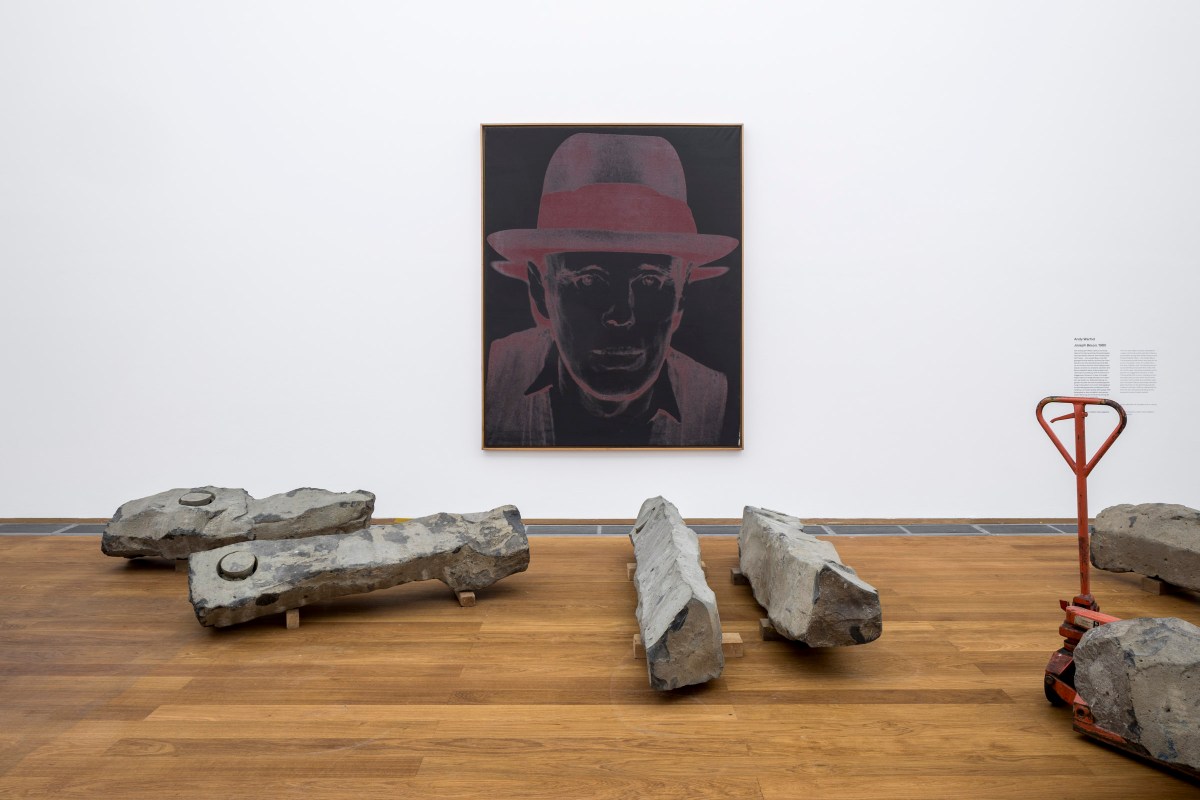
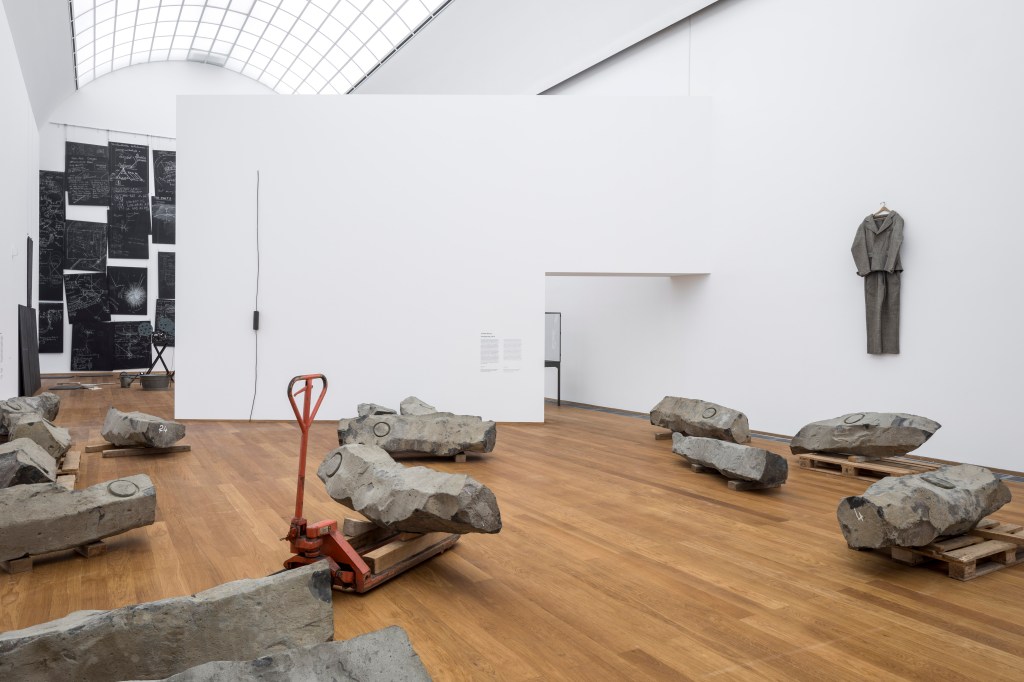
Joseph Beuys in Hamburger Bahnhof, Berlin, 2024. @Jacopo La Forgia
Joseph Beuys. Collection Presentation
Hamburger Bahnhof, from 12 April 2024.
A collection presentation by Nationalgalerie, Staatliche Museen zu Berlin
Opening: Thursday, 11 April 2024, 7 pm
Joseph Beuys – Works from the Nationalgalerie Collection
Hamburger Bahnhof presents its extensive holdings of works by artist Joseph Beuys (1921–86) in the Kleihueshalle, reopening on this occasion. The exhibition will include major pieces from the Nationalgalerie’s collection, which recently entered the collection thanks to the generous donation of the family of collector Erich Marx, who died in 2020. Visitors can explore the complex oeuvre and critical reception of the artist Beuys in a presentation comprising 15 works and a multimedia study island.
Joseph Beuys was a draftsman, sculptor, action and installation artist, teacher, politician and activist. Born in Krefeld in 1921, he grew up in Kleve. He died in Düsseldorf in 1986. Having grown up under National Socialism in Germany, and actively participated in the Hitler Youth and the armed forces, Beuys sought to transform the totalitarian society of his youth into one of warmth and radical democracy: by means of art, and in conversation and cooperation with all people. Beuys called the collective transformation of society he envisaged “social sculpture.” By that, he meant an expanded form of art, in which all human beings – as the artists they innately are – could and should participate. Beuys took his own personal transformation as his point of departure. The extent to which he actually achieved the inner change he was striving for is still highly contested today.
The collection presentation explores the ways in which Beuys explored the boundaries and responsibilities of art through his work. It also offers an insight into the mixed public response to the artist through books and audio contributions, while juxtaposing his vision of social renewal with the ideas of other people, such as the civil rights activist Angela Davis, the writer Ursula K. Le Guin, and the rapper and poet Kae Tempest. The exhibition celebrates the generous donation of works to the Nationalgalerie made by the family of collector Erich Marx.
Below are some of the works by Joseph Beuys that are presented in this exhibition.
Joseph Beuys, Capri-Batterie, 1985
Several works by Joseph Beuys, such as the Capri Battery, are related to the concept of a “solar state,” or “city of the sun”. Beuys came across it in Civitas Solis (1623): a utopian work by political philosopher Tommaso Campanella. Like Campanella, Beuys placed the power and warmth of the sun at the center of his social utopia. Named after the island of Capri where it was conceived, Beuys’s tiny work resembles a miniature model of the sun. It combines a light bulb representing the light of the sun with a lemon symbolizing the energy of the sun. The result is a fruit battery – not unlike the ones you might have made in physics class at school. With this simple gesture, Beuys transformed Campanella’s rigid social model into a continuously changing one. The Capri Battery is among the artist’s final works. It can be thought of as his intellectual and political testament.
From the early 1960s onwards, Andy Warhol created colorful silk-screen portraits of famous personalities, among them Marilyn Monroe, Elvis Presley, Elizabeth Taylor – and Joseph Beuys. The oversized portrait shown here casts him as an icon of popular culture. It is coated with a thin layer of glittery dust. The painting was produced after Beuys had spent time in New York for his first major international exhibition at the Solomon R. Guggenheim Museum in 1979. The two artists, both of whom cultivated a mythical public persona, had met for the first time only a few months earlier at an exhibition opening in Düsseldorf. Beuys presumably attached great importance to the advertising potential of Warhol’s portrait. In 1981, he claimed that his entire life was ultimately advertising: for the renewal of society through creativity.
Joseph Beuys, DAS KAPITAL RAUM1970–1977, 1980
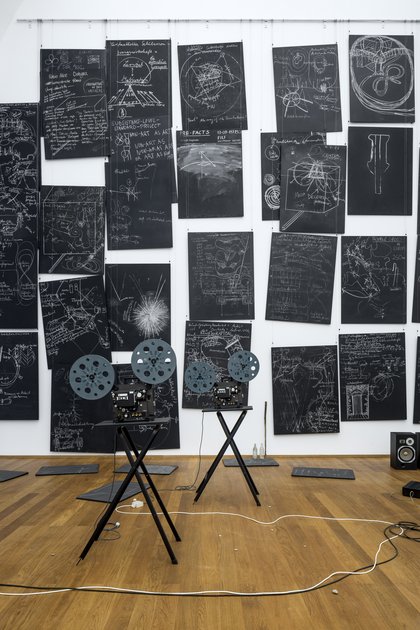
In the course of the 1970s Joseph Beuys realized that there could be no transformation of society without a fundamental rethinking of capital and economics. The installation displayed here explicitly refers to Das Kapital, Karl Marx’s critique of political economy. In contrast to Marx, Beuys equated capital with human creativity. This large-scale enigmatic work resembles an abandoned stage. It brings together objects and devices drawn from actions and projects largely carried out between 1970 and 1977, such as a concert grand piano and axe, film projectors and a screen, a microphone, tape recorders and loudspeakers. The blackboards with chalk drawings were produced in conjunction with teaching and learning situations that Beuys presented as artworks at two major exhibitions: the Organisation for Direct Democracy through Referendum at documenta 5 (1972) and the Free International University at documenta 6 (1977). In each instance the artist and the public spent 100 days discussing politics, society, and the economy.
Joseph Beuys, Das Kapital Raum 1970–1977 (Detail, 1980). Staatliche Museen zu Berlin, Nationalgalerie, Marx Collection (Property of the Stiftung Preußischer Kulturbesitz).
Comprising 15 works, the collection presentation brings together for the first time in one space Tram Stop. A monument to the future (1976), DAS KAPITAL RAUM, 1970–1977 (1980) and THE END OF THE 20TH CENTURY (1982) from the Nationalgalerie Collection. The study island offers visitors an insight into the ambivalent perception of the artist through audio contributions by well-known personalities and selected books and confronts his vision of social renewal with the civil rights activist Angela Davis, the writer Ursula Le Guin or the poet Kae Tempest, among others.
In addition to sculptures, environments, drawings and multiples the exhibi- tion also includes groundbreaking actions such as how to explain pictures to a dead hare (1964), Transsiberian Rail (1970) and I like America and America likes Me. In these works, Beuys developed and illustrated his idea of how everyone could actively contribute to the democratization of society as an artist. From 1963 onwards, he performed over thirty actions in various roles, among them a shaman, teacher, gangster or gardener. Beuys used materials such as felt, fat and copper, to which he attributed certain properties within his work. The Felt Suit (1970), for example, is made of a material that Beuys valued for its warming, insulating qualities. He also developed theories, as the Projekt Westmensch notebooks in the exhibition illustrate. From electromagnetism to quantum physics, he inten- sively investigated the properties of energy.
Energy-generating and energy-conducting processes played a central role in the development of his Theory of Social Sculpture, which he also referred to as the Energy Plan. The Energy Staff (1974) and Capri Battery (1985) attest to this in the exhibition.
The presentation probes the ways in which Beuys’s work questioned the nature, materiality, language and perception of the boundaries and tasks of art. He incorporated myths about himself into his work, actively integrated the public into his art in the spirit of social sculpture and ultimately moved outside the museum world. The model for Tram Stop. A monument to the future (1976) was a peace memorial made of decommissioned weapons and a railway track from Beuys’s hometown of Kleve. DAS KAPITAL RAUM, 1970–1977 (1980) refers to Das Kapital by Karl Marx (1867), although Beuys equates capital with human creativity. The installation consists of objects from actions from 1970 to 1977. The blackboards with chalk drawings were created as part of the Organisation for Direct Democracy through Referendum at documenta 5 (1972) and the Free International University at documenta 6 (1977). Here the artist and the public spent 100 days discussing politics, society and the economy. THE END OF THE 20TH CENTURY was created after 7000 Oaks for documenta 7 (1982) and also incorporates basalt steles. With this large-scale ecological sculpture in Kassel, in the realization of which thousands of people took part, Beuys left the conventional art space.
The Felt Suit (1970) already testifies to Beuys’s tendency to situate himself at the center of his artistic-political movement. The portrait by Andy Warhol from 1980 depicts Beuys as an icon of popular culture. Beuys was presumably aware of the advertising potential of Warhol’s portrait. In 1981, he claimed that his entire life was advertising: for the renewal of society through creativity.
The exhibition aims to actively involve the public. New voices on the subject of transformation and social renewal will be added to the study island every three months. Visitors are invited to enter suggestions in a notebook.
In addition to free guided tours on Sundays, which offer participants a basic overview of the artist’s issues and themes, the education and outreach program also includes new guided tours that can be booked individually. Schools have the opportunity to book exhibition talks on Beuys’s work, which deal with topics such as ecology, environmental protection and sustainability. The program also includes a range of workshops on political, sociocritical and utopian art. These interactive discussions offer high school students the opportunity to view and discuss Beuys’s art in the context of contemporary artistic positions shown at the museum. A school project with the Erika Mann primary school will create a program for beuysradio based on an intensive examination of his work.
In 2022, the family of the well-known Berlin collector Erich Marx, who died in 2020, donated the entire holdings of works by the artist Joseph Beuys from the Marx Collection to the Prussian Cultural Heritage Foundation. The donation included the following works, which are now in the collection of the Nationalgalerie: The secret block for a secret person in Ireland (1936–76); STELLE, 2nd Version (1967–76); Energy Staff (1974); Tram Stop, 2nd Version (1961–76); Untitled (Blackboard, 1977); Untitled (ART = CAPITAL, 1980); Untitled (Neutralied CapitaI, 1980); DAS KAPITAL RAUM 1970–1977 (1980). Of these works, the following can be seen in the new collection presentation: Energy Staff (1974); Tram Stop, 2nd Version (1961–76); and DAS KAPITAL RAUM 1970–1977 (1980).
The new permanent display is being held to mark the generous donation of works from the family of the collector Erich Marx. It will be accompanied by a rotating series of solo exhibitions featuring the work of contemporary artists – the first of whom will be Naama Tsabar with Estuaries (until 22.9.2024, curated by Ingrid Buschmann). From 8 November 2024, Andrea Pichl will follow with Wertewirtschaft (Values Economy, until 4.5.2025, curated by Sven Beckstette).
In addition to the new collection presentation in the Kleihueshalle, Beuys’s installation “Unschlitt/Tallow” (1977) from the collection of the Nationalgalerie is on display in the west wing of the museum as part of the permanent presentation Endless Exhibition.
Joseph Beuys. Works from the Nationagalerie Collection is curated by Catherine Nichols, curator at Hamburger Bahnhof – Nationalgalerie der Gegenwart.
Hamburger Bahnhof – Nationalgalerie der Gegenwart Invalidenstraße 50/51, 10557 Berlin, Germany
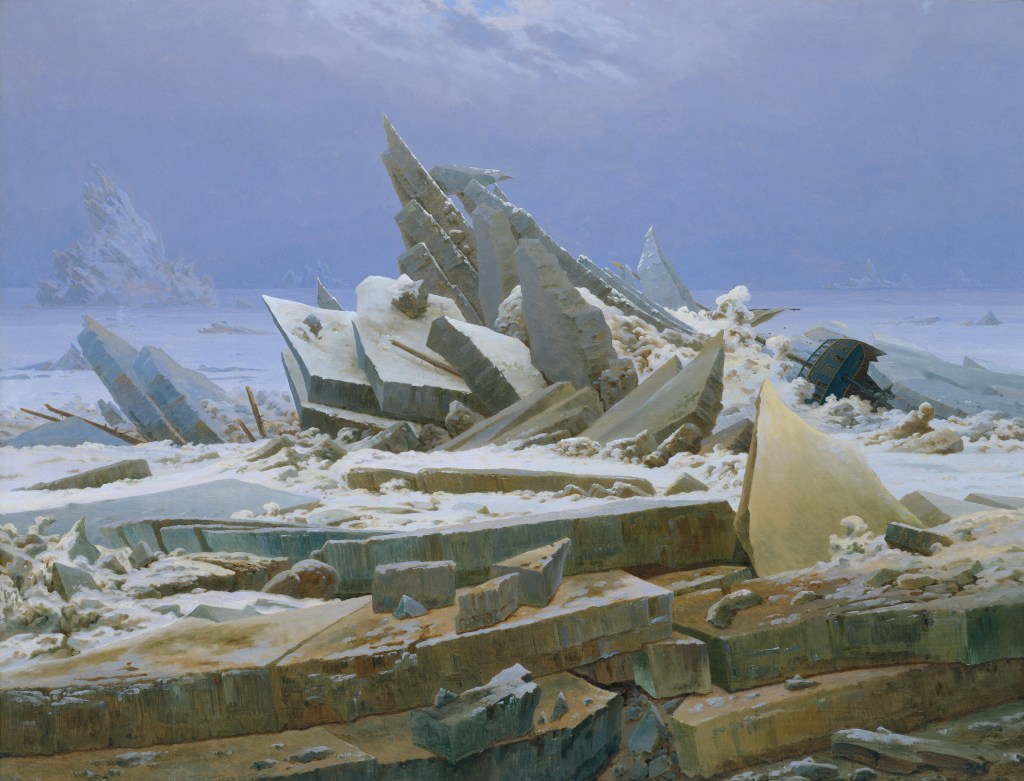
Caspar David Friedrich, Das Eismeer, 1823 – 1824. Öl auf Leinwand, 96,7 x 126,9 cm, Hamburger Kunsthalle / bpk. Foto: Elke Walford
EXHIBITION PREVIEW
Museumsinsel Berlin, Alte Nationalgalerie
Bodestr. 1-3, 10178 Berlin Opening hours: Tue – Sun, 10 am – 6 pm
Caspar David Friedrich. Infinite Landscapes
19 April – 4 August, 2024 A special exhibition by the Nationalgalerie – Staatliche Museen zu Berlin
Press conference: Wednesday, 17 April, 2024, 11 am Special opening hours: Fridays and Saturdays 10am – 8pm
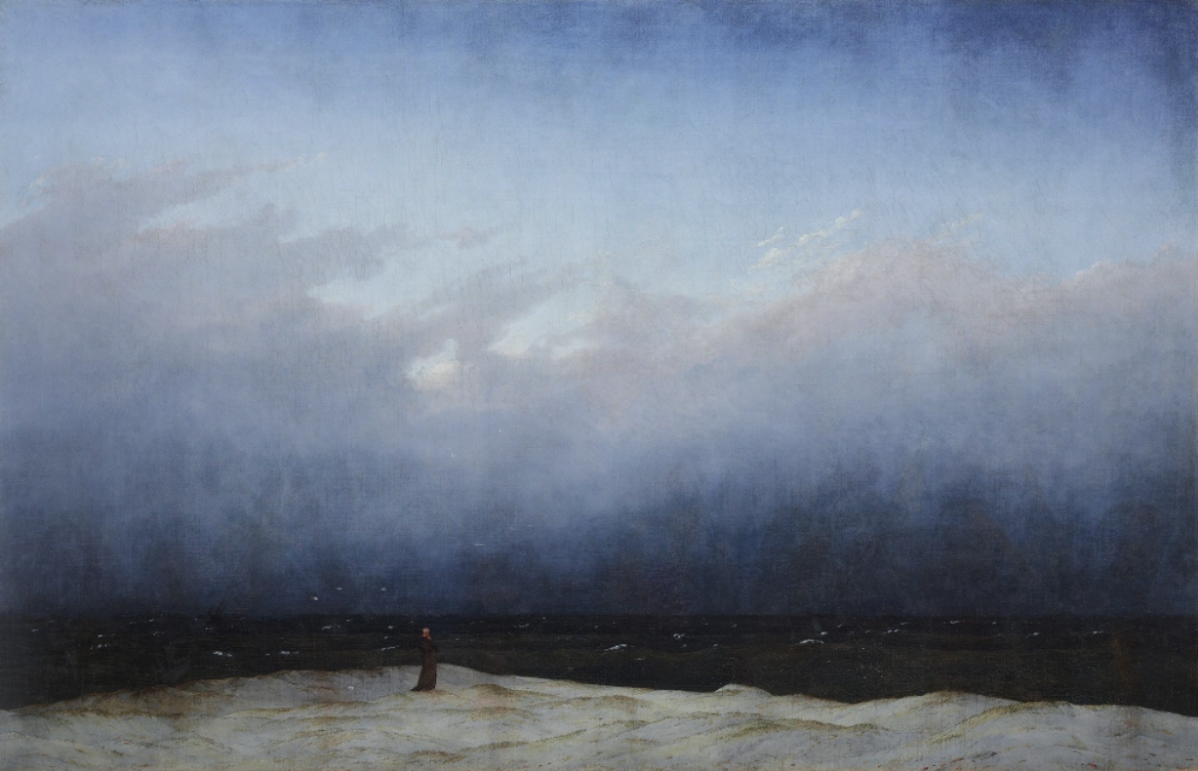
To mark the occasion of the 250th anniversary of the birth of Caspar David Friedrich (1774–1840), the Alte Nationalgalerie of the Staatliche Museen zu Berlin, in cooperation with the Kupferstichkabinett, will for the very first time present a comprehensive exhibition dedicated to the oeuvre of the most prominent painter of the German Romantic movement. More than 60 paintings and 50 drawings by Friedrich from Germany and abroad will be on display, including a number of world-famous, iconic works such as The Sea of Ice, Chalk Cliffs on Rügen or Monk by the Sea.
Caspar David Friedrich, Mönch am Meer, 1808-1810. Öl auf Leinwand, 110 x 171,5 cm. Staatliche Museen zu Berlin, Nationalgalerie. Foto: Andres Kilger
An exhibition of this kind is long overdue in Berlin, if only by virtue of the fact that the numerous acquisitions and public exhibitions that occurred in the Prussian capital played a considerable part in fostering the artist’s initial renown during his own lifetime. After the painter had faded into obscurity during the second half of the 19th century, the Nationalgalerie paid tribute to him in 1906 in its most comprehensive retrospective to date, the legendary Deutsche Jahrhundertausstellung, which included 93 of the artist’s paintings and drawings. Friedrich was lauded as a painter with an extraordinary proficiency for capturing light and atmosphere, and as a pioneer of modern art.
The rediscovery of Friedrich’s art, his pairs of paintings, as well as the artist’s process and technique will be in the center of the exhibition. Based on these themes, an overview of the life and work of the painter will be presented. The essence of his art between the precise study of nature and romantic imagination will become palpable. Friedrich created landscapes of longing with wide skies and distant horizons in which the infinity of space and time becomes perceptible. His timeless images stimulate thought and feeling, which makes them so fascinating to this day.
The exhibition will be accompanied by catalogues in both English and German at Prestel Publishing, ed. by Birgit Verwiebe and Ralph Gleis (hardcover circa 350 pages).
Please note the exhibition’s special opening hours: On Fridays and Saturdays the museum is open from 10 a.m. to 8 p.m.
The anniversary exhibitions marking the 250th birthday of Caspar David Friedrich in the Hamburger Kunsthalle, the Alte Nationalgalerie, Staatliche Museen zu Berlin and the Staatliche Kunstsammlungen Dresden are under the patronage of Federal President Frank-Walter Steinmeier.
The exhibition “Caspar David Friedrich. Infinite Landscapes” is made possible by the Freunde der Nationalgalerie.
In honor of the 250th anniversary of Caspar David Friedrich’s birth, the Metropolitan Museum of Art presents the first comprehensive exhibition dedicated to the artist held in the United States (“Caspar David Friedrich: The Soul of Nature”, February 7–May 11, 2025). It is organized in cooperation with the Alte Nationalgalerie of the Staatliche Museen zu Berlin, Staatliche Kunstsammlungen Dresden, and Hamburger Kunsthalle.
Reimagining Art through Immersive Technologies: The Digital Renaissance
By Jean Arnaud
Our society is currently undergoing rapid changes that are profoundly redefining our perception of the world and our relationship with it. The fields of art and culture are no exception. Innovative technologies, often referred to as “new media,” are introducing revolutionary paradigm shifts in art, heralding the inexorable triumph of a new era, a “digital renaissance.”
These new works, primarily developed using immersive technologies such as 3D video, holography, virtual reality (VR), augmented reality (AR), and the metaverse, distinguish themselves from traditional static works through their dynamism and their ability to evoke more intense emotions. They also stand out for their power to deepen and expand our reality. These works are meant to be lived and experienced rather than passively observed, continuing the advances initiated by revolutionary artists like Marcel Duchamp, whose kinetic art challenged traditional norms by introducing movement into art, or artists like Mark Rothko, whose abstract and suggestive expressionism increase the viewer’s role in the artistic experience by encouraging active interpretation.
Indeed, the art produced by new media immerses viewers in a dynamic, and multisensory experience that goes beyond mere observation and interpretation. Not only does it transport them into a perpetually transforming world that invites exploration of the artwork’s depth and complexity, by blending sensations, it also opens up new horizons of perception and self-awareness into the immeasurable abyss of one’s inner being, or to borrow from Pessoa, to “travel while remaining still.” These new genre works are created to be contemplated and admired, in addition to being experienced, and above all, to be transcended.
Exhibitions of video or reflective art, like Yayoi Kusama’s Infinity Mirror Rooms, have gradually made way for light displays and immersive experiences dedicated to the works of artists such as Klimt, Van Gogh, Cézanne, and Matisse, as seen in the Atelier des Lumières in Paris, for example, or the Hall of Lights in New York City. While novel and refreshing, these retrofitted works do not hold nearly the same value as those aesthetically conceived experiences in which technological tools were employed in the service of an artistic vision and integrated into the creative process.
In my immersive video experience, The Universe Within, various technologies were used to bring my aesthetic vision to life. This allegorical piece represents the forces at play within an individual during the act of creation. It also seeks to embody the very movement of a being simultaneously creating itself and shaping its work. Depicting a gradual awakening and a powerful universe of colors, scents, and harmonious orders, when projected, The Universe Within envelops viewers, inviting them to contemplate the surges occurring within their inner selves, like mirrors reflecting the ever-shifting complexity of their psychic life, urging them to transform themselves through an act of creation. This synesthetic and multisensory experience creates a strange and cathartic impression for the viewer: Imagine being carried by an indomitable wave toward the shores of a more accomplished self – the supreme being that assimilates with destiny, one shaped and polished through perseverance, one to which all the power of existence aspires. This demiurgic act is made possible by combining artistic vision with immersive technologies, and the beauty that constitutes the true purpose of any work of art becomes enriched with a dimension both mystical and metaphysical.
Other artists have also explored this dynamism in their work. For example, Refik Anadol’s stunning piece, Unsupervised, recently joined the permanent collection of the prestigious MoMA in New York. Anadol’s offering examines the idea of art creating itself, a process in which moving forms attempt to break free from their boundaries. Ultimately, machines, like human beings, are still constrained by their own nature and the physical reality in which they are rooted and upon which they depend. Thus, while these phygital works can create unprecedented experiences due to their dynamic, immersive, and multisensory nature, and while they foster the development of deeper, more vivid emotions and ideas, they are limited by physical constraints that only virtual reality and augmented reality can transcend.
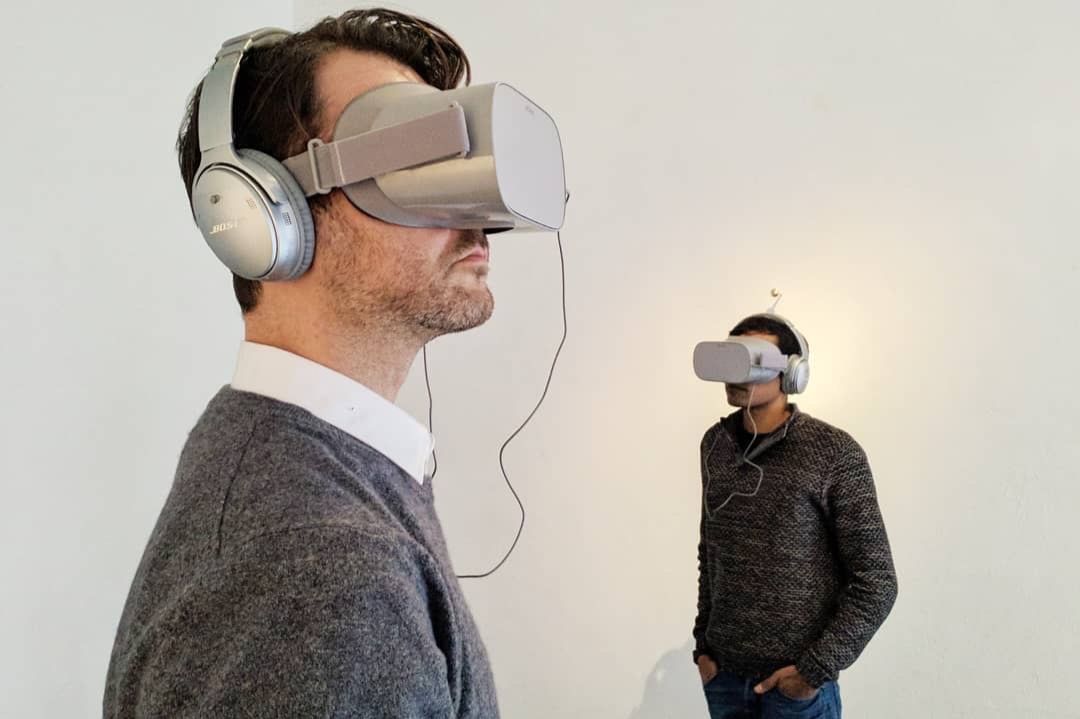
Students at MIT’s Computer Science and Artificial Intelligence Laboratory have developed an augmented reality experience that presents the viewer with a digital canvas on which a creature moves through a lush jungle, and they can interact with it by scanning a QR code. When the viewer solves the artist’s riddle, the artwork comes to life, and the environment flourishes. Augmented reality not only frees an artwork from physical constraints such as frames, walls, or spheres, but it also places the viewer at the center of the artistic experience, where they can actively participate. However, while the viewer can have an impact on the work, their actions are still restricted and guided by the artist-engineer, or the artist assisted by computer engineers. If a piece of art is developed within a VR or AR environment, true transcendence can only take place within the metaverse, a more open digital world where each participant can interact and collaborate with friends in the form of avatars, redefining the entire artistic experience. In the metaverse, boundaries between the realms of art and play blur, and the possibilities for artists and viewers are infinitely expanded.
The metaverse allows artists to create dynamic art that defies the laws of physics, whether it be inverted, floating pyramids, immersive digital art spaces that transport viewers, the synesthetic integration of visuals and music, interactive philosophical, historical, technical, or cultural elements, or animated discussions by avatars representing both the artwork’s characters and the artist. Such metaverse-based work transcends traditional boundaries that define artistic genres, offering an impression of limitless possibilities and experimentation, as well as introducing ludic elements like escape games, which invite viewers to participate actively, even in the creation process. Within the metaverse, art is no longer akin to Greek columns carved from marble destined to exist eternally in petrified beauty; it can now take on the vibrant and colorful appearance of living trees, whose multiplying branches ignite the infinite motion of worlds, life, and the creative soul, offering a boundless universe of possibilities.
My work, Prometheus Ἑωσφόρος, is an interactive 3D sculpture in the metaverse, inspired by ancient mythology. After stealing the sacred fire from the gods, Prometheus, the divine rebel, offers it to human beings, granting them the ability to break free from the constraints of a predetermined, imposed, and disputable order. Now free to be sovereign, humans must shape their existence with the fire of love, ardently stoked by the breath of will, guided by the high visions of creative imagination, and shaped, sculpted, and polished by the skilled hands of reason. Beyond the beauty of art that each demiurgic soul aspires to, there are underlying philosophical messages, encouraging humans to be the sculptor of themselves and their destinies, to elevate the powers inherent in their being, and to be present in the world, open to its mystery and complexity, as the architect of a more enlightened humanity by employing technology in service of their vision.
My digital statue represents the first level of meaning, containing an experience hidden within. Prometheus Ἑωσφόρος is located inside a futuristic 3D triangle that moves through the air and can only be accessed after deciphering a symbolic and mysterious poem, a kind of enigmatic relic guarding the “threshold of intrusion,” to borrow Novalis’s vocabulary. To answer the call of the humanist artists of the digital renaissance, one must draw upon their inner strength to move beyond mere aesthetic contemplation and delve into their own depths to rise to the creative act: “What [every artist] seeks when they cast these sparkling fragments of themselves onto the world are beings of their rank, filled with a supreme love for life, entirely devoted to their sacred mission, miners of knowledge, hallucinators and seers, inventors of values, creators of the future… To these magnificent beings falls the enormous, sublime, and superhuman task of raising, in the skies of the future, the star their predecessors sketched in dreams, of shaping and perfecting the star whose rays they have outlined” (Soliloquies, foreword). Thus, the viewer is called upon to participate and interact with my sculpture by taking the torch held by the cybernetic titan that it depicts. A circle with mysterious inscriptions moves, revealing a cryptic poem – a bridge to another experience, the recreation of the sculpture in a different way. The goal is then to encourage the viewer to enrich the artwork with their own vision, so that they become a creator themselves.
The artwork made possible by new media is no longer meant solely for observation; it is designed to be lived and experienced. These innovative technologies offer the opportunity to create dynamic, immersive, synesthetic, palimpsest, interactive, and participatory artistic experiences that have brought about profound paradigm shifts in the field of art. It is a total art that requires artists to be versatile and master complex technologies, transforming themselves into technical artificers or visionary philosopher-poets surrounded by talented experts, painters, musicians, and engineers. The artists of the Renaissance were masters in various disciplines; Michelangelo excelled in sculpture, painting, and poetry, and Leonardo da Vinci excelled in philosophy, sculpture, painting, and engineering, relying on the most talented individuals of their time in order to execute their work. The new art of the digital renaissance is thus open to an infinity of possibilities and meanings, surpassing the notion of artistic genre and allowing the viewer to adopt a new role beyond that of a mere observer or exegete by participating in the creative process and rising to the level of the artist. The artwork itself can now offer in its structure the means of its own transcendence and present itself to posterity as a moving temple dedicated to change and successive metamorphoses, challenging the old artistic hubris that glorified the illusion of immortality in opposition to time. There is no being that does not become, or, to put it differently, there is no being but in the process of becoming. This philosophical principle is embraced by this new art, even defining it as the ideal.
A new era has opened, one in which humanity, thanks to advances in technology, is compelled to question its limits, a practice that must be embraced if one wishes to push these limits and transcend them. The makers of the impossible owe much to limitation, as it became an invitation to act with invention. Art, more than ever, is not only a manifestation of these existential questions but also the most refined and spiritual way to answer them. It also then becomes the most sophisticated means of self-fulfillment and improvement, of becoming more oneself and more than oneself. By accumulating and mobilizing the powers of existence through philosophy, science, art, and technology, and by becoming more of what they must be, the artist of the digital renaissance ensures that their being fulfills its destiny (or that their being is fulfilled as destiny) and shapes, at the same time, that of humanity, which always shines above, guiding our supreme aspiration toward higher beauties and the skies of the sublime.
Jean Arnaud, also known as Jean Arno, is a Boston-based tech entrepreneur and the founder of Nova, a company dedicated to developing interactive AI solutions to accelerate academic research and enhance its efficiency. In addition to his entrepreneurial pursuits, Jean is a published author and an artist renowned for his innovative work at the intersection of technology and art. He is recognized for pioneering new approaches that push the boundaries of both fields.
Publishing in Art Style Magazine is free of charge for anyone. There are no article processing charges or other publication fees. Art Style Magazine is independent and supports the Open Access Movement. The editors of Art Style Magazine cannot be held responsible for errors or any consequences arising from the use of information contained in essays and articles published on the Art Style Magazine’s website and editions. Authors agree to the terms and conditions and assure that their submissions are free of third parties’ rights. The views and opinions expressed in the essays and articles are those of the author and do not reflect the views of Art Style Magazine. The authors of Art Style Magazine’s essays and articles are responsible for its content. The Art Style Magazine‘s website provides links to third-party websites. However, the magazine is not responsible for the contents of those linked sites, nor for any link contained in the linked site content of external Internet sites (see Terms & Conditions).
Solo exhibition at HackelBury Fine Art, London 7 March – 4 May 2024
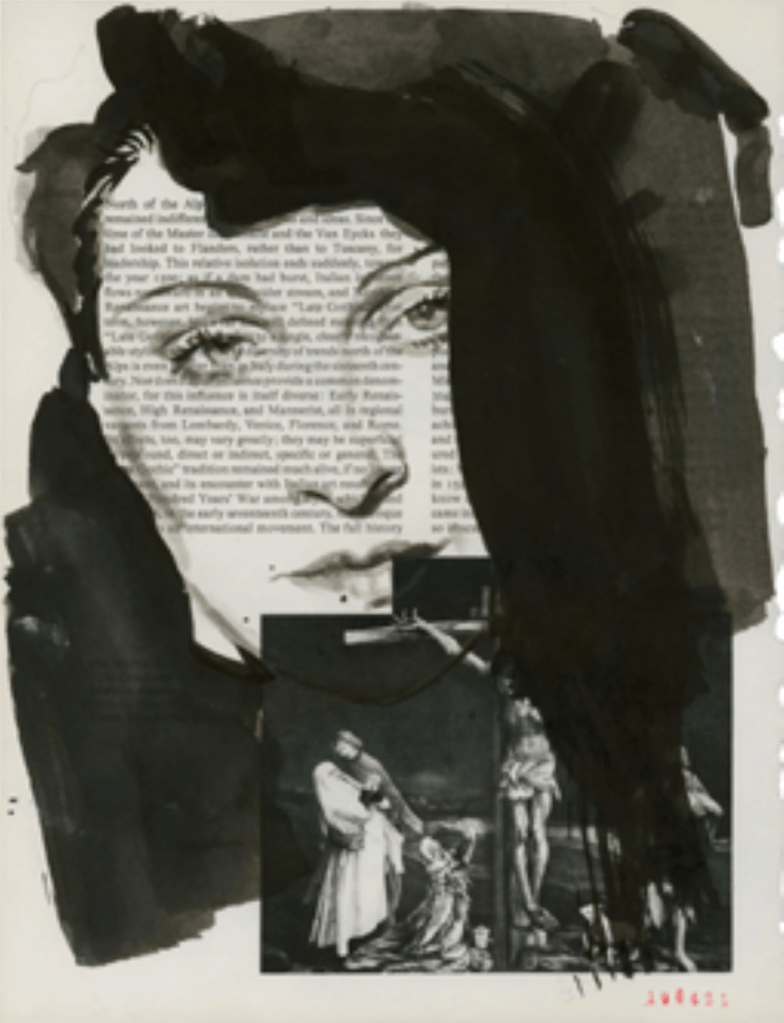
Dora Maar, 2021
HackelBury Fine Art, London, presents Coral Woodbury’s second solo exhibition, Revised Edition, featuring new work from three series, all inspired by the form and substance of the book. Woodbury uses recurring motifs such as ashes, palimpsests, and remnants of material culture to evoke themes of absence and memory, and bridge human connection across time.
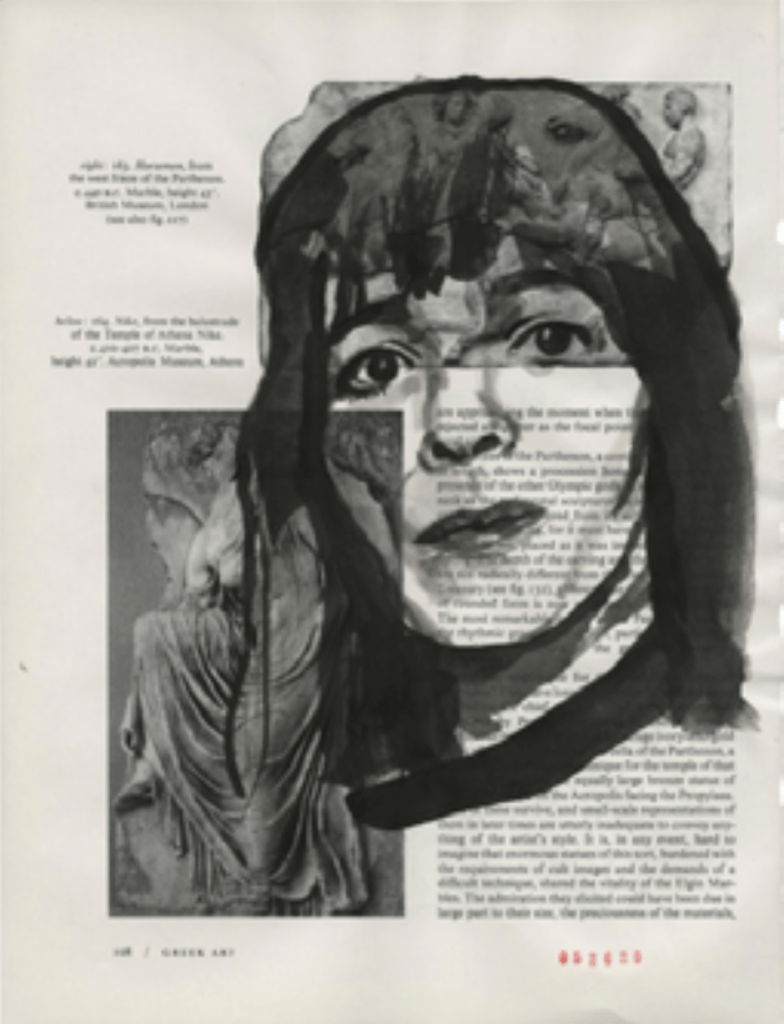
In her series, Revised Edition, Woodbury enacts a feminist intervention in the art history canon. On pages torn from the seminal Janson’s History of Art – which entirely omitted artist women from its first 29 printings – she, with sumi ink, paints women back into the history which excluded them. Her work renders the invisible visible.
“When complete, Revised Edition will encompass 617 paintings and will stand as testimony against the erasure of others which reaches deeply into our culture.”
Susan Rothenburg, 2020
Oil paintings from the Broken Spine series continue this same exploration of the vagaries of memory, time, and history. Translucent layers of paint and obscured writing lend an ephemeral quality which suggests the fading, forgetting, and fragmenting of the past. From parchment manuscripts, to authors’ galley proofs, to the current US book banning epidemic — the traces and erasures of thought become part of the process of painting.
“These paintings originated when I was recovering from a fractured spine. Themes of brokenness and repair entered my work, and I began exploring the metaphorical connections between book and body.”
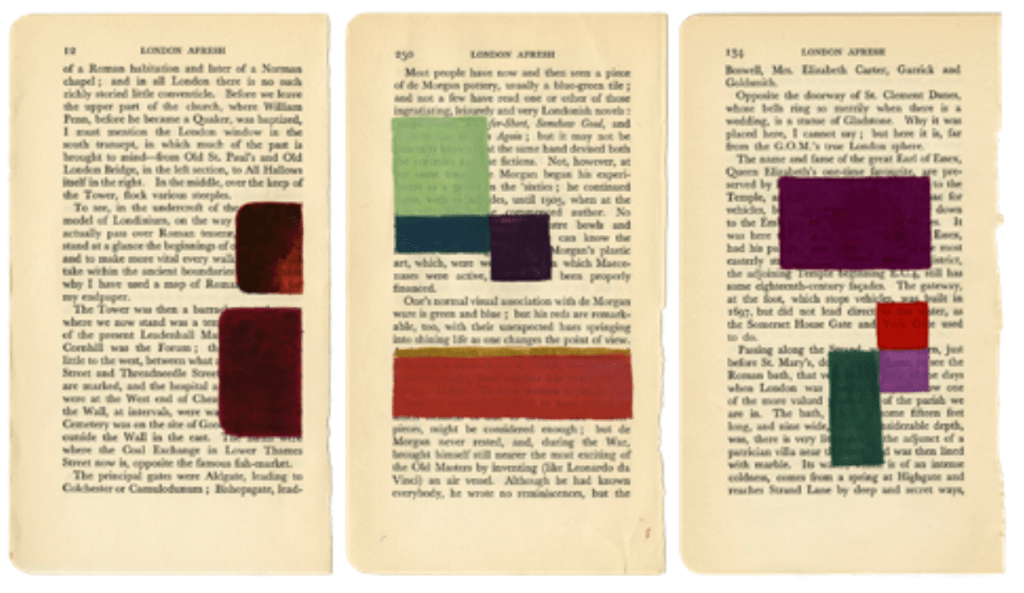
The series In Place is Woodbury’s personal travelogue, noted in colour rather than writing. Finding a timeworn book specific to the location has become an orienting ritual upon arrival. The pages, swatched in various hues of gouache, record fleeting experiences in the language of color.
Broken Spine V, 2021
Triptych: Hoop and Grapes, Leather and Stout; Mary Seton Watts Cemetery Chapel; Bentley 8 Litre Mirror with Velvet Scrunchie, 2022 (London)
About Coral Woodbury
Boston-based artist Coral Woodbury (b.1971) exhibits nationally and internationally and in 2020 was a finalist for the international Mother Art Prize, culminating in the Procreate Project exhibition at Cromwell Place in London. In 2018 she took part in the International Travelling Art exhibition at Taragaon Museum, Kathmandu, Nepal; #00Bienal de la Habana, Cuba; and VANITAS#IMPERMANENCE, Travelling Exhibition in Genova and Trieste, Italy. Woodbury was recently included in the group exhibition ‘Medium & Memory’ curated by Griselda Pollock at HackelBury Fine Art and its accompanying catalogue.
Her work is held in public and private collections, including The Katrin Bellinger Collection, The Cross Steele Family Collection and The Women’s Art Collection, University of Cambridge.
About HackelBury Fine Art
HackelBury Fine Art was founded twenty-five years ago by Marcus Bury and Sascha Hackel. The gallery is committed to championing artists working with the visual arts who push the boundaries of their medium to create meaningful and contemplative work.
The London based gallery initially showcased classic photography from the 20th century including Henri Cartier-Bresson, Berenice Abbott, Willy Ronis, Malick Sidibe, Sebastião Salgado and Edouard Boubat. The transition from traditional photography to more conceptual work was as intuitive as it was organic, beginning with artists such as William Klein, Pascal Kern, Doug and Mike Starn, Garry Fabian Miller, Katja Liebmann, Ian McKeever, Stephen Inggs and Bill Armstrong. In recent years the gallery has also taken on emerging artists such as Oli Kellett, Nadezda Nikolova, Alys Tomlinson and Coral Woodbury.
Each artist, whether emerging or established, creates work defined by a depth of thought and breadth and consistency of approach. The small group of artists with whom HackelBury work, represent a diversity of practice yet share an artistic integrity which the gallery is fully committed to supporting in the long-term.
Synthesis Gallery is proud to announce its fifth anniversary of art exhibitions.
Marc Lee, installation view, Same but different opening show, Berlin, 2018.
Adam Broomberg and Oliver Chanarin, Woe from Wit premiere, Berlin, 2019. The work was later exhibited at Eye Filmmuseum and Biennale für Aktuelle Fotografie.
synthesis gallery has come a long way since its inception in New York City in 2017. The gallery has always been committed to showcasing immersive art, and in 2018, it expanded its reach by opening a new location in Berlin. Synthesis has been instrumental in promoting emerging artists and collaborating with established names in the digital art world, helping to launch and support their careers. The gallery’s focus on VR, AR, and XR works has been a significant contribution to the art world, and it continues to play a pivotal role in nurturing new talent.
Over the course of five years, Synthesis Gallery has organized more than 20 shows, cementing XR as a significant medium. In 2021, they transformed into a non-profit organization, expanding their focus to include new media and digital art. Their mission is to position the digital art community within the rich tapestry of art history while promoting critical discourse about the potential of technology without perpetuating binary thinking or singular theories.
Synthesis Gallery has been successful in showcasing its exhibitions in leading cultural institutions across the globe. They are now actively seeking new international platforms to expand their reach and bring their unique exhibitions to a wider audience.
synthesis x Vodafone: panel and intervention for European Union Presidency, Brussels, 2019.
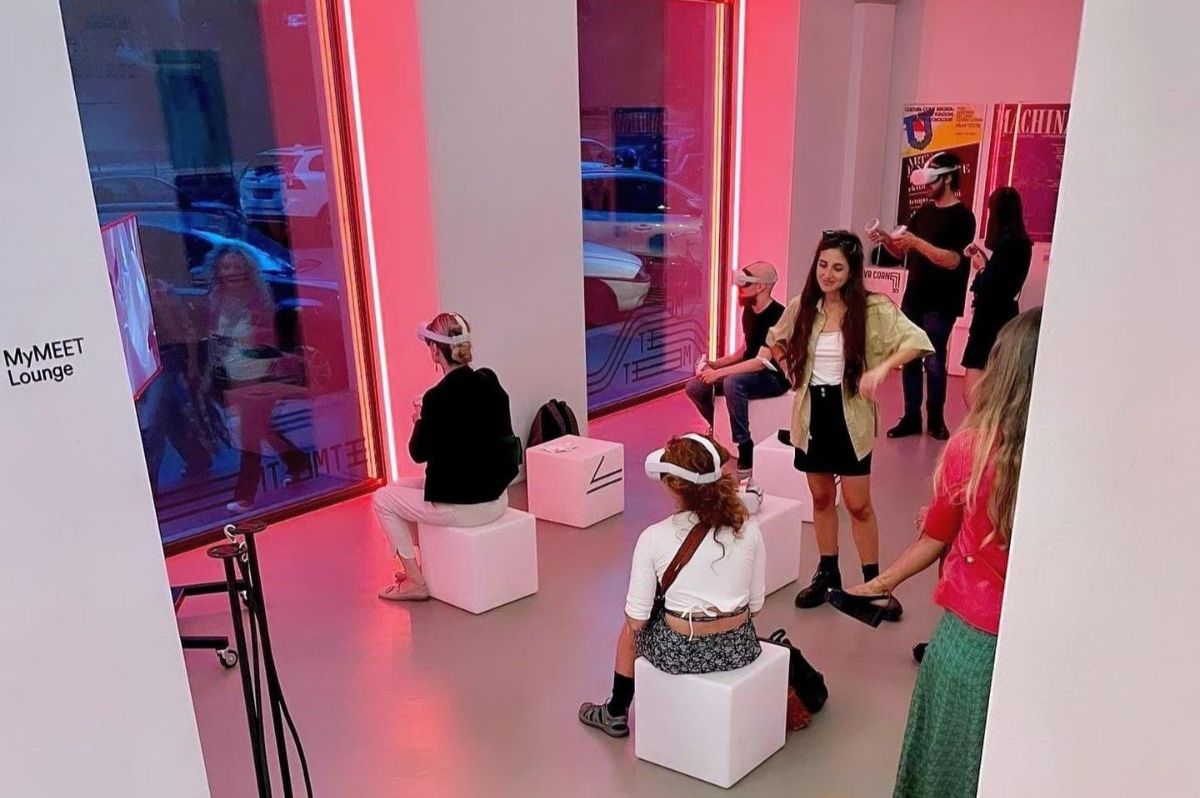
Sound Becomes Site: Symphony For The Metaverse, group show presented at MEET Digital Culture Center, Milan, 2022.
AES+F Lynx avatar, installation view, synthesis x Feral File I KNOW, Berlin, 2023. The work was acquired by NFT Museum of Digital Art as part of their relevant collection.
synthesis is a genre-defining cultural institution working with new media. Since its inception in 2017, the gallery has produced over twenty exhibitions of new media art in Berlin and abroad, online and on chain and is dedicated to exhibiting internationally renowned, well-established artists alongside emerging ones.
Solo exhibition at HackelBury Fine Art, London until 2nd March 2024
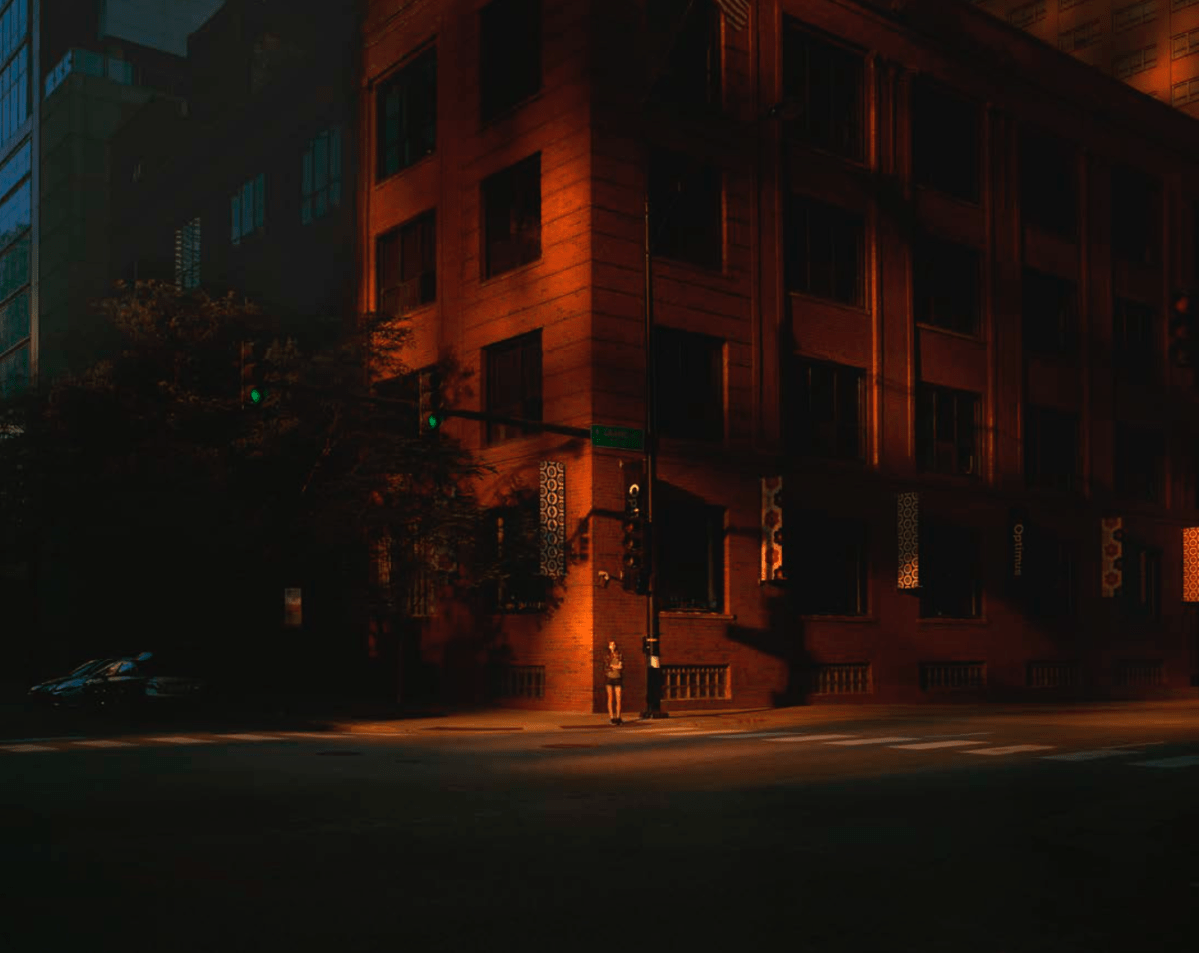
Grand Ave, Chicago, 2017
HackelBury is pleased to present Oli Kellett’s third solo exhibition, Waiting for a Sign, from 24th November 2023 until 2nd March 2024, accompanied by the book of the same title published by Nazraeli Press.
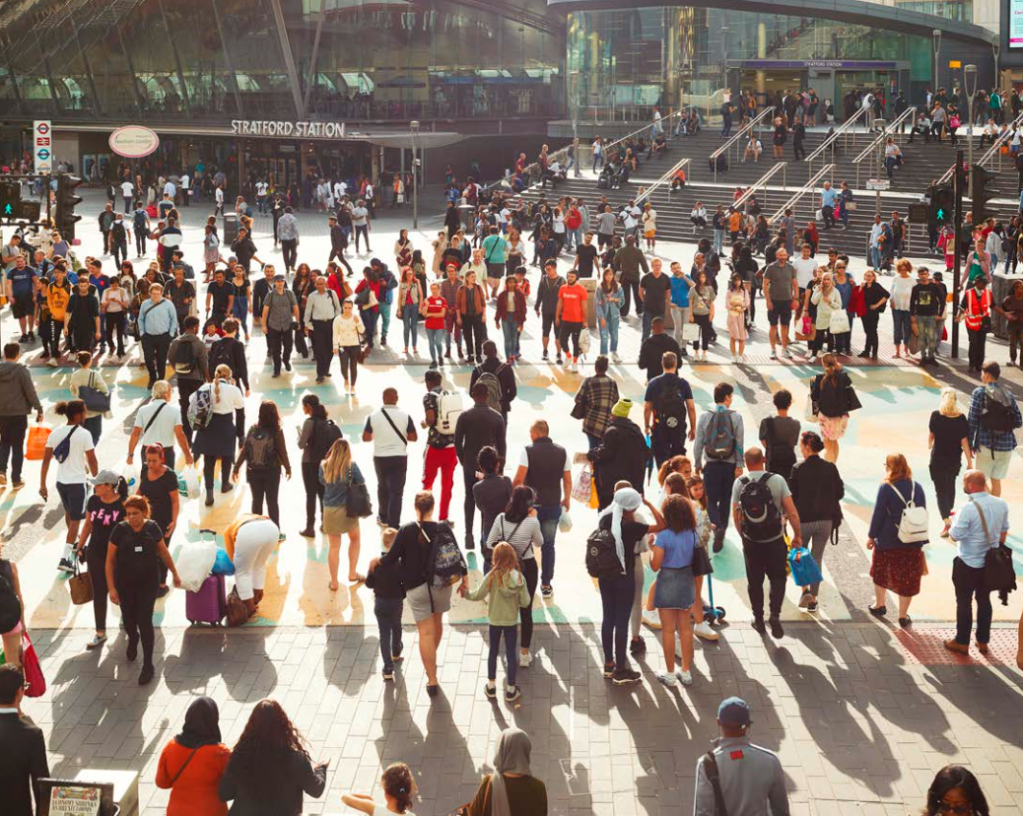
Waiting for a Sign focuses on Kellett’s iconic Crossroad Blues series of large-scale portraits of people waiting at crossroads in urban cities across the globe from London to Mexico City and numerous across North America. The series began in 2016 when Kellett was visiting Los Angeles during the lead-up to the 2016 presidential election and the country was at a political crossroads. It continued to evolve over the following four years as a result of Kellett’s numerous visits to countries including Spain, Japan, Mexico, Brazil and Colombia.
Great Eastern Rd, London, 2019
In these times of seismic geo-political shifts and significant global events, the series has now taken on a universal significance. It captures still moments of contemplation in which individuals question the direction they take and the life they make. Inspired by the title of Gauguin’s painting “Where Do We Come From? What Are We? Where Are We Going? in the Museum of Fine Arts, Boston, this series reflects our existential search for an answer.
As the writer and philosopher Nigel Warburton writes in his introductory essay for the accompanying book ‘Crossroad Blues’ published by Nazraeli Press;
“The step each person is about to take seems far more momentous than simply crossing a street”.
As Oli Kellett explains: “I’m looking for a moment when somebody is psychologically removed from the physical space they are in, alone with their thoughts for a few seconds.”
The large-scale photographs in ‘Crossroad Blues’ series contrast the anonymity of urban space with the individuality of human experience. The scale of these photographs captures tangible human expression and allows the viewer to recognise a moment of conscious contemplation in their lives.
Kellett’s commitment to find the perfect light saw him walking the streets of cities for days before setting up his large format architectural camera and waiting to capture these private moments. The way the buildings frame his subjects and his focus on the light and composition creates a cinematic quality, providing a dramatic architectural backdrop to these unstaged scenes which reveal the artist’s deep interest in the human psyche. Kellett’s interest in art history began at art college, when he took up street painting to recreate Renaissance masterpieces. His last composition in the ‘Crossroad Blues’ series in 2019 on Avenida Almirante Barroso in Rio de Janeiro, Brazil shows two people looking skywards, one of them with the gesture of the finger pointing up to the sky. Reminiscent of Raphael’s ‘School of Athens’ painting, posing questions of spirituality and immortality, this was to be Kellett’s last work in the series. For him it felt like a sign and a natural stepping stone to explore more metaphysical ideas in his work.
I don’t look for people or hunt people down. I turn up with my kit, set up and I wait for someone else to turn up on the other side of the road. I feel like we meet in the middle somehow and then we go on our separate ways. The crossroads becomes this space where I like to think people are wrestling with these big ideas – guidance, morality and the weight of decision making. Oli Kellett
Tremont Street, Boston, 2018
About Oli Kellett
Oli Kellett is a British artist based in Hastings, UK. He began taking photographs in 2008. Since 2016 he has devoted himself to exploring the urban setting and our relationship with the crossroad and how people navigate their lives in his series ‘Crossroad Blues’.
After studying at Central Saint Martins, Kellett began his career as a creative in the advertising industry. Although Kellett had experimented with black and white photography since his teenage years, he moved onto colour photography and a large format camera when he left the advertising industry. While Kellett is strongly influenced by painting and the compositional techniques used, he loves the chance moment which one can capture with a photograph and is intrigued by moments of human contemplation. In 2018 Oli Kellett was awarded the Rose Award for Photography and the Royal Academy Arts Club Award, London. In 2021 he was shortlisted for the Photo London Emerging Photographer Award. He was awarded the Royal Photographic Society International Photography Exhibition 161 Bronze Prize. Works from Kellett’s ‘Soap Drawings’ series were included in the RA Summer Exhibition in 2022 and 2023.
Oli Kellett has works in private collections in the UK, Europe and the USA.
“I’m looking for a moment where individuals are dwarfed by what surrounds them, appearing lost but searching for something. They then go on their way, whichever direction that may be.”
Prior to the ‘Crossroads’ series he worked on a series titled ‘Welcome to Paradise’ where he travelled around the UK over ten years photographing places with the word ‘paradise’ in the title; often revealing that these places were anything but paradise and far removed from any utopian vision.
About HackelBury Fine Art
HackelBury Fine Art was founded twenty-five years ago by Marcus Bury and Sascha Hackel. The gallery is committed to championing artists working with the visual arts who push the boundaries of their medium to create meaningful and contemplative work.
The London based gallery initially showcased classic photography from the 20th century including Henri Cartier-Bresson, Berenice Abbott, Willy Ronis, Malick Sidibe, Sebastiao Salgado and Edouard Boubat. The transition from traditional photography to more conceptual work was as intuitive as it was organic, beginning with artists such as William Klein, Pascal Kern, Doug and Mike Starn, Garry Fabian Miller, Katja Liebmann, Ian McKeever, Stephen Inggs and Bill Armstrong. In recent years the gallery has also taken on emerging artists such as Oli Kellett, Nadezda Nikolova, Alys Tomlinson and Coral Woodbury.
Each artist, whether emerging or established, creates work defined by a depth of thought and breadth and consistency of approach. The small group of artists with whom HackelBury work, represent a diversity of practice yet share an artistic integrity which the gallery is fully committed to supporting in the long-term.
A short film directed by Will Garthwaite shows how Kellett explores the use of the large format architectural camera to create these works and allows us to understand the process behind the thinking and making of his Crossroads series.
Film by Will Garthwaite Sound Design by Patrick Lee
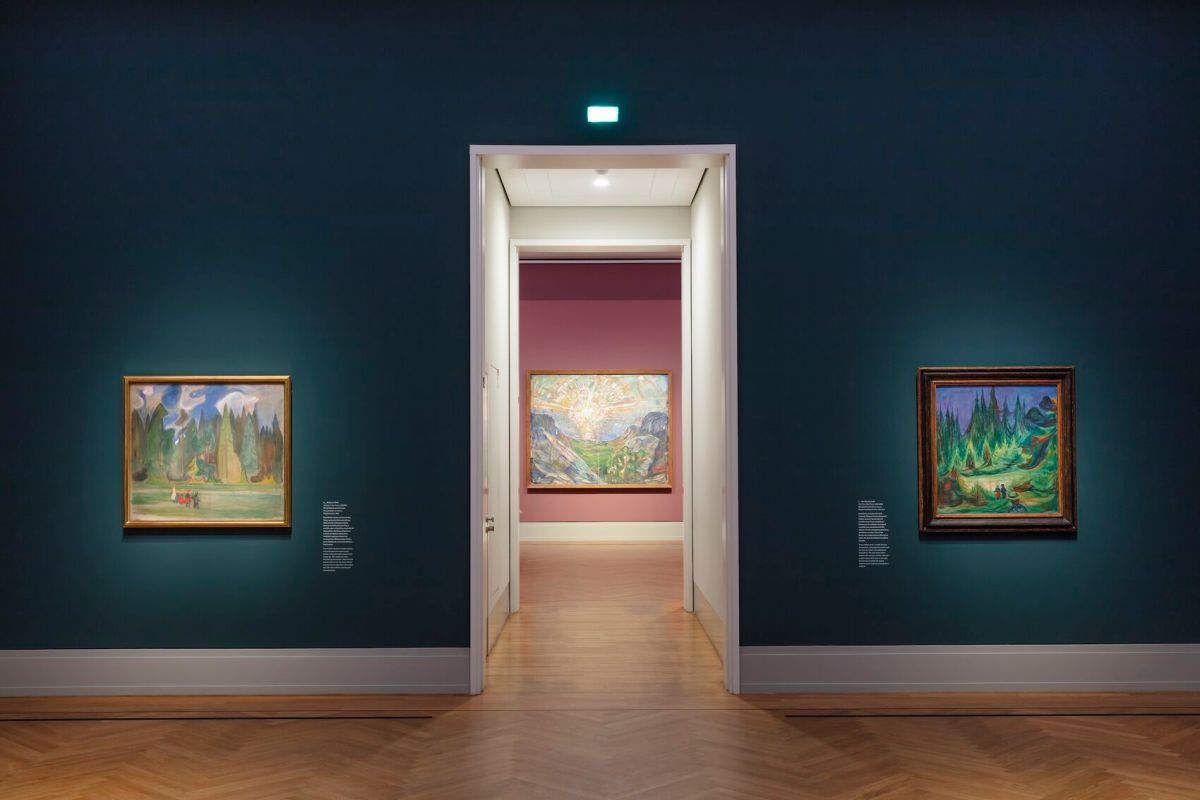
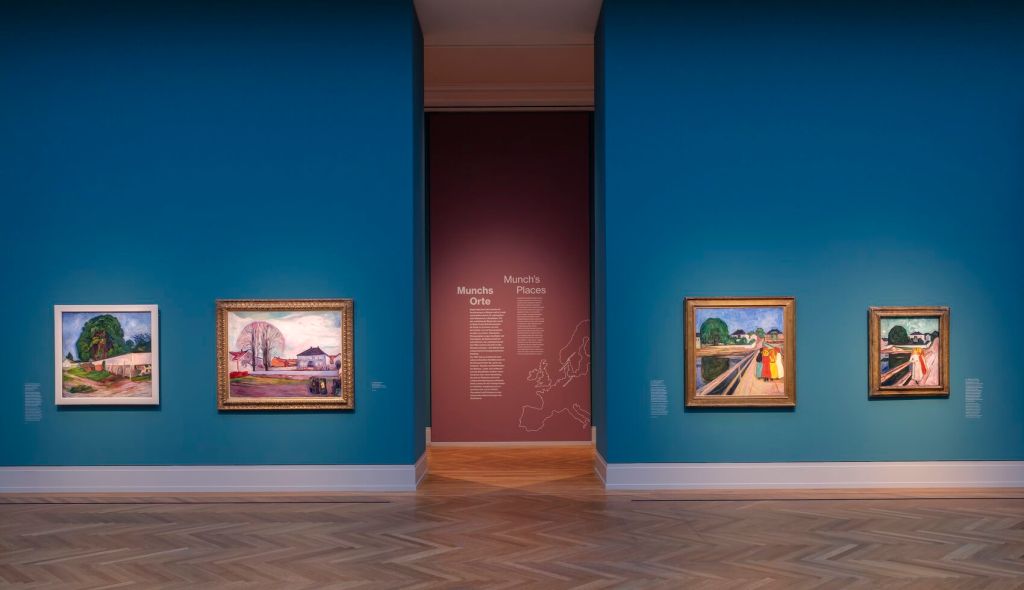
On November 18, the exhibition Edvard Munch: Trembling Earth was opened at the Museum Barberini. Organized in cooperation with the Clark Art Institute in Williamstown, USA, and the MUNCH in Oslo, the exhibition is the first to focus on Edvard Munch’s fascination with nature. The show features over 110 works by the Norwegian artist, with some of his most famous motifs as well as unknown works. Also on view are the monumental preliminary studies for Munch’s paintings for the Aula at the University of Oslo, which have not been exhibited in Germany for over a century. Lenders include the MUNCH in Oslo, the Museum of Modern Art in New York, the Dallas Museum of Art in Texas, the Musée d’Orsay in Paris, the Museum Folkwang in Essen, the Kupferstichkabinett of the Staatliche Museen zu Berlin, and the Von der Heydt Museum in Wuppertal. The exhibition in Potsdam is curated by guest curator Jill Lloyd, an expert on modern European art.
The first exhibition of Edvard Munch’s landscapes
Edvard Munch is known for his haunting images of primal human emotion. His interest in the psychological dimensions of existence, however, was matched by an equally strong fascination with nature. Employing his unique sensibility and power of imagination, Munch explored motifs taken from nature, seeking to fathom humanity’s place in the cosmic cycle of life. The image of the landscape in Munch’s work, however, has received little systematic attention up to this point. Now for the first time, the exhibition Edvard Munch: Trembling Earth and the accompanying catalogue investigate the meaning of such images in Munch’s oeuvre, questioning common assumptions and examining the contemporaneous artistic, scientific, and philosophical influences that contributed to his understanding of nature. With motifs ranging from undulating coastlines and fairy-tale forests to snow-covered or stormy landscapes, luxuriant gardens, and the exuberant play of sun, air, and water, Munch’s work also resonates with the present-day climate crisis against the backdrop of current natural catastrophes.
“Although Edvard Munch devoted almost half of his works to motifs from nature, until now he has not been perceived as a landscape painter. With Edvard Munch: Trembling Earth, our desire is to open up this perspective on his work,” says Ortrud Westheider, director of the Museum Barberini. “Especially in conjunction with the Impressionist landscapes in the Hasso Plattner Collection, it is fascinating to see how Munch, a Norwegian contemporary of the Impressionists, connected landscape with the inner life and how such different perspectives on nature could develop at the same time in Europe. While the goal of the Impressionists was to recreate the sensory experience of nature through light and color, for Munch nature was always also a mirror of his own inner turmoil, giving his landscape images a greater sense of drama. We are especially fortunate that the exhibition Edvard Munch: Magic of the North at the Berlinische Galerie overlaps with our Munch show for eight weeks. The public thus has the opportunity to experience the dimensions of the oeuvre of one of the most important artists of the modern era in all its facets in both Berlin and Potsdam. With the preliminary works for the Aula paintings, which were exhibited at the Berlin Secession in 1913 and were enthusiastically received by audiences in Berlin, we also have a direct thematic connection to the exhibition of our Berlin colleagues.”
116 paintings, woodcuts, lithographs, and drawings from twenty-one lenders in eight exhibition chapters
From June 10 to October 15, 2023, the exhibition was on view at its first station, the Clark Art Institute in Williamstown, Massachusetts. Curated by Jay A. Clark, it received outstanding reviews: “A revelatory exhibit” (The Wall Street Journal); “Magnificent . . . Munch the landscapist coexists with the connoisseur of affliction” (Financial Times); “Glorious . . . It’s a revelation” (The Atlantic); “a major modern painter in a new, broader, enlivening light” (The New York Times). The Potsdam exhibition, curated by guest curator Jill Lloyd, features 116 works in eight exhibition chapters. In late April 2024, the show will travel to its third station, the MUNCH in Oslo, where it will be curated by Trine Otte Bak Nielsen.
The chapters of the exhibition engage with a variety of natural spaces to explore the active role played by the landscape in the art of Edvard Munch. While the chapter In the Forest exemplifies Munch’s sense of nature as a mysterious realm and a place of romantic growth and decay, the chapter Garden and Field reveals his fascination with the interaction between humanity and nature. In Between Land and Sea, coastal landscapes serve as a backdrop for separation, attraction, and solitude, while the beaches of Åsgårdstrand, Warnemünde, Hvitsten, and Ekely—locations where Munch lived and worked for many years—symbolize a Summer Retreat. The chapter The Scream of Nature addresses existential questions of the relationship between man and nature: here, a lithograph of what is probably Munch’s most famous work, The Scream, is juxtaposed with the explosive color of his monumental painting The Sun. The chapter Storm and Snow explores the degree to which early twentieth-century climate fears, marked by anxiety over the dawn of a new ice age, are reflected in Munch’s landscapes. In a Cosmic Cycle shows how Munch assimilated new scientific discoveries that revealed nature as a dynamic force, visualizing it as vital and ever-changing and interweaving it with the human body and fate. The exhibition concludes with the chapter Light and Knowledge, featuring the designs for Munch’s monumental Aula paintings. For the presentation of these works, some of which are six meters long, the Museum Barberini has installed a special “room within a room,” facilitating a presentation similar to the hanging of the works in the Aula at the University of Oslo.
Tone Hansen, director of the MUNCH, states: “In 1940, Edvard Munch bequeathed the entirety of his oeuvre still in his possession to the city of Oslo. This legacy, now housed in the MUNCH, includes not only texts, letters, photographs, and personal items, but over 26,000 works of art—an extraordinary oeuvre that we can now also spatially accommodate since the opening of the new museum building in 2021. Our primary aim is not only to conserve the collection, but also to investigate and interrogate it again and again, and for us, too, it made sense to focus on his landscape images for the first time. The tremendous interest in the three exhibition stations in the United States, Germany, and Norway demonstrates that even 160 years after Munch’s birth, his work continues to be relevant.”
The works in the exhibition come from twenty-one lenders, including the MUNCH and the Nasjonalmuseet for kunst, arkitektur og design in Oslo, the Museum of Modern Art in New York, the Dallas Museum of Art in Texas, the Musée d’Orsay in Paris, the Finnish National Gallery in Helsinki, the Kupferstichkabinett of the Staatliche Museen zu Berlin, the Museum Folkwang in Essen, the Staatsgalerie Stuttgart, and the Von der Heydt-Museum in Wuppertal.
The exhibition is accompanied by a 228-page English catalogue published by MUNCH, Oslo, with essays by Jay A. Clark, Nanna Leander, Jill Lloyd, Trine Otte Bak Nielsen, and Arne Johan Vetlesen.
For the duration of the exhibition, the Museum Barberini will extend its opening hours: beginning November 18, the museum will open at 9:00 a.m., Wednesday through Sunday. On Mondays, the museum open at 10:00 a.m. as usual.
Concurrent with the show in Potsdam, a second exhibition on Munch and Berlin, Edvard Munch: Magic of the North, is on view at the Berlinische Galerie until January 22, 2024. A combination ticket for admission to both exhibitions is available from the museums for € 20 (reduced admission € 12).
Both exhibitions are under the joint patronage of Federal President Frank-Walter Steinmeier and His Majesty King Harald V of Norway.
An exhibition of the Museum Barberini, Potsdam, the Clark Art Institute, Williamstown, Massachusetts, and the Munchmuseet, Oslo. In Williamstown, the exhibition was curated by Jay A. Clark and was on view June 10–October 15, 2023. The MUNCH in Oslo will present the exhibition April 27–August 25, 2024, curated by Trine Otte Bak Nielsen.
Structure of the Exhibition
In the Forest: Myths and Fairy Tales
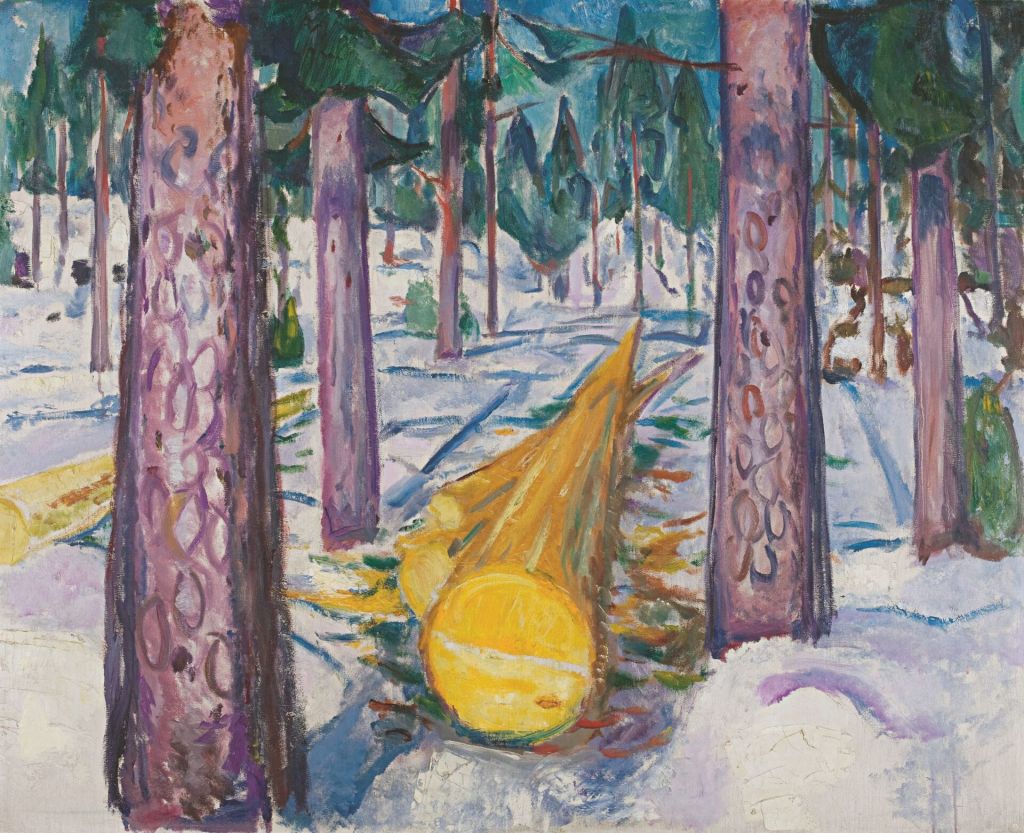
Munch’s depictions of trees and forests include romantic encounters between couples, children wandering into dense woods, and scenes of Norway’s logging industry. His images of lush Norwegian elm and pine forests capture their beauty throughout the varying seasons. Timber was among Norway’s largest exports in the early twentieth century, and while many of these paintings celebrate nature’s bounty, they also document the depletion of the country’s national resources. Throughout his life, both at home and abroad, Munch portrayed trees and forests as representations of mystery. Inspired by the forests near Åsgårdstrand, Norway, the elm trees near his home at Ekely, outside of Oslo, and the Thuringian Forest in Germany, Munch celebrated the cycle of life in paintings and prints.
Munch’s paintings of cultivated landscapes—land cleared of vegetation and then planted with crops, orchards, or gardens—reflect his keen interest in human interaction with nature. These motifs were inspired by the fertile coastal peninsula around the Oslo Fjord where he owned several properties. Reflecting a horticultural boom in Norway, Munch created flower and kitchen gardens at his various homes; he planted fruit trees, maintained orchards, and kept animals such as hens, doves, and horses. The artist regarded his gardens and fields as places of refuge overflowing with life. They can also be understood as liminal zones between nature and civilization and as symbols of fertility and rejuvenation. During a time when Norwegian agriculture was undergoing modernization and mechanization, Munch depicted traditional small-scale farming practices, celebrating the farmer’s way of life in opposition to industrialization and encroaching urbanization.
Edvard Munch, Young Girls on a Bridge, 1902. Private collection.
Between Land and Sea: Spaces of Melancholy
The shoreline was an important motif for Munch, living as he did on or near the coast of the Oslo Fjord for most of his adult life. Munch depicted a characteristically curving shoreline in his paintings, drawings, and prints from the 1890s through the 1930s. It became a recurring theme in his work, one he identified with the “perpetually shifting lines of life.” In some depictions, the shoreline itself, on a moonlit evening, is the subject; in others it is a backdrop for human emotion. The shoreline features most prominently in Munch’s works depicting themes of melancholy, human isolation, and physical separation. As the Norwegian writer Sigbjørn Obstfelder (1866–1900) remarked in 1896: “He sees in wavelengths; he sees the shoreline weave next to the ocean. . . . he sees women’s hair and women’s bodies in waves.” By setting his depictions of separation, attraction, and loneliness against the undulating shoreline of the Oslofjord the shore became an active agent in his depictions of nature.
Edvard Munch, Summer Night by the Beach, 1902/03. Private collection.
Summer Retreat: Back to the Coast
From 1889 onwards Munch’s family often rented a house in Åsgårdstrand for the summer. The rocky, curving shoreline became a frequent motif for the artist’s work. In 1907 to 1908, Munch spent a period in Warnemünde, on the northern coast of Germany, where he sought water cures and rest before being hospitalized for alcoholism and a nervous breakdown. In Warnemünde, Munch became acquainted with the Lebensreform movement and its belief in the beneficial effects of sunbathing and exercise in the fresh sea air.
He focused on outdoor bathing scenes. Returning to Norway in 1910, Munch bought a summer house on the Oslo Fjord in Hvitsten, where he continued to create bathing scenes and built outdoor studios for his monumental works. His color palette brightened, and his contemporaries began to perceive the artist as happier and in tune with nature.
The Scream of Nature: Humankind and Environment
In the lithographs Anxiety and The Scream, Munch evokes an atmosphere of anxiety that is in stark contrast to his quiet scenes of country life. The people in these images confront the viewer directly, and nature is in a state of turmoil. The Sun, on the other hand, conveys positive, vital energy. Despite the differences between the images, The Scream and The Sun can be seen as pendants. Munch repeatedly depicted the sun. In the cycle that he created for the ceremonial hall of the University of Oslo it serves as a symbol of knowledge. Both The Scream and The Sun show the existential influence of nature on humans. While The Scream raises questions about humankind’s interaction with nature, the composition of The Sun, which is devoid of people, concentrates on the star as an elemental force, a provider of energy, and the foundation of all life on earth. The Scream and The Sun communicate the unity of humans and nature. The cycle that Munch designed for the Aula of the University of Oslo is displayed on the ground level in Wing B.
Munch’s fascination with metamorphosis, together with his faith in nature’s cyclical renewal, led him to depict each changing season. His paintings of snowy landscapes celebrate the mystery and wonder of Norway’s long, dark winters. The large-scale evening scenes painted in hues of white and blue feature starry night skies and sturdy pine trees that have survived the winter cold. His snowcapped forests, townscapes, and moonlit winter skies convey a sense of quiet awe. Munch also depicted extreme weather events such as storms during the warmer months, allowing him to explore tumultuous conditions such as windblown trees and clouds scurrying across the sky. For all his awareness of humankind’s imprint on nature and interconnectedness with the universe, Munch’s paintings of snow, storm, and ice present nature as a force that is ultimately beyond human control.
Edvard Munch, Stormy Landscape, 1902/03. Private collection.
In a Cosmic Cycle: Art and Philosophy
Edvard Munch’s artistic practice was impacted by his overlapping interests in philosophy, religion, and the natural sciences. Raised in a staunchly Christian household, Munch’s religious views in adulthood were shaped by scientific theories such as Charles Darwin’s evolution and Ernst Haeckel’s Monism, a philosophical belief that all existence—both organic and inorganic—is unified. The position of humans as part of a cosmic cycle is a recurrent theme in his art.
Light and Knowledge:
Monumental Paintings for the University of Oslo
Munch represents scientific disciplines such as chemistry, physics, and botany as explorations of a world permeated by light and energy. The overarching theme of his designs for the monumental works of the ceremonial hall known as the Aula at the University of Oslo is enlightenment. The Sun, which casts its prismatic rays across the landscape, is the central motif. It is both a symbol of enlightenment and a vitalistic celebration of nature’s inherent life force. The decorative project of the Aula was the first major art commission in Norway after the country achieved independence from Sweden in 1905. Munch’s concept for the series included romantic and national ideas of vitalism and renewal. History and Alma Mater show old Norwegian peasants who pass on their knowledge to the young. Past, present, and future are thus united, while humankind fuses with the transformative forces of nature in a radiant universe.
Gunther Maria Kolck, Hamburg, and BrücknerAping, Bremen
Exhibition:
November 18, 2023 – April 1, 2024
Museum Barberini, Alter Markt, Humboldtstraße 5–6, 14467 Potsdam
21 Lending Institutions:
Staatliche Museen zu Berlin
Kupferstichkabinett Dallas Museum of Art, Texas Museum Folkwang, Essen Kimbell Art Museum, Fort Worth, Texas Finnish National Gallery, Ateneum Art Museum, Antell Collections Kunsthalle Mannheim Museum of Modern Art, New York Canica Art Collection, Oslo Christen Sveaas Art Collection, Oslo Munchmuseet, Oslo Nasjonalmuseet for kunst, arkitektur og design, Oslo Frank Mosvold Musée d’Orsay, Paris Staatsgalerie Stuttgart Von der Heydt-Museum, Wuppertal and private collectors who wish to remain anonymo
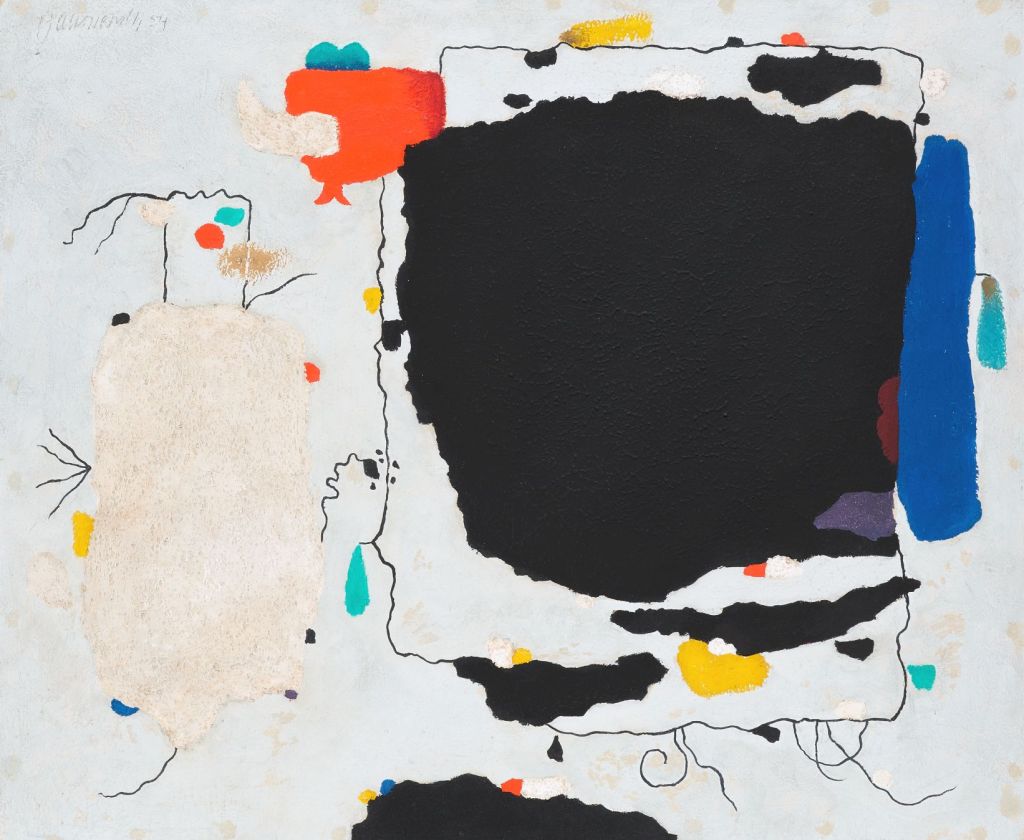
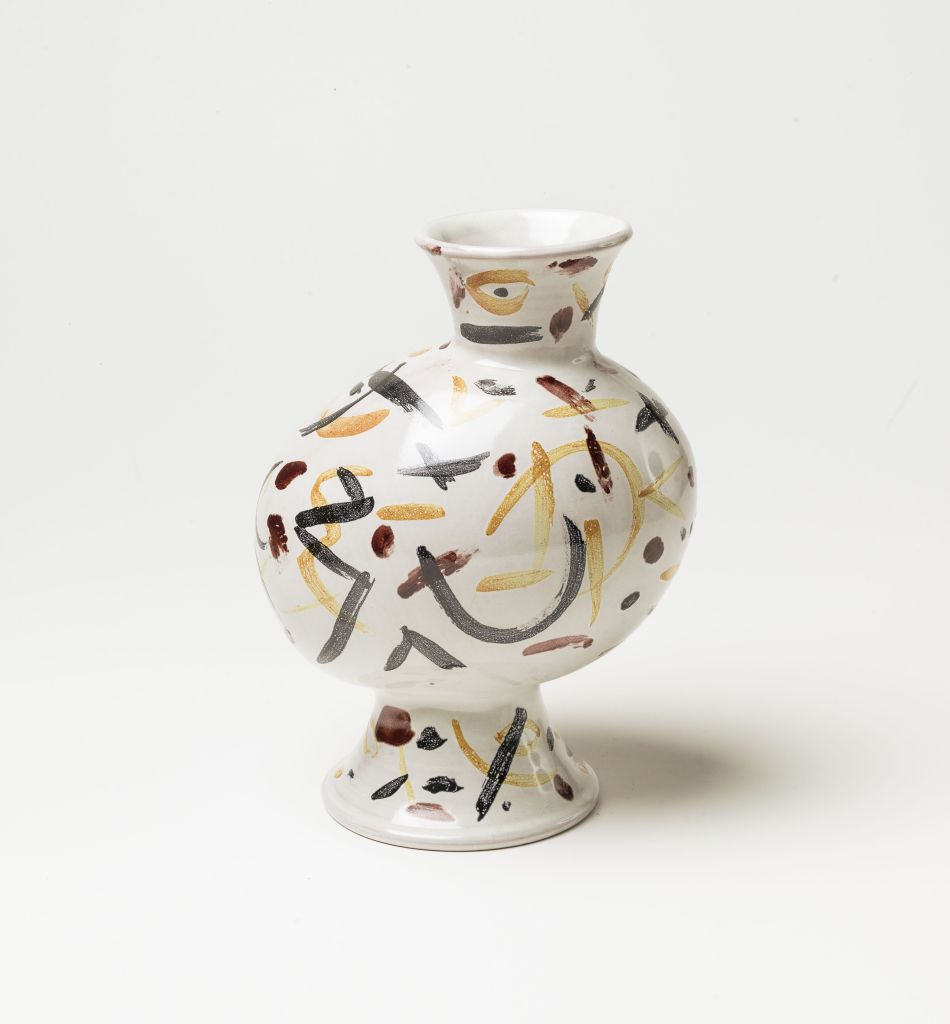
The exhibition reflects the entire spectrum of Willi Baumeister’s (1889-1955) artistic oeuvre. Baumeister was an exceptional artist in many respects. His artistic path was characterised by constant change and renewal. One of his specialities was his ability to use a wide variety of media for his purposes at a time when a strict, classical separation of artistic genres still prevailed.
Hannelore Paflik-Huber and Hans Dieter Huber (curators of the exhibition): “Baumeister—this visionary of abstraction—is worth to be rediscovered. We are showing him as a masterful networker of his time.”
From today’s perspective, Willi Baumeister can be characterised as a “social hub.” He was an excellent networker throughout his life, establishing important international contacts very early on in his artistic career, which he was largely able to maintain during the Second World War. His circle of friends included Hans Arp, Hanna Bekker, Max Bill, Robert Delaunay, Sonja Delaunay-Terk, Karl Otto Götz, Camille Graeser, Alexej von Jawlensky, Wassily Kandinsky, Paul Klee and Oskar Kokoschka. But his extensive contacts in architecture (such as Le Corbusier, Alfred Roth and Richard Döcker) and in the world of commercial art (Ella Bergmann-Michel, Robert Michel, Kurt Schwitters and others) also proved to be extremely fruitful for the wide-ranging development of an essentially intermedial oeuvre that was not limited to painting.
Together with the Domnick Collection in Nürtingen the Museum Gunzenhauser in Chemnitz owns the third largest public collection of Willi Baumeister paintings in Germany after the Staatsgalerie Stuttgart. Today, the collection comprises 39 works from the artist’s various stylistic phases. This collection, which has never been shown in its entirety before, offers an ideal starting point for a large-scale Willi Baumeister exhibition dedicated to this exceptional artist and all of his work phases and media, his art theory and artistic attitudes. The show has a particular focus on the visualisation of works from artists’ estates that have rarely been shown to date. The exhibits are supplemented by items on loan from other museums.
Furthermore, a wide-ranging selection of films, letters, postcards and photographs sheds light on the artist as a cultural-political cosmopolitan, advocate of abstract art and exceptional university teacher. Supplementary documents and artworks by third parties illustrate the high esteem in which he was held.
Next to works by Willi Baumeister, the following artists are presented in the exhibition: Max Ackermann, Gerhard Altenbourg, Hans Arp, Hanna Bekker, Ella Bergmann-Michel, Karl Bohrmann, Peter Brüning, Carlfriedrich Claus, Le Corbusier, Lily Hildebrandt, Adolf Hölzel, Marta Hoeppfner, Johannes Itten, Alexej von Jawlensky, Wassily Kandinsky, Ida Kerkovius, Franz Krause, Fernand Léger, Charlotte Mayer-Posenenske, Kasimir Malevich, László Moholy-Nagy, Otto Meyer-Amden, Robert Michel, Gonn Mosny, Margarete Oehm-Baumeister, Amédée Ozenfant, Oskar Schlemmer, Kurt Schwitters, Hermann Stenner, Ludwig Wilding.
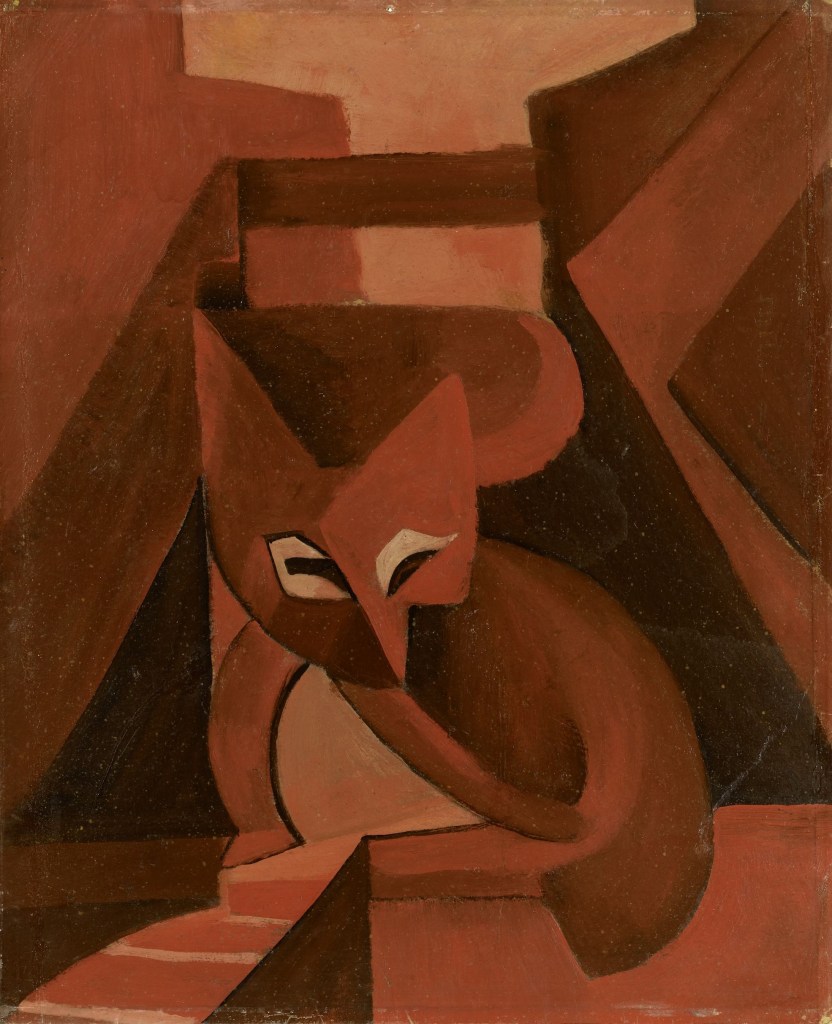
Hanna Bekker, Roter Fuchs, um 1920. Oil on cardboard, 29,5 x 24,5 cm Estate Hanna Bekker/Archive Hanna Bekker vom Rath, Frankfurt/Main Photo: Fotostudio Herbert Fischer FrankfurtWassily Kandinsky, Rot im Quadrat, 1931 Watercolour, pen and ink on paper,34 x 33,9 cm. Private collection Photo: Archiv Baumeister im Kunstmuseum Stuttgart
The Museum of the City of Belgrade, Princess Ljubica’s Residence, 8 Kneza Sime Markovića Street in Belgrade, and The Association of Artists in Fine Arts, Applied Arts and Designers of Serbia (ULUPUDS) is pleased to present:
Annual Exhibition of the Painting and Graphic Section of ULUPUDS
7th – 20th November, 2023
The Association of Artists in Fine Arts, Applied Arts and Designers of Serbia organizes the Annual Exhibition of painting and graphic arts, which, through the presentation of artistic concepts and their elaborations in diverse media, techniques and formats, aims to provide insight into ways of thinking about the very concept of artistic presentation.
The Annual Exhibition, showcasing the individual artistic creativity within the framework of contemporary aesthetic, anthropological, cultural, political, economic, feminist, historical and sociological dimensions, aim to examine the expressive capacities of contemporary Serbian artists dealing with technologically and materially complex ideas.
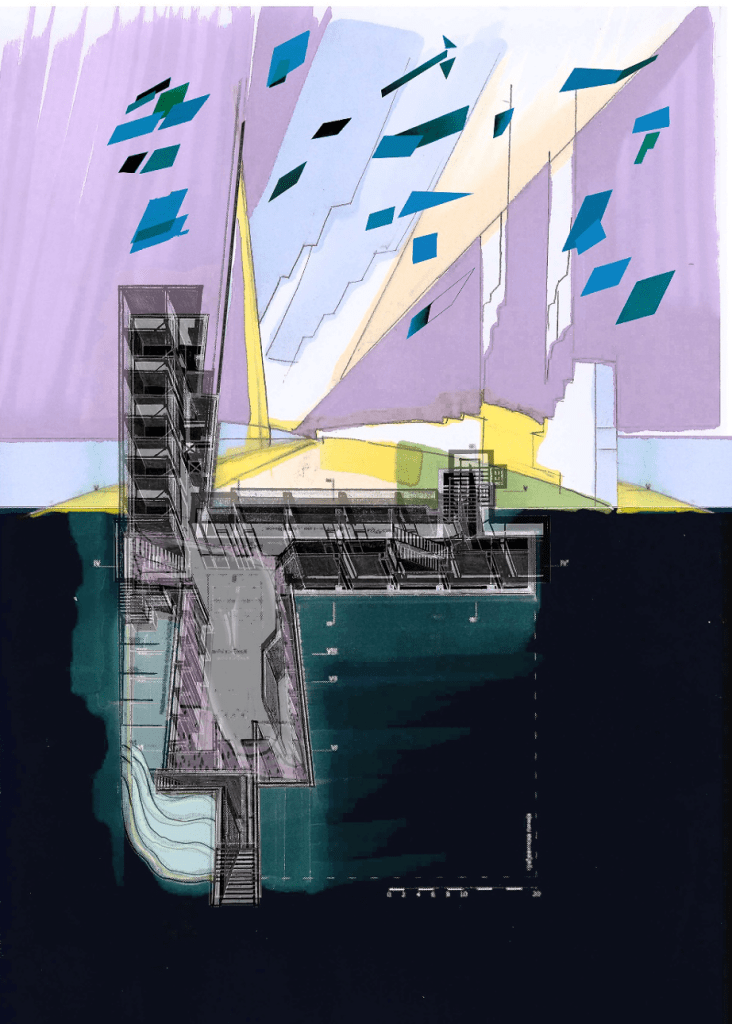
One of the featured works is Katarina Andjelkovic’s digital graphics, The Levitation Scene, which is a part of the decade-long drawing project called War [Un]Story.
Katarina Andjelkovic, The Levitation Scene (from The Sequence of explosion of architectural orders: patterning of relations). Digital graphics, 76 x 55 cm, 2021.
Katarina Andjelkovic’s digital graphics The Levitation Scene has championed a decade-long drawing project War [Un]Story. The author of this collection has offered an aesthetic reflection on the aftermath of war by appropriating the concept of architecture as a visual resource to (un)tell the apocalyptic scenario of NATO-sanctioned bombings of the former Federal Republic of Yugoslavia. A series of digital graphics deal with an aesthetic reflection on political bodies and conditions, asking how they have re-territorialised the material reality of the Serbian Military Headquarters in Belgrade (Generalštab building, architect Nikola Dobrović, built between 1956 and 1965) as a cultural artifact into the performativity of its political function. The project is seen as an opportunity to rethink political power through the analytics of physical sciences. It is revealed as a type of image which, instead of reproducing architectural reality, rather produces new perceptions of the event through the power of the energy and forces war unleashes. To animate the viewing encounter, the author chose to transcribe the energetic event of explosion into visual forms. Material decay of the building granted access to the immateriality of perceptual fields and delineated a multi-layered untold story in a fusion of energy (the fundamental concept in physics), power (the fundamental concept in social science) and transformation. The resulting choreographic notations can be registered and apprehended through the universe of image representation that negotiates physical boundaries by energy and forces. In Boccioni’s early twentieth-century references to the ‘electric theory of matter’, according to which matter is only energy, the exhibition shifts away from representational images to a more abstracted non-representational forms, the fragments of broken structure that are represented in a flow, bearing a striking resemblance to electrons in their ‘bareness’ or lack of materiality.
About Katarina Andjelkovic
Katarina Andjelkovic, with a Ph.D., M.Arch.Eng., M. Applied Arts, is a theorist, practicing architect, researcher and painter. She is a high-skilled draftsman, writer and researcher. Andjelkovic is simultaneously engaged in architectural practice, teaching, and research. Katarina’s research, writing and teaching, focus on how ideas can be translated across different media, crossing architecture, visual arts and film. In Spring semester 2021, Katarina is the main instructor of the HAND-DRAWING COURSE: THE FACE[S] OF ARCHITECTURE at SMT New York in New York City. She served as a Visiting Professor, Chair of Creative Architecture, at the University of Oklahoma U.S.A., Visiting Lecturer at Coburg University of Applied Sciences – Faculty of Design (Department of Architecture) in Germany, Institute of Form Theory and History in Oslo, Institute of Urbanism and Landscape in Oslo, Norway, at The University of Belgrade – Faculty of Architecture. Katarina is guest-lecturing and mentoring at Master Studies of TU Delft – Faculty of architecture and the built environment, Doctoral studies of AHO – Oslo School of architecture and design, FAUP Porto, DIA Anhalt Dessau, SMT New York, and Bachelor studies of ITU – Istanbul Technical University. She lectures internationally at conferences in film, photography and architecture, urban space and visual representation, exploring architecture with image technologies: from film to VR and AR, modern aesthetics of architecture, film-philosophy, drawing research, teaching-research frameworks, artistic research, and visual culture in more than 35 countries in Europe, United Kingdom, North America, Canada, Australia, China, and South America. Katarina has published her research widely in international journals (Web of Science). She is a full author of the Preliminary Architectural Design, a national project supported by the government of Serbia. She won the Belgrade Chamber of Commerce Award for Best Master Thesis defended at Universities in Serbia in all disciplines. Katarina has published two monographs; an upcoming book chapter and several journal articles with Intellect United Kingdom, University of Chicago Press (U.S.), Routledge, Taylor and Francis Group (London, United Kingdom), Büchner-Verlag eG, Marburg/Germany, etc. During her Ph.D., Andjelkovic’s research stays were all at European universities in Copenhagen, Ljubljana, Porto, Dundee U.K., Brighton U.K., Dublin, Madrid, etc. Andjelkovic exhibited her artwork at 7 Solo Exhibitions and at more than 70 international architectural, fine arts, and photography exhibitions, including group exhibitions at Pall Mall Gallery in London, Royal Hibernian Academy in Dublin, MAAT Museum in Lisbon, International Biennial of Illustration ”Golden Pen” in Belgrade, Loughborough University in the United Kingdom, TU Delft in the Netherlands, the Museum of Applied Arts in Belgrade, the National Museum in Belgrade, Prodajna Galerija “Beograd” (Kosancicev venac, Belgrade), Gallery Singidunum in Belgrade, Stepenište in Art Education Center ”Šumatovačka”, Gallery of the Central Military Club, Suluj Gallery, Pavillion Cvijeta Zuzoric of the Association of Fine Artists of Serbia, and Mala Gallery of the Association of Fine Artists of Applied Arts and Designers of Serbia. Katarina is a recipient of EDRA’S 2022 AMBASSADOR FUND AWARDS [California, U.S., Awarded in South Carolina], THE ULUS 2021 Spring Exhibition Award “INVISIBLE PORTRAIT” [awarded by Association of Fine Artists of Serbia], and won numerous awards for her architecture design and urban design competitions.
About The Museum of the City of Belgrade, Princess Ljubica’s Residence
The Museum of the City of Belgrade, Princess Ljubica’s Residence, 8 Kneza Sime Markovića Street in Belgrade, is one of the few preserved buildings from the time of the first reign of Prince Miloš Obrenović. Princess Ljubica’s residence was built in 1830. After restoration and reconstruction, the building became part of the Museum of the City of Belgrade in 1980, and in September of the same year, the permanent museum exhibition “Interiors of Belgrade houses of the 19th century” was opened. The display consists of a representative selection of fine and applied art objects from the collections of the Museum of the City of Belgrade. The objects were created during the 19th century as a product of Western European and domestic craft-art and industrial production. Today, the lower level of the building regularly hosts art exhibitions.
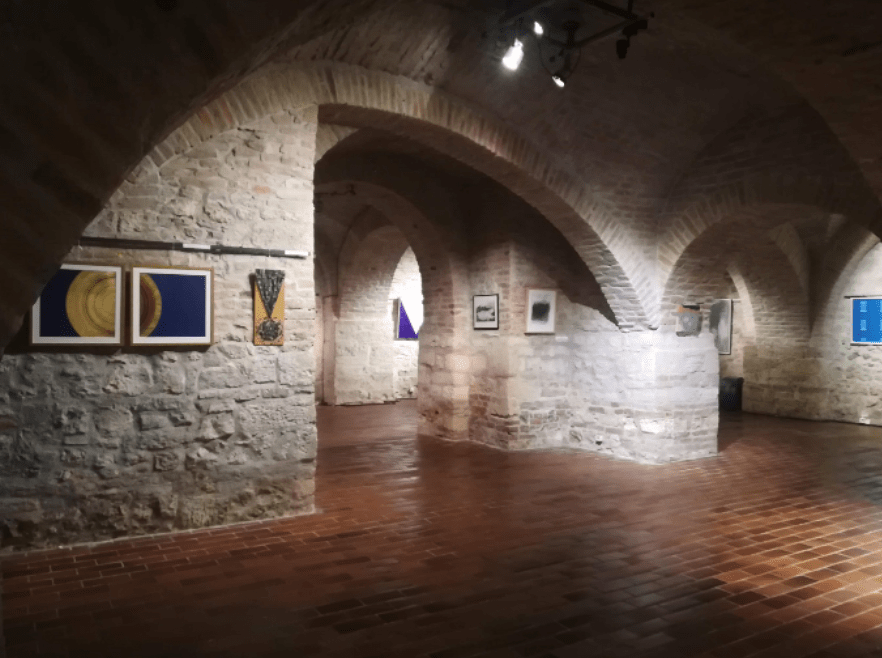
Katarina Andjelkovic with her artwork, Princess Ljubica’s Residence in Belgrade, November 2023.Annual Exhibition of The Painting and Graphic Section of ULUPUDS, Princess Ljubica’s Residence in Belgrade, November 2023.
Exhibition opening: Tuesday, November 7th, 2023, at 19h.



























 Art Style | Art & Culture International Magazine