
Joseph Beuys. Collection Presentation
Hamburger Bahnhof, from 12 April 2024.
A collection presentation by Nationalgalerie, Staatliche Museen zu Berlin
Opening: Thursday, 11 April 2024, 7 pm
Joseph Beuys – Works from the Nationalgalerie Collection
Hamburger Bahnhof presents its extensive holdings of works by artist Joseph Beuys (1921–86) in the Kleihueshalle, reopening on this occasion. The exhibition will include major pieces from the Nationalgalerie’s collection, which recently entered the collection thanks to the generous donation of the family of collector Erich Marx, who died in 2020. Visitors can explore the complex oeuvre and critical reception of the artist Beuys in a presentation comprising 15 works and a multimedia study island.
Joseph Beuys was a draftsman, sculptor, action and installation artist, teacher, politician and activist. Born in Krefeld in 1921, he grew up in Kleve. He died in Düsseldorf in 1986. Having grown up under National Socialism in Germany, and actively participated in the Hitler Youth and the armed forces, Beuys sought to transform the totalitarian society of his youth into one of warmth and radical democracy: by means of art, and in conversation and cooperation with all people. Beuys called the collective transformation of society he envisaged “social sculpture.” By that, he meant an expanded form of art, in which all human beings – as the artists they innately are – could and should participate. Beuys took his own personal transformation as his point of departure. The extent to which he actually achieved the inner change he was striving for is still highly contested today.
The collection presentation explores the ways in which Beuys explored the boundaries and responsibilities of art through his work. It also offers an insight into the mixed public response to the artist through books and audio contributions, while juxtaposing his vision of social renewal with the ideas of other people, such as the civil rights activist Angela Davis, the writer Ursula K. Le Guin, and the rapper and poet Kae Tempest. The exhibition celebrates the generous donation of works to the Nationalgalerie made by the family of collector Erich Marx.
Below are some of the works by Joseph Beuys that are presented in this exhibition.
Joseph Beuys, Capri-Batterie, 1985
Several works by Joseph Beuys, such as the Capri Battery, are related to the concept of a “solar state,” or “city of the sun”. Beuys came across it in Civitas Solis (1623): a utopian work by political philosopher Tommaso Campanella. Like Campanella, Beuys placed the power and warmth of the sun at the center of his social utopia. Named after the island of Capri where it was conceived, Beuys’s tiny work resembles a miniature model of the sun. It combines a light bulb representing the light of the sun with a lemon symbolizing the energy of the sun. The result is a fruit battery – not unlike the ones you might have made in physics class at school. With this simple gesture, Beuys transformed Campanella’s rigid social model into a continuously changing one. The Capri Battery is among the artist’s final works. It can be thought of as his intellectual and political testament.

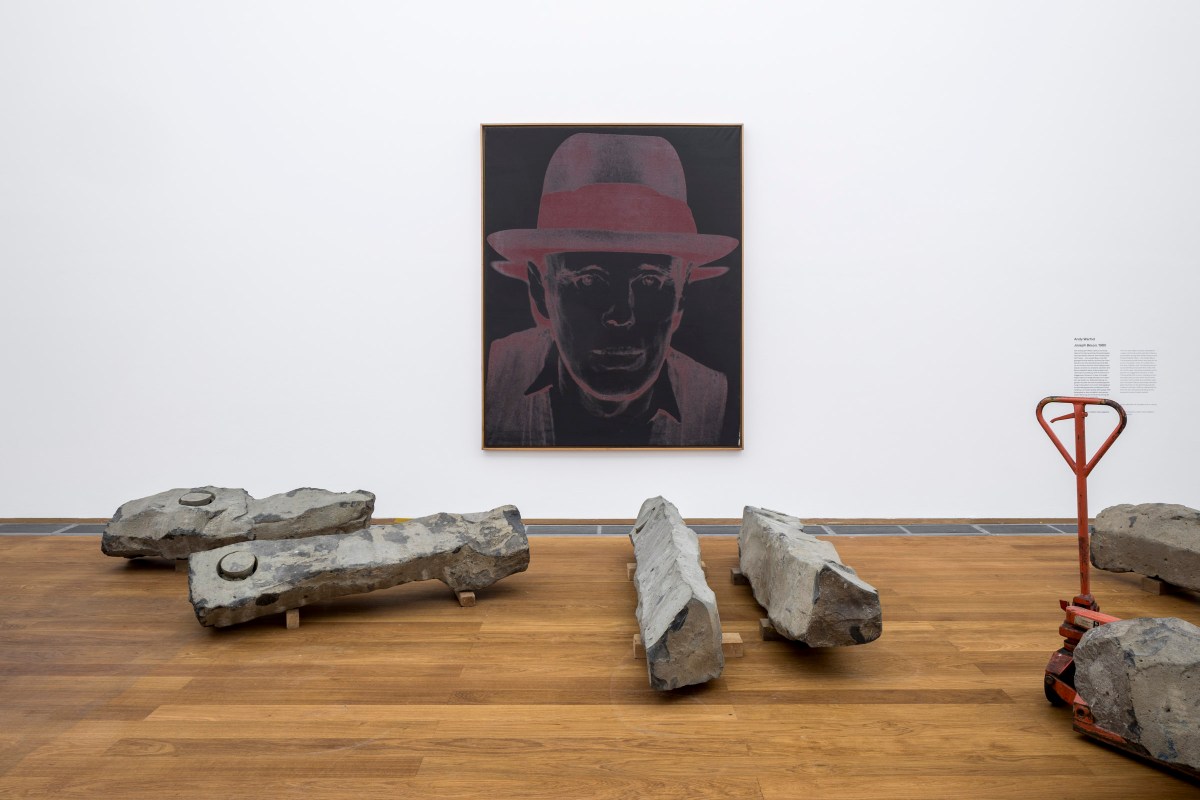
Andy Warhol, Joseph Beuys, 1980
From the early 1960s onwards, Andy Warhol created colorful silk-screen portraits of famous personalities, among them Marilyn Monroe, Elvis Presley, Elizabeth Taylor – and Joseph Beuys. The oversized portrait shown here casts him as an icon of popular culture. It is coated with a thin layer of glittery dust. The painting was produced after Beuys had spent time in New York for his first major international exhibition at the Solomon R. Guggenheim Museum in 1979. The two artists, both of whom cultivated a mythical public persona, had met for the first time only a few months earlier at an exhibition opening in Düsseldorf. Beuys presumably attached great importance to the advertising potential of Warhol’s portrait. In 1981, he claimed that his entire life was ultimately advertising: for the renewal of society through creativity.
Joseph Beuys, DAS KAPITAL RAUM 1970–1977, 1980
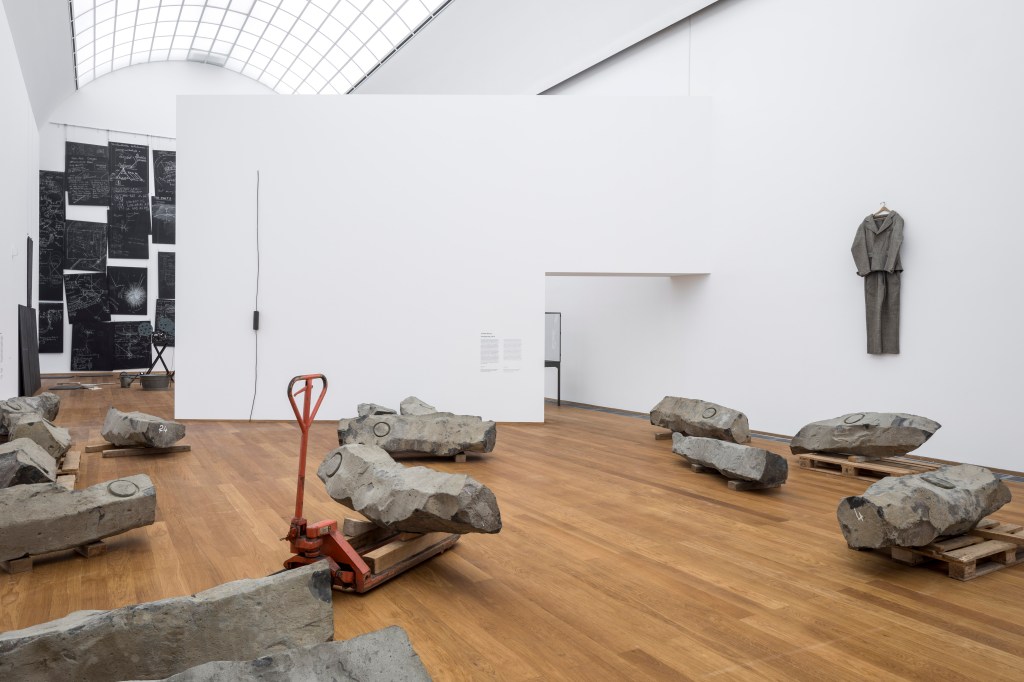
In the course of the 1970s Joseph Beuys realized that there could be no transformation of society without a fundamental rethinking of capital and economics. The installation displayed here explicitly refers to Das Kapital, Karl Marx’s critique of political economy. In contrast to Marx, Beuys equated capital with human creativity. This large-scale enigmatic work resembles an abandoned stage. It brings together objects and devices drawn from actions and projects largely carried out between 1970 and 1977, such as a concert grand piano and axe, film projectors and a screen, a microphone, tape recorders and loudspeakers. The blackboards with chalk drawings were produced in conjunction with teaching and learning situations that Beuys presented as artworks at two major exhibitions: the Organisation for Direct Democracy through Referendum at documenta 5 (1972) and the Free International University at documenta 6 (1977). In each instance the artist and the public spent 100 days discussing politics, society, and the economy.
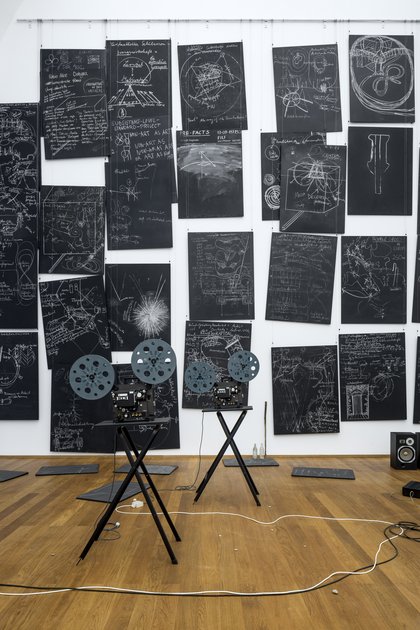
Comprising 15 works, the collection presentation brings together for the first time in one space Tram Stop. A monument to the future (1976), DAS KAPITAL RAUM, 1970–1977 (1980) and THE END OF THE 20TH CENTURY (1982) from the Nationalgalerie Collection. The study island offers visitors an insight into the ambivalent perception of the artist through audio contributions by well-known personalities and selected books and confronts his vision of social renewal with the civil rights activist Angela Davis, the writer Ursula Le Guin or the poet Kae Tempest, among others.
In addition to sculptures, environments, drawings and multiples the exhibi- tion also includes groundbreaking actions such as how to explain pictures to a dead hare (1964), Transsiberian Rail (1970) and I like America and America likes Me. In these works, Beuys developed and illustrated his idea of how everyone could actively contribute to the democratization of society as an artist. From 1963 onwards, he performed over thirty actions in various roles, among them a shaman, teacher, gangster or gardener. Beuys used materials such as felt, fat and copper, to which he attributed certain properties within his work. The Felt Suit (1970), for example, is made of a material that Beuys valued for its warming, insulating qualities. He also developed theories, as the Projekt Westmensch notebooks in the exhibition illustrate. From electromagnetism to quantum physics, he inten- sively investigated the properties of energy.
Energy-generating and energy-conducting processes played a central role in the development of his Theory of Social Sculpture, which he also referred to as the Energy Plan. The Energy Staff (1974) and Capri Battery (1985) attest to this in the exhibition.
The presentation probes the ways in which Beuys’s work questioned the nature, materiality, language and perception of the boundaries and tasks of art. He incorporated myths about himself into his work, actively integrated the public into his art in the spirit of social sculpture and ultimately moved outside the museum world. The model for Tram Stop. A monument to the future (1976) was a peace memorial made of decommissioned weapons and a railway track from Beuys’s hometown of Kleve. DAS KAPITAL RAUM, 1970–1977 (1980) refers to Das Kapital by Karl Marx (1867), although Beuys equates capital with human creativity. The installation consists of objects from actions from 1970 to 1977. The blackboards with chalk drawings were created as part of the Organisation for Direct Democracy through Referendum at documenta 5 (1972) and the Free International University at documenta 6 (1977). Here the artist and the public spent 100 days discussing politics, society and the economy. THE END OF THE 20TH CENTURY was created after 7000 Oaks for documenta 7 (1982) and also incorporates basalt steles. With this large-scale ecological sculpture in Kassel, in the realization of which thousands of people took part, Beuys left the conventional art space.
The Felt Suit (1970) already testifies to Beuys’s tendency to situate himself at the center of his artistic-political movement. The portrait by Andy Warhol from 1980 depicts Beuys as an icon of popular culture. Beuys was presumably aware of the advertising potential of Warhol’s portrait. In 1981, he claimed that his entire life was advertising: for the renewal of society through creativity.
The exhibition aims to actively involve the public. New voices on the subject of transformation and social renewal will be added to the study island every three months. Visitors are invited to enter suggestions in a notebook.
In addition to free guided tours on Sundays, which offer participants a basic overview of the artist’s issues and themes, the education and outreach program also includes new guided tours that can be booked individually. Schools have the opportunity to book exhibition talks on Beuys’s work, which deal with topics such as ecology, environmental protection and sustainability. The program also includes a range of workshops on political, sociocritical and utopian art. These interactive discussions offer high school students the opportunity to view and discuss Beuys’s art in the context of contemporary artistic positions shown at the museum. A school project with the Erika Mann primary school will create a program for beuysradio based on an intensive examination of his work.
In 2022, the family of the well-known Berlin collector Erich Marx, who died in 2020, donated the entire holdings of works by the artist Joseph Beuys from the Marx Collection to the Prussian Cultural Heritage Foundation. The donation included the following works, which are now in the collection of the Nationalgalerie: The secret block for a secret person in Ireland (1936–76); STELLE, 2nd Version (1967–76); Energy Staff (1974); Tram Stop, 2nd Version (1961–76); Untitled (Blackboard, 1977); Untitled (ART = CAPITAL, 1980); Untitled (Neutralied CapitaI, 1980); DAS KAPITAL RAUM 1970–1977 (1980). Of these works, the following can be seen in the new collection presentation: Energy Staff (1974); Tram Stop, 2nd Version (1961–76); and DAS KAPITAL RAUM 1970–1977 (1980).
The new permanent display is being held to mark the generous donation of works from the family of the collector Erich Marx. It will be accompanied by a rotating series of solo exhibitions featuring the work of contemporary artists – the first of whom will be Naama Tsabar with Estuaries (until 22.9.2024, curated by Ingrid Buschmann). From 8 November 2024, Andrea Pichl will follow with Wertewirtschaft (Values Economy, until 4.5.2025, curated by Sven Beckstette).
In addition to the new collection presentation in the Kleihueshalle, Beuys’s installation “Unschlitt/Tallow” (1977) from the collection of the Nationalgalerie is on display in the west wing of the museum as part of the permanent presentation Endless Exhibition.
Joseph Beuys. Works from the Nationagalerie Collection is curated by Catherine Nichols, curator at Hamburger Bahnhof – Nationalgalerie der Gegenwart.
Hamburger Bahnhof – Nationalgalerie der Gegenwart
Invalidenstraße 50/51, 10557 Berlin, Germany
 Art Style | Art & Culture International Magazine