

Reimagining Art through Immersive Technologies: The Digital Renaissance
By Jean Arnaud
Our society is currently undergoing rapid changes that are profoundly redefining our perception of the world and our relationship with it. The fields of art and culture are no exception. Innovative technologies, often referred to as “new media,” are introducing revolutionary paradigm shifts in art, heralding the inexorable triumph of a new era, a “digital renaissance.”
These new works, primarily developed using immersive technologies such as 3D video, holography, virtual reality (VR), augmented reality (AR), and the metaverse, distinguish themselves from traditional static works through their dynamism and their ability to evoke more intense emotions. They also stand out for their power to deepen and expand our reality. These works are meant to be lived and experienced rather than passively observed, continuing the advances initiated by revolutionary artists like Marcel Duchamp, whose kinetic art challenged traditional norms by introducing movement into art, or artists like Mark Rothko, whose abstract and suggestive expressionism increase the viewer’s role in the artistic experience by encouraging active interpretation.
Indeed, the art produced by new media immerses viewers in a dynamic, and multisensory experience that goes beyond mere observation and interpretation. Not only does it transport them into a perpetually transforming world that invites exploration of the artwork’s depth and complexity, by blending sensations, it also opens up new horizons of perception and self-awareness into the immeasurable abyss of one’s inner being, or to borrow from Pessoa, to “travel while remaining still.” These new genre works are created to be contemplated and admired, in addition to being experienced, and above all, to be transcended.
Exhibitions of video or reflective art, like Yayoi Kusama’s Infinity Mirror Rooms, have gradually made way for light displays and immersive experiences dedicated to the works of artists such as Klimt, Van Gogh, Cézanne, and Matisse, as seen in the Atelier des Lumières in Paris, for example, or the Hall of Lights in New York City. While novel and refreshing, these retrofitted works do not hold nearly the same value as those aesthetically conceived experiences in which technological tools were employed in the service of an artistic vision and integrated into the creative process.
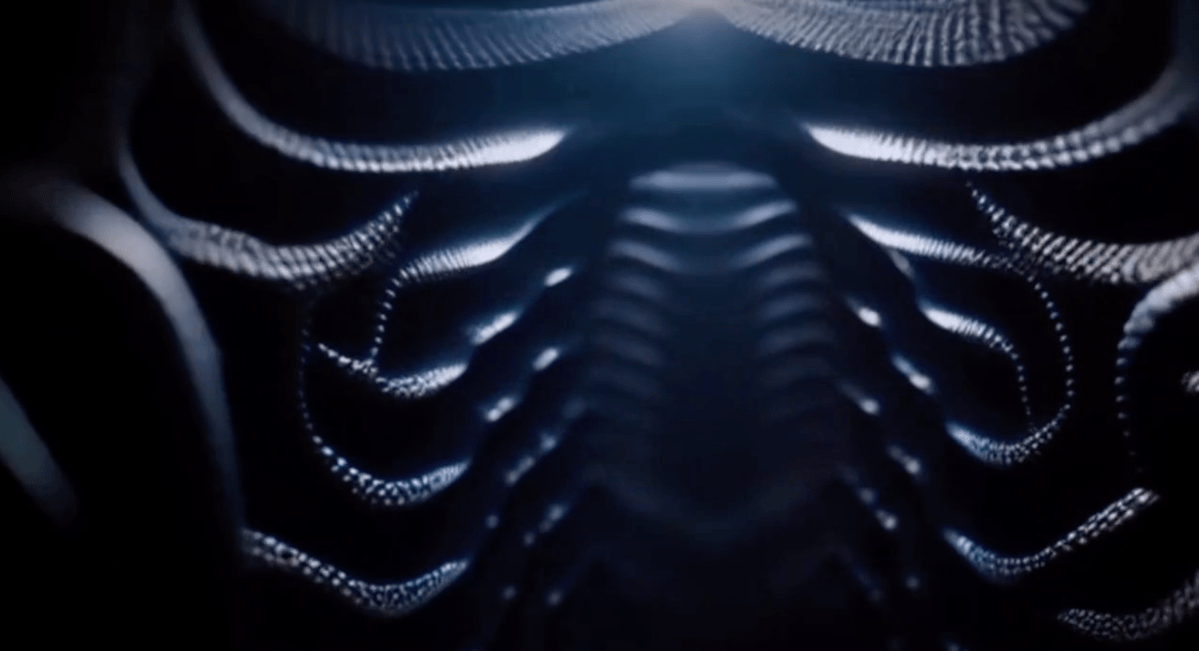
In my immersive video experience, The Universe Within, various technologies were used to bring my aesthetic vision to life. This allegorical piece represents the forces at play within an individual during the act of creation. It also seeks to embody the very movement of a being simultaneously creating itself and shaping its work. Depicting a gradual awakening and a powerful universe of colors, scents, and harmonious orders, when projected, The Universe Within envelops viewers, inviting them to contemplate the surges occurring within their inner selves, like mirrors reflecting the ever-shifting complexity of their psychic life, urging them to transform themselves through an act of creation. This synesthetic and multisensory experience creates a strange and cathartic impression for the viewer: Imagine being carried by an indomitable wave toward the shores of a more accomplished self – the supreme being that assimilates with destiny, one shaped and polished through perseverance, one to which all the power of existence aspires. This demiurgic act is made possible by combining artistic vision with immersive technologies, and the beauty that constitutes the true purpose of any work of art becomes enriched with a dimension both mystical and metaphysical.

Other artists have also explored this dynamism in their work. For example, Refik Anadol’s stunning piece, Unsupervised, recently joined the permanent collection of the prestigious MoMA in New York. Anadol’s offering examines the idea of art creating itself, a process in which moving forms attempt to break free from their boundaries. Ultimately, machines, like human beings, are still constrained by their own nature and the physical reality in which they are rooted and upon which they depend. Thus, while these phygital works can create unprecedented experiences due to their dynamic, immersive, and multisensory nature, and while they foster the development of deeper, more vivid emotions and ideas, they are limited by physical constraints that only virtual reality and augmented reality can transcend.
Students at MIT’s Computer Science and Artificial Intelligence Laboratory have developed an augmented reality experience that presents the viewer with a digital canvas on which a creature moves through a lush jungle, and they can interact with it by scanning a QR code. When the viewer solves the artist’s riddle, the artwork comes to life, and the environment flourishes. Augmented reality not only frees an artwork from physical constraints such as frames, walls, or spheres, but it also places the viewer at the center of the artistic experience, where they can actively participate. However, while the viewer can have an impact on the work, their actions are still restricted and guided by the artist-engineer, or the artist assisted by computer engineers. If a piece of art is developed within a VR or AR environment, true transcendence can only take place within the metaverse, a more open digital world where each participant can interact and collaborate with friends in the form of avatars, redefining the entire artistic experience. In the metaverse, boundaries between the realms of art and play blur, and the possibilities for artists and viewers are infinitely expanded.
The metaverse allows artists to create dynamic art that defies the laws of physics, whether it be inverted, floating pyramids, immersive digital art spaces that transport viewers, the synesthetic integration of visuals and music, interactive philosophical, historical, technical, or cultural elements, or animated discussions by avatars representing both the artwork’s characters and the artist. Such metaverse-based work transcends traditional boundaries that define artistic genres, offering an impression of limitless possibilities and experimentation, as well as introducing ludic elements like escape games, which invite viewers to participate actively, even in the creation process. Within the metaverse, art is no longer akin to Greek columns carved from marble destined to exist eternally in petrified beauty; it can now take on the vibrant and colorful appearance of living trees, whose multiplying branches ignite the infinite motion of worlds, life, and the creative soul, offering a boundless universe of possibilities.
My work, Prometheus Ἑωσφόρος, is an interactive 3D sculpture in the metaverse, inspired by ancient mythology. After stealing the sacred fire from the gods, Prometheus, the divine rebel, offers it to human beings, granting them the ability to break free from the constraints of a predetermined, imposed, and disputable order. Now free to be sovereign, humans must shape their existence with the fire of love, ardently stoked by the breath of will, guided by the high visions of creative imagination, and shaped, sculpted, and polished by the skilled hands of reason. Beyond the beauty of art that each demiurgic soul aspires to, there are underlying philosophical messages, encouraging humans to be the sculptor of themselves and their destinies, to elevate the powers inherent in their being, and to be present in the world, open to its mystery and complexity, as the architect of a more enlightened humanity by employing technology in service of their vision.
My digital statue represents the first level of meaning, containing an experience hidden within. Prometheus Ἑωσφόρος is located inside a futuristic 3D triangle that moves through the air and can only be accessed after deciphering a symbolic and mysterious poem, a kind of enigmatic relic guarding the “threshold of intrusion,” to borrow Novalis’s vocabulary. To answer the call of the humanist artists of the digital renaissance, one must draw upon their inner strength to move beyond mere aesthetic contemplation and delve into their own depths to rise to the creative act: “What [every artist] seeks when they cast these sparkling fragments of themselves onto the world are beings of their rank, filled with a supreme love for life, entirely devoted to their sacred mission, miners of knowledge, hallucinators and seers, inventors of values, creators of the future… To these magnificent beings falls the enormous, sublime, and superhuman task of raising, in the skies of the future, the star their predecessors sketched in dreams, of shaping and perfecting the star whose rays they have outlined” (Soliloquies, foreword). Thus, the viewer is called upon to participate and interact with my sculpture by taking the torch held by the cybernetic titan that it depicts. A circle with mysterious inscriptions moves, revealing a cryptic poem – a bridge to another experience, the recreation of the sculpture in a different way. The goal is then to encourage the viewer to enrich the artwork with their own vision, so that they become a creator themselves.

The artwork made possible by new media is no longer meant solely for observation; it is designed to be lived and experienced. These innovative technologies offer the opportunity to create dynamic, immersive, synesthetic, palimpsest, interactive, and participatory artistic experiences that have brought about profound paradigm shifts in the field of art. It is a total art that requires artists to be versatile and master complex technologies, transforming themselves into technical artificers or visionary philosopher-poets surrounded by talented experts, painters, musicians, and engineers. The artists of the Renaissance were masters in various disciplines; Michelangelo excelled in sculpture, painting, and poetry, and Leonardo da Vinci excelled in philosophy, sculpture, painting, and engineering, relying on the most talented individuals of their time in order to execute their work. The new art of the digital renaissance is thus open to an infinity of possibilities and meanings, surpassing the notion of artistic genre and allowing the viewer to adopt a new role beyond that of a mere observer or exegete by participating in the creative process and rising to the level of the artist. The artwork itself can now offer in its structure the means of its own transcendence and present itself to posterity as a moving temple dedicated to change and successive metamorphoses, challenging the old artistic hubris that glorified the illusion of immortality in opposition to time. There is no being that does not become, or, to put it differently, there is no being but in the process of becoming. This philosophical principle is embraced by this new art, even defining it as the ideal.
A new era has opened, one in which humanity, thanks to advances in technology, is compelled to question its limits, a practice that must be embraced if one wishes to push these limits and transcend them. The makers of the impossible owe much to limitation, as it became an invitation to act with invention. Art, more than ever, is not only a manifestation of these existential questions but also the most refined and spiritual way to answer them. It also then becomes the most sophisticated means of self-fulfillment and improvement, of becoming more oneself and more than oneself. By accumulating and mobilizing the powers of existence through philosophy, science, art, and technology, and by becoming more of what they must be, the artist of the digital renaissance ensures that their being fulfills its destiny (or that their being is fulfilled as destiny) and shapes, at the same time, that of humanity, which always shines above, guiding our supreme aspiration toward higher beauties and the skies of the sublime.

Jean Arnaud, also known as Jean Arno, is a Boston-based tech entrepreneur and the founder of Nova, a company dedicated to developing interactive AI solutions to accelerate academic research and enhance its efficiency. In addition to his entrepreneurial pursuits, Jean is a published author and an artist renowned for his innovative work at the intersection of technology and art. He is recognized for pioneering new approaches that push the boundaries of both fields.
Publishing in Art Style Magazine is free of charge for anyone. There are no article processing charges or other publication fees. Art Style Magazine is independent and supports the Open Access Movement. The editors of Art Style Magazine cannot be held responsible for errors or any consequences arising from the use of information contained in essays and articles published on the Art Style Magazine’s website and editions. Authors agree to the terms and conditions and assure that their submissions are free of third parties’ rights. The views and opinions expressed in the essays and articles are those of the author and do not reflect the views of Art Style Magazine. The authors of Art Style Magazine’s essays and articles are responsible for its content. The Art Style Magazine‘s website provides links to third-party websites. However, the magazine is not responsible for the contents of those linked sites, nor for any link contained in the linked site content of external Internet sites (see Terms & Conditions).
 Art Style | Art & Culture International Magazine